
API particle size governs in situ forming implant formation, microstructure evolution and performance
IF 5.2
2区 医学
Q1 PHARMACOLOGY & PHARMACY
International Journal of Pharmaceutics
Pub Date : 2026-06-05
Epub Date: 2026-05-05
DOI:10.1016/j.ijpharm.2026.126951
引用次数: 0
Abstract
In situ forming implants (ISFIs) are long-acting injectable (LAI) drug delivery systems that undergo phase inversion upon contacting an aqueous environment, resulting in the formation of a semisolid–solid implant. To date, six ISFI products are commercially available, four of which are suspension-based formulations. Despite their growing clinical use, no generic ISFI products have reached the market. This underscores the need to better understand their complex behavior and to elucidate the critical quality attributes (CQAs) that govern their performance. While relationships between polymer physicochemical properties (e.g., molecular weight, lactic-to-glycolic acid ratio, end-group chemistry) and release kinetics have been extensively explored, the influence of the active pharmaceutical ingredient (API) remains insufficiently defined. To fill this knowledge gap, the present study investigates a risperidone ISFI that is qualitatively and quantitatively (Q1/Q2) equivalent to the commercial product Perseris®. Previous work has shown that Q1/Q2 equivalence alone does not ensure equivalent performance in vitro and in vivo, prompting the need to investigate additional formulation attributes. The current work focuses on evaluating the impact of API particle size and morphology on implant formation and in vitro release behavior. Thus, formulations containing risperidone with different particle sizes were prepared and evaluated. Subsequently, implant microstructure, water uptake, polymer degradation, and drug release were extensively characterized. A novel aspect of this work is the application of multiple imaging strategies, including laser scanning confocal microscopy (LSCM) for surface imaging and an adhesive thin-film technique for internal imaging, enabling detailed investigation of the evolution of microstructural differences between formulations. The findings highlight the importance of API particle size in governing implant microstructure, water uptake, polymer degradation, and in vitro release behavior, providing insight that will support the development of future generic and innovator ISFI products.
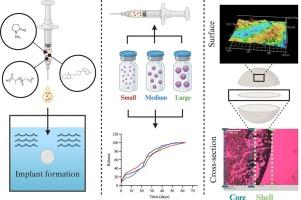
原料药粒径决定原位成形植入物的形成、微观结构演变和性能。
原位成形植入物(isfi)是一种长效可注射(LAI)药物递送系统,在接触水环境时发生相转化,导致半固体-固体植入物的形成。迄今为止,已有六种ISFI产品上市,其中四种是基于悬浮液的配方。尽管临床使用越来越多,但没有通用的ISFI产品进入市场。这强调了更好地理解它们的复杂行为和阐明控制它们性能的关键质量属性(cqa)的必要性。虽然聚合物的物理化学性质(例如分子量、乳酸与乙醇酸比、端基化学)和释放动力学之间的关系已经被广泛探索,但活性药物成分(API)的影响仍然不够明确。为了填补这一知识空白,本研究调查了一种定性和定量(Q1/Q2)等同于商业产品Perseris®的利培酮ISFI。先前的研究表明,仅Q1/Q2等效并不能确保体外和体内的等效性能,因此需要研究其他配方属性。目前的工作重点是评估原料药颗粒大小和形态对植入物形成和体外释放行为的影响。因此,制备了不同粒径的利培酮制剂并对其进行了评价。随后,植入物的微观结构、吸水、聚合物降解和药物释放被广泛表征。这项工作的一个新颖方面是多种成像策略的应用,包括用于表面成像的激光扫描共聚焦显微镜(LSCM)和用于内部成像的粘附薄膜技术,从而可以详细研究配方之间微观结构差异的演变。研究结果强调了API粒度在控制植入物微观结构、吸水、聚合物降解和体外释放行为方面的重要性,为未来通用和创新ISFI产品的开发提供了支持。
本文章由计算机程序翻译,如有差异,请以英文原文为准。
求助全文
约1分钟内获得全文
求助全文
来源期刊
CiteScore
10.70
自引率
8.60%
发文量
951
审稿时长
72 days
期刊介绍:
The International Journal of Pharmaceutics is the third most cited journal in the "Pharmacy & Pharmacology" category out of 366 journals, being the true home for pharmaceutical scientists concerned with the physical, chemical and biological properties of devices and delivery systems for drugs, vaccines and biologicals, including their design, manufacture and evaluation. This includes evaluation of the properties of drugs, excipients such as surfactants and polymers and novel materials. The journal has special sections on pharmaceutical nanotechnology and personalized medicines, and publishes research papers, reviews, commentaries and letters to the editor as well as special issues.
 求助内容:
求助内容: 应助结果提醒方式:

 京公网安备 11010802042870号


