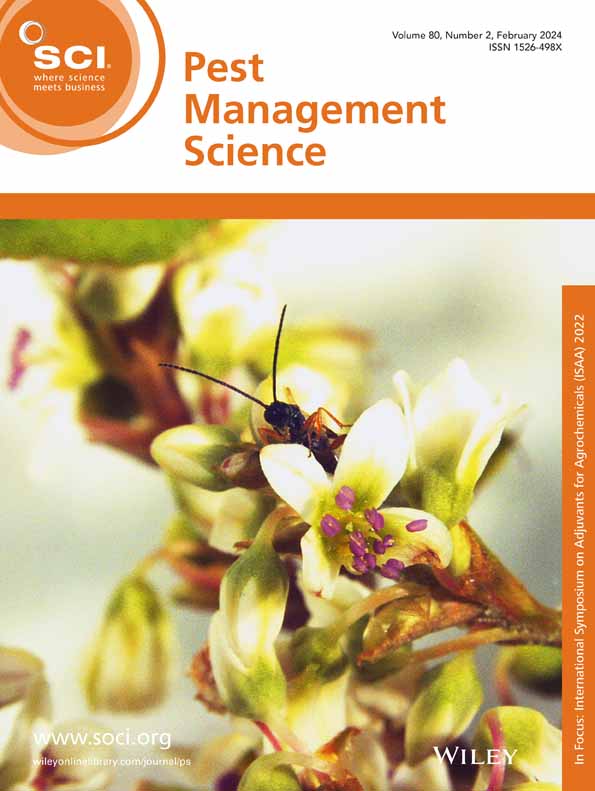
Volatiles from Momordica charantia L. fruits and leaves attract Zeugodacus cucurbitae (Coquillett).

IF 3.8 1区 农林科学 Q1 AGRONOMY
Jingjing Wang, Jinhua Li, Ruwen Li, Yunshuang Deng, Yang Yue, Zhenya Tian, Guangmei Chen, Weihua Ma, Zhongshi Zhou
{"title":"Volatiles from Momordica charantia L. fruits and leaves attract Zeugodacus cucurbitae (Coquillett).","authors":"Jingjing Wang, Jinhua Li, Ruwen Li, Yunshuang Deng, Yang Yue, Zhenya Tian, Guangmei Chen, Weihua Ma, Zhongshi Zhou","doi":"10.1002/ps.70877","DOIUrl":null,"url":null,"abstract":"<p><strong>Background: </strong>The melon fly, Zeugodacus cucurbitae (Coquillett), is a significant pest of cucurbit crops, and its ovipositing females cause direct damage to fruits. However, existing management strategies primarily target the male population, leaving a critical gap in female-specific control measures. Plant-derived volatiles are environmentally sustainable alternatives for developing behavior-based pest-management tools.</p><p><strong>Results: </strong>The volatiles of the preferred host plant, bitter gourd (Momordica charantia L.), were characterized qualitatively and semiquantitatively using headspace solid-phase microextraction gas chromatography coupled with mass spectrometry (HS-SPME/GC-MS) under targeted sampling conditions. A total of 48 fruit and 44 leaf volatiles were identified, with 28 compounds common to both tissues. Electroantennography (EAG) screenings revealed dose-dependent female antennal responses to 13 compounds, six of which (terpinen-4-ol, trans-verbenol, α-terpineol, 1-decanal, β-caryophyllene and perillaldehyde) exhibited consistent female-specific attraction in behavioral assays. A synthetic six-component blend (each at 10 μg μL<sup>-1</sup> in a 1:1:1:1:1:1 ratio) demonstrated a significantly stronger attraction than any individual compound did. Further optimization yielded an optimized four-component formulation comprising terpinen-4-ol, perillaldehyde, trans-verbenol and β-caryophyllene (each at 10 μg μL<sup>-1</sup> in a 1:1:1:1 ratio), which effectively attracted both male and female Z. cucurbitae.</p><p><strong>Conclusion: </strong>This plant-based volatile blend offers a targeted candidate attractant with strong potential for subsequent field development for sustainable management of Z. cucurbitae. The six-component blend exhibited potent female-specific attraction, addressing the current control gap for female melon flies, whereas the optimized four-component formulation achieved effective dual-sex attraction and provided a practical tool for integration into monitoring and mass-trapping programs. © 2026 Society of Chemical Industry.</p>","PeriodicalId":218,"journal":{"name":"Pest Management Science","volume":" ","pages":""},"PeriodicalIF":3.8000,"publicationDate":"2026-05-05","publicationTypes":"Journal Article","fieldsOfStudy":null,"isOpenAccess":false,"openAccessPdf":"","citationCount":"0","resultStr":null,"platform":"Semanticscholar","paperid":null,"PeriodicalName":"Pest Management Science","FirstCategoryId":"97","ListUrlMain":"https://doi.org/10.1002/ps.70877","RegionNum":1,"RegionCategory":"农林科学","ArticlePicture":[],"TitleCN":null,"AbstractTextCN":null,"PMCID":null,"EPubDate":"","PubModel":"","JCR":"Q1","JCRName":"AGRONOMY","Score":null,"Total":0}
引用次数: 0

Abstract

Background: The melon fly, Zeugodacus cucurbitae (Coquillett), is a significant pest of cucurbit crops, and its ovipositing females cause direct damage to fruits. However, existing management strategies primarily target the male population, leaving a critical gap in female-specific control measures. Plant-derived volatiles are environmentally sustainable alternatives for developing behavior-based pest-management tools.

Results: The volatiles of the preferred host plant, bitter gourd (Momordica charantia L.), were characterized qualitatively and semiquantitatively using headspace solid-phase microextraction gas chromatography coupled with mass spectrometry (HS-SPME/GC-MS) under targeted sampling conditions. A total of 48 fruit and 44 leaf volatiles were identified, with 28 compounds common to both tissues. Electroantennography (EAG) screenings revealed dose-dependent female antennal responses to 13 compounds, six of which (terpinen-4-ol, trans-verbenol, α-terpineol, 1-decanal, β-caryophyllene and perillaldehyde) exhibited consistent female-specific attraction in behavioral assays. A synthetic six-component blend (each at 10 μg μL-1 in a 1:1:1:1:1:1 ratio) demonstrated a significantly stronger attraction than any individual compound did. Further optimization yielded an optimized four-component formulation comprising terpinen-4-ol, perillaldehyde, trans-verbenol and β-caryophyllene (each at 10 μg μL-1 in a 1:1:1:1 ratio), which effectively attracted both male and female Z. cucurbitae.

Conclusion: This plant-based volatile blend offers a targeted candidate attractant with strong potential for subsequent field development for sustainable management of Z. cucurbitae. The six-component blend exhibited potent female-specific attraction, addressing the current control gap for female melon flies, whereas the optimized four-component formulation achieved effective dual-sex attraction and provided a practical tool for integration into monitoring and mass-trapping programs. © 2026 Society of Chemical Industry.

苦瓜(Momordica charantia L.)果实和叶片中的挥发物可吸引西葫芦(Zeugodacus cucurbitae)。
背景:瓜蝇(Zeugodacus cucurbitae, Coquillett)是危害瓜类作物的重要害虫,其雌性产卵直接危害瓜类果实。然而,现有的管理战略主要针对男性人口,在针对女性的控制措施方面留下了严重的差距。植物源挥发物是开发基于行为的虫害管理工具的环境可持续替代品。结果:采用顶空固相微萃取-质谱联用技术(HS-SPME/GC-MS)对优选寄主植物苦瓜(Momordica charantia L.)挥发物在目标取样条件下进行了定性和半定量分析。共鉴定出48种果实挥发物和44种叶片挥发物,其中28种化合物为两种组织共有。触角电图(EAG)筛选显示,雌性触角对13种化合物的反应具有剂量依赖性,其中6种化合物(松油烯-4-醇、反式马尾草醇、α-松油醇、1-癸醛、β-石竹烯和紫苏醛)在行为分析中表现出一致的雌性特异性吸引力。合成的六组分混合物(各为10 μL-1, 1:1:1:1:1的比例)的吸引力明显强于任何单个化合物。进一步优化得到由松油烯-4-醇、紫苏醛、反式马鞭草酚和β-石竹烯组成的四组分优化配方(各为10 μg μL-1,比例为1:1:1:1),对雌雄葫芦小蠊均有较好的诱蚊效果。结论:该植物性挥发物是一种有针对性的候选引诱剂,在后续的田间开发中具有很强的潜力,可用于葫芦小蠊的可持续管理。六组分混合物显示出强大的雌性特异性吸引,解决了目前雌性甜瓜蝇的控制空白,而优化的四组分混合物实现了有效的双性吸引,并为整合监测和大规模捕获计划提供了实用工具。©2026化学工业协会。
本文章由计算机程序翻译,如有差异,请以英文原文为准。
求助全文
约1分钟内获得全文 求助全文
来源期刊
Pest Management Science
Pest Management Science 农林科学-昆虫学
CiteScore
7.90
自引率
9.80%
发文量
553
审稿时长
4.8 months
期刊介绍: Pest Management Science is the international journal of research and development in crop protection and pest control. Since its launch in 1970, the journal has become the premier forum for papers on the discovery, application, and impact on the environment of products and strategies designed for pest management. Published for SCI by John Wiley & Sons Ltd.

×
引用
GB/T 7714-2015
复制
MLA
复制
APA
复制
导出至
BibTeX EndNote RefMan NoteFirst NoteExpress
×
提示
您的信息不完整,为了账户安全,请先补充。
现在去补充
×
提示
您因"违规操作"
具体请查看互助需知
我知道了
×
提示
确定
请完成安全验证×
copy
已复制链接
快去分享给好友吧!
我知道了
右上角分享
点击右上角分享
0
联系我们:info@booksci.cn Book学术提供免费学术资源搜索服务,方便国内外学者检索中英文文献。致力于提供最便捷和优质的服务体验。 Copyright © 2023 布克学术 All rights reserved.
京ICP备2023020795号-1
ghs 京公网安备 11010802042870号
Book学术文献互助
Book学术文献互助群
群 号:604180095
Book学术官方微信
小红书