Zheng Ji, Jiahao He, Bing Peng, Gaowei Li, Tiaoqi Fu, Hao Sun, Haopeng Bao, Xianhui Wang, Xiaowang Sun
{"title":"A Study on Compressive Mechanical Properties and Constitutive Characterization of Porcine Costal Cartilage across a Broad Strain Rate Range","authors":"Zheng Ji, Jiahao He, Bing Peng, Gaowei Li, Tiaoqi Fu, Hao Sun, Haopeng Bao, Xianhui Wang, Xiaowang Sun","doi":"10.1007/s11665-025-12815-w","DOIUrl":null,"url":null,"abstract":"<div><p>Costal cartilage, as a thoracic cushioning structure, is subjected to mechanical loads spanning a broad spectrum of strain rates under various loading scenarios, including blasts, impacts, and collisions. Studying its mechanical behavior across broad strain rates and establishing an accurate constitutive model are highly valuable for engineering. In this study, porcine costal cartilage, with high anatomical similarity to humans, was used for uniaxial compression experiments across broad strain rates. A Psylotech μTs system was used for quasi-static testing (0.001-0.1 s<sup>−1</sup>), while an improved Split Hopkinson Pressure Bar system was used for dynamic testing (1400-4200 s<sup>−1</sup>), with deformation recorded via a high-speed camera. Subsequently, by introducing a strain rate term, the modified five-parameter polynomial hyperelastic and improved Zhu-Wang-Tang (ZWT) viscoelastic constitutive models were developed. Characterization of compressive properties of porcine costal cartilage across broad strain rates was performed. The results show that porcine costal cartilage displays pronounced nonlinear mechanical behavior and strain rate dependency: its elastic modulus, compressive stress, and failure stress increase bi-exponentially with strain rate; failure strain correlates negatively with strain rate in the quasi-static regime but positively in the dynamic regime. The modified and improved constitutive model enables a unified characterization across strain rates through a single expression, thereby addressing the gap in existing studies where no constitutive model of costal cartilage has been established over a wide strain-rate range. The improved ZWT model exhibits higher prediction accuracy than the modified hyperelastic model, with an average relative root mean square error (RRMSE) of 5.04% and a coefficient of determination (<i>R</i><sup>2</sup>) of 0.99 when compared with experimental data.</p></div>","PeriodicalId":644,"journal":{"name":"Journal of Materials Engineering and Performance","volume":"35 17","pages":"17027 - 17043"},"PeriodicalIF":2.0000,"publicationDate":"2025-11-28","publicationTypes":"Journal Article","fieldsOfStudy":null,"isOpenAccess":false,"openAccessPdf":"","citationCount":"0","resultStr":null,"platform":"Semanticscholar","paperid":null,"PeriodicalName":"Journal of Materials Engineering and Performance","FirstCategoryId":"88","ListUrlMain":"https://link.springer.com/article/10.1007/s11665-025-12815-w","RegionNum":4,"RegionCategory":"材料科学","ArticlePicture":[],"TitleCN":null,"AbstractTextCN":null,"PMCID":null,"EPubDate":"","PubModel":"","JCR":"Q3","JCRName":"MATERIALS SCIENCE, MULTIDISCIPLINARY","Score":null,"Total":0}
引用次数: 0
Abstract
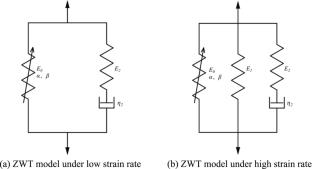
Costal cartilage, as a thoracic cushioning structure, is subjected to mechanical loads spanning a broad spectrum of strain rates under various loading scenarios, including blasts, impacts, and collisions. Studying its mechanical behavior across broad strain rates and establishing an accurate constitutive model are highly valuable for engineering. In this study, porcine costal cartilage, with high anatomical similarity to humans, was used for uniaxial compression experiments across broad strain rates. A Psylotech μTs system was used for quasi-static testing (0.001-0.1 s−1), while an improved Split Hopkinson Pressure Bar system was used for dynamic testing (1400-4200 s−1), with deformation recorded via a high-speed camera. Subsequently, by introducing a strain rate term, the modified five-parameter polynomial hyperelastic and improved Zhu-Wang-Tang (ZWT) viscoelastic constitutive models were developed. Characterization of compressive properties of porcine costal cartilage across broad strain rates was performed. The results show that porcine costal cartilage displays pronounced nonlinear mechanical behavior and strain rate dependency: its elastic modulus, compressive stress, and failure stress increase bi-exponentially with strain rate; failure strain correlates negatively with strain rate in the quasi-static regime but positively in the dynamic regime. The modified and improved constitutive model enables a unified characterization across strain rates through a single expression, thereby addressing the gap in existing studies where no constitutive model of costal cartilage has been established over a wide strain-rate range. The improved ZWT model exhibits higher prediction accuracy than the modified hyperelastic model, with an average relative root mean square error (RRMSE) of 5.04% and a coefficient of determination (R2) of 0.99 when compared with experimental data.
期刊介绍:
ASM International''s Journal of Materials Engineering and Performance focuses on solving day-to-day engineering challenges, particularly those involving components for larger systems. The journal presents a clear understanding of relationships between materials selection, processing, applications and performance.
The Journal of Materials Engineering covers all aspects of materials selection, design, processing, characterization and evaluation, including how to improve materials properties through processes and process control of casting, forming, heat treating, surface modification and coating, and fabrication.
Testing and characterization (including mechanical and physical tests, NDE, metallography, failure analysis, corrosion resistance, chemical analysis, surface characterization, and microanalysis of surfaces, features and fractures), and industrial performance measurement are also covered

 求助内容:
求助内容: 应助结果提醒方式:

 京公网安备 11010802042870号


