Tingting Zhang, Qiyue Tao, Jiahe Chen, Jia-Hao Chen, Hong Zhou and Zhijie Zhang
{"title":"In2O3/AgBiS2 heterojunction – gated organic photoelectrochemical transistor with DNAzyme-mediated reaction for sensitive detection of bisphenol A","authors":"Tingting Zhang, Qiyue Tao, Jiahe Chen, Jia-Hao Chen, Hong Zhou and Zhijie Zhang","doi":"10.1039/D6RA02509A","DOIUrl":null,"url":null,"abstract":"<p >In recent years, organic photoelectrochemical transistor (OPECT) sensors have attracted growing attention in various fields. Nevertheless, their potential remains far from being fully exploited, and these systems still face substantial challenges. In this work, a novel OPECT aptamer biosensor is rationally designed and fabricated by integrating photoelectrochemical analysis with organic electrochemical transistor technology. In this sensor, In<small><sub>2</sub></small>O<small><sub>3</sub></small>/AgBiS<small><sub>2</sub></small> is employed as the photoactive material, and target-specific DNA strand displacement hybridization is utilized as the signal amplification strategy. Specifically, for bisphenol A (BPA) detection, DNAzyme (G-quadruplex/hemin) acts as a horseradish peroxidase (HRP) mimic to catalyze H<small><sub>2</sub></small>O<small><sub>2</sub></small>-mediated oxidation reactions, generating insoluble precipitation, which markedly decreases Δ<em>I</em><small><sub>DS</sub></small>. Experimental verification shows that the developed sensor exhibits excellent analytical performance. Its linear detection range can cover from 1 fg mL<small><sup>−1</sup></small> to 0.1 ng mL<small><sup>−1</sup></small>, and the limit of detection is as low as 0.29 fg mL<small><sup>−1</sup></small>. This innovative biosensing platform not only provides a highly potential solution for the accurate detection of BPA but also shows broad application prospects and great development potential in the future expansion of the analysis and detection of other pollutants.</p>","PeriodicalId":102,"journal":{"name":"RSC Advances","volume":" 26","pages":" 24248-24255"},"PeriodicalIF":4.6000,"publicationDate":"2026-05-08","publicationTypes":"Journal Article","fieldsOfStudy":null,"isOpenAccess":false,"openAccessPdf":"https://pubs.rsc.org/en/content/articlepdf/2026/ra/d6ra02509a?page=search","citationCount":"0","resultStr":null,"platform":"Semanticscholar","paperid":null,"PeriodicalName":"RSC Advances","FirstCategoryId":"92","ListUrlMain":"https://pubs.rsc.org/en/content/articlelanding/2026/ra/d6ra02509a","RegionNum":3,"RegionCategory":"化学","ArticlePicture":[],"TitleCN":null,"AbstractTextCN":null,"PMCID":null,"EPubDate":"","PubModel":"","JCR":"Q2","JCRName":"CHEMISTRY, MULTIDISCIPLINARY","Score":null,"Total":0}
引用次数: 0
Abstract
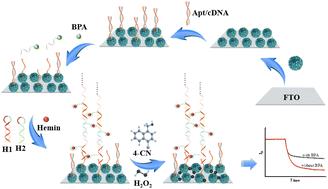
In recent years, organic photoelectrochemical transistor (OPECT) sensors have attracted growing attention in various fields. Nevertheless, their potential remains far from being fully exploited, and these systems still face substantial challenges. In this work, a novel OPECT aptamer biosensor is rationally designed and fabricated by integrating photoelectrochemical analysis with organic electrochemical transistor technology. In this sensor, In2O3/AgBiS2 is employed as the photoactive material, and target-specific DNA strand displacement hybridization is utilized as the signal amplification strategy. Specifically, for bisphenol A (BPA) detection, DNAzyme (G-quadruplex/hemin) acts as a horseradish peroxidase (HRP) mimic to catalyze H2O2-mediated oxidation reactions, generating insoluble precipitation, which markedly decreases ΔIDS. Experimental verification shows that the developed sensor exhibits excellent analytical performance. Its linear detection range can cover from 1 fg mL−1 to 0.1 ng mL−1, and the limit of detection is as low as 0.29 fg mL−1. This innovative biosensing platform not only provides a highly potential solution for the accurate detection of BPA but also shows broad application prospects and great development potential in the future expansion of the analysis and detection of other pollutants.
期刊介绍:
An international, peer-reviewed journal covering all of the chemical sciences, including multidisciplinary and emerging areas. RSC Advances is a gold open access journal allowing researchers free access to research articles, and offering an affordable open access publishing option for authors around the world.


 求助内容:
求助内容: 应助结果提醒方式:

 京公网安备 11010802042870号


