Changwen Gao, Jiasheng Zhang, Guangsong Li and Hongjian Peng
{"title":"Photocatalysts for the decarboxylation conversion of C(sp3)-carboxylic acids: a review","authors":"Changwen Gao, Jiasheng Zhang, Guangsong Li and Hongjian Peng","doi":"10.1039/D6RA01440B","DOIUrl":null,"url":null,"abstract":"<p >C(sp<small><sup>3</sup></small>)-carboxylic acids are derived from a broad spectrum of sources and possess excellent biosafety. Its decarboxylation conversion provides an important route for constructing C–H, C<img>C and C–X (X = C, O, and F) bonds. Photocatalysis provides a mild and efficient method for achieving this conversion. In this paper, the photocatalysts used in the decarboxylation of C(sp<small><sup>3</sup></small>)-carboxylic acids over the past 8 years are systematically reviewed. They are classified into four categories: organic transition metal complexes, simple transition metal salts, metal-free homogeneous photocatalysts and semiconductor material photocatalysts. The structural characteristics, catalytic principles and reaction mechanisms of various catalysts are described in detail, and the core reaction paths of different catalytic systems are analyzed. The advantages and disadvantages of various catalysts in terms of catalytic efficiency, substrate applicability, cost and recovery were compared. Finally, the key challenges in this field are pointed out, and the future development directions, such as the design of near-infrared light-responsive catalysts and the improvement of quantum efficiency, are proposed.</p>","PeriodicalId":102,"journal":{"name":"RSC Advances","volume":" 26","pages":" 24095-24127"},"PeriodicalIF":4.6000,"publicationDate":"2026-05-08","publicationTypes":"Journal Article","fieldsOfStudy":null,"isOpenAccess":false,"openAccessPdf":"https://pubs.rsc.org/en/content/articlepdf/2026/ra/d6ra01440b?page=search","citationCount":"0","resultStr":null,"platform":"Semanticscholar","paperid":null,"PeriodicalName":"RSC Advances","FirstCategoryId":"92","ListUrlMain":"https://pubs.rsc.org/en/content/articlelanding/2026/ra/d6ra01440b","RegionNum":3,"RegionCategory":"化学","ArticlePicture":[],"TitleCN":null,"AbstractTextCN":null,"PMCID":null,"EPubDate":"","PubModel":"","JCR":"Q2","JCRName":"CHEMISTRY, MULTIDISCIPLINARY","Score":null,"Total":0}
引用次数: 0
Abstract
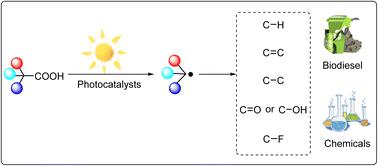
C(sp3)-carboxylic acids are derived from a broad spectrum of sources and possess excellent biosafety. Its decarboxylation conversion provides an important route for constructing C–H, CC and C–X (X = C, O, and F) bonds. Photocatalysis provides a mild and efficient method for achieving this conversion. In this paper, the photocatalysts used in the decarboxylation of C(sp3)-carboxylic acids over the past 8 years are systematically reviewed. They are classified into four categories: organic transition metal complexes, simple transition metal salts, metal-free homogeneous photocatalysts and semiconductor material photocatalysts. The structural characteristics, catalytic principles and reaction mechanisms of various catalysts are described in detail, and the core reaction paths of different catalytic systems are analyzed. The advantages and disadvantages of various catalysts in terms of catalytic efficiency, substrate applicability, cost and recovery were compared. Finally, the key challenges in this field are pointed out, and the future development directions, such as the design of near-infrared light-responsive catalysts and the improvement of quantum efficiency, are proposed.
期刊介绍:
An international, peer-reviewed journal covering all of the chemical sciences, including multidisciplinary and emerging areas. RSC Advances is a gold open access journal allowing researchers free access to research articles, and offering an affordable open access publishing option for authors around the world.

 求助内容:
求助内容: 应助结果提醒方式:

 京公网安备 11010802042870号


