Adewale Ajose, Gary A. Leeke, Pritha Sen, Preeti Singh, Pratik Kokane, Syed Altaf and Matthew J. Keith
{"title":"Shelf life and time-resolved thermal, chemical, and thermodynamic characterization of four hydrophobic deep eutectic solvents","authors":"Adewale Ajose, Gary A. Leeke, Pritha Sen, Preeti Singh, Pratik Kokane, Syed Altaf and Matthew J. Keith","doi":"10.1039/D6RA01239F","DOIUrl":null,"url":null,"abstract":"<p >Hydrophobic deep eutectic solvents (HDESs) are increasingly recognized as green alternatives to traditional organic solvents in extraction, catalysis, and polymer processing; however, their long-term stability remains poorly understood. This study investigated the critical gap in systematically characterizing the effects of long-term storage on four thymol-and tetraoctylammonium bromide (TOAB)-based HDESs with decanoic (C10) and dodecanoic (C12) over 20 weeks of storage. Weekly comprehensive measurements and characterization techniques were used to monitor changes in both bulk properties and molecular structures. Thermal stability was evaluated using differential scanning calorimetry (DSC) and thermogravimetric analysis (TGA), which consistently showed onset decomposition temperatures between 136 °C and 205 °C across all four solvents, with a variation of ±2.77 °C over the 20-week storage period. TOAB- based systems exhibited superior thermal stability, likely due to ionic hydrogen bond networks. Thermodynamic analysis revealed that molar excess Gibbs free energy values satisfied the non-ideality criterion <img>, and activity coefficients remained well below unity throughout the study, confirming strong intermolecular interactions and eutectic integrity. Fourier-transform infrared (FTIR) spectra showed consistent features with no signs of chemical degradation or moisture-induced structural changes. The C12-based systems undergo reversible room temperature crystallisation attributed to segregation of a fatty-acid-rich solid phase; this microphase separation modifies processability but not the underlying eutectic chemistry. Density (0.88–0.95 g cm<small><sup>−3</sup></small>), viscosity (18–85 mPa s @ 25 °C), and apparent pH remain within the acidic range expected for carboxylic acid-based HDESs, with observed fluctuations attributed mainly to the known limitations of glass electrodes in low conductivity media rather than genuine chemical change. These findings demonstrate that TOAB- and thymol-based HDESs are thermally and chemically stable during the storage period. This research contributes to an important knowledge gap in green solvent technology and supports their further development from laboratory research to industrial applications.</p>","PeriodicalId":102,"journal":{"name":"RSC Advances","volume":" 26","pages":" 23754-23769"},"PeriodicalIF":4.6000,"publicationDate":"2026-05-07","publicationTypes":"Journal Article","fieldsOfStudy":null,"isOpenAccess":false,"openAccessPdf":"https://pubs.rsc.org/en/content/articlepdf/2026/ra/d6ra01239f?page=search","citationCount":"0","resultStr":null,"platform":"Semanticscholar","paperid":null,"PeriodicalName":"RSC Advances","FirstCategoryId":"92","ListUrlMain":"https://pubs.rsc.org/en/content/articlelanding/2026/ra/d6ra01239f","RegionNum":3,"RegionCategory":"化学","ArticlePicture":[],"TitleCN":null,"AbstractTextCN":null,"PMCID":null,"EPubDate":"","PubModel":"","JCR":"Q2","JCRName":"CHEMISTRY, MULTIDISCIPLINARY","Score":null,"Total":0}
引用次数: 0
Abstract
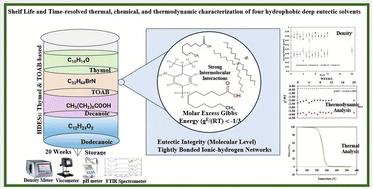
Hydrophobic deep eutectic solvents (HDESs) are increasingly recognized as green alternatives to traditional organic solvents in extraction, catalysis, and polymer processing; however, their long-term stability remains poorly understood. This study investigated the critical gap in systematically characterizing the effects of long-term storage on four thymol-and tetraoctylammonium bromide (TOAB)-based HDESs with decanoic (C10) and dodecanoic (C12) over 20 weeks of storage. Weekly comprehensive measurements and characterization techniques were used to monitor changes in both bulk properties and molecular structures. Thermal stability was evaluated using differential scanning calorimetry (DSC) and thermogravimetric analysis (TGA), which consistently showed onset decomposition temperatures between 136 °C and 205 °C across all four solvents, with a variation of ±2.77 °C over the 20-week storage period. TOAB- based systems exhibited superior thermal stability, likely due to ionic hydrogen bond networks. Thermodynamic analysis revealed that molar excess Gibbs free energy values satisfied the non-ideality criterion , and activity coefficients remained well below unity throughout the study, confirming strong intermolecular interactions and eutectic integrity. Fourier-transform infrared (FTIR) spectra showed consistent features with no signs of chemical degradation or moisture-induced structural changes. The C12-based systems undergo reversible room temperature crystallisation attributed to segregation of a fatty-acid-rich solid phase; this microphase separation modifies processability but not the underlying eutectic chemistry. Density (0.88–0.95 g cm−3), viscosity (18–85 mPa s @ 25 °C), and apparent pH remain within the acidic range expected for carboxylic acid-based HDESs, with observed fluctuations attributed mainly to the known limitations of glass electrodes in low conductivity media rather than genuine chemical change. These findings demonstrate that TOAB- and thymol-based HDESs are thermally and chemically stable during the storage period. This research contributes to an important knowledge gap in green solvent technology and supports their further development from laboratory research to industrial applications.
疏水深共晶溶剂(hess)越来越被认为是传统有机溶剂在萃取、催化和聚合物加工中的绿色替代品;然而,人们对它们的长期稳定性仍然知之甚少。本研究探讨了长期储存对四种百里香和四辛基溴化铵(TOAB)为基础的十六烷酸(C10)和十二烷酸(C12) hess在20周储存期间的影响。每周综合测量和表征技术用于监测体积性质和分子结构的变化。采用差示扫描量热法(DSC)和热重分析(TGA)对热稳定性进行了评估,结果一致表明,在所有四种溶剂中,起始分解温度在136°C至205°C之间,在20周的储存期间变化为±2.77°C。基于TOAB的体系表现出优异的热稳定性,可能是由于离子氢键网络。热力学分析表明,摩尔过量吉布斯自由能满足非理想准则,活度系数在整个研究过程中保持在1以下,证实了强分子间相互作用和共晶完整性。傅里叶变换红外(FTIR)光谱显示出一致的特征,没有化学降解或水分引起的结构变化的迹象。由于富含脂肪酸的固相分离,c12基体系经历了可逆的室温结晶;这种微相分离改变了可加工性,但没有改变潜在的共晶化学性质。密度(0.88-0.95 g cm - 3)、粘度(18-85 mPa s @ 25°C)和表观pH值保持在羧酸基hess预期的酸性范围内,观察到的波动主要归因于玻璃电极在低电导率介质中的已知限制,而不是真正的化学变化。这些结果表明,TOAB和百里香基hess在储存期间具有热稳定性和化学稳定性。这项研究有助于填补绿色溶剂技术的重要知识空白,并支持其从实验室研究到工业应用的进一步发展。
期刊介绍:
An international, peer-reviewed journal covering all of the chemical sciences, including multidisciplinary and emerging areas. RSC Advances is a gold open access journal allowing researchers free access to research articles, and offering an affordable open access publishing option for authors around the world.

 求助内容:
求助内容: 应助结果提醒方式:

 京公网安备 11010802042870号


