Saba Ahmed Abdulkareem, Khalid T. Rashid, Adnan A. AbdulRazak, Mohammed Ahmed Shehab, Mohammed Nabeel, Mohammed A. Salih and Haidar Hasan Mohammed
{"title":"Advanced green functional groups for tailoring the membrane features and performance in contaminated wastewater treatment: a comprehensive review","authors":"Saba Ahmed Abdulkareem, Khalid T. Rashid, Adnan A. AbdulRazak, Mohammed Ahmed Shehab, Mohammed Nabeel, Mohammed A. Salih and Haidar Hasan Mohammed","doi":"10.1039/D5RA09447J","DOIUrl":null,"url":null,"abstract":"<p >The need to strike a balance between separation performance and environmental responsibility has led to the development of polymeric membranes with green functional groups as a viable approach for sustainable wastewater treatment. Beyond descriptive reporting, this review critically synthesizes molecular findings connecting membrane structure–property–performance correlations to bio-based functional additives. The effects of naturally occurring functional groups, such as phenolics, flavonoids, polysaccharides, amino-rich biopolymers, and plant-based reactive moieties, on the shape, surface chemistry, and interfacial interactions of the membrane are methodically examined. In order to assess several classes of green additives and fabrication techniques based on their operational stability, durability, sustainability indicators, permeability-selectivity trade-offs, and fouling resistance, a comparative approach is presented. The review clarifies the main mechanisms for antifouling and separation, including hydrogen-bonding networks, surface charge modulation, hydration layer formation, radical scavenging, and antimicrobial activity. It also critically analyzes how these mechanisms result in better dye, heavy metal, and oil contamination removal. Significantly, the analysis reveals the discrepancies and knowledge gaps in published mechanistic interpretations, such as the long-term stability of bio-functionalized membranes under practical operating conditions, the relative contributions of surface chemistry <em>versus</em> bulk structural changes, and additive dispersion and leaching effects. Lastly, future research directions are discussed, with a focus on scalable manufacturing routes, hybrid green nanocomposite functionalization, and intelligent and stimulus-responsive bio-additives. All things considered, this review offers a comparative and mechanistic viewpoint that clarifies the actual and potential constraints of green advanced functional groups for developing next-generation high-performance wastewater treatment membranes.</p>","PeriodicalId":102,"journal":{"name":"RSC Advances","volume":" 24","pages":" 22166-22185"},"PeriodicalIF":4.6000,"publicationDate":"2026-05-05","publicationTypes":"Journal Article","fieldsOfStudy":null,"isOpenAccess":false,"openAccessPdf":"https://pubs.rsc.org/en/content/articlepdf/2026/ra/d5ra09447j?page=search","citationCount":"0","resultStr":null,"platform":"Semanticscholar","paperid":null,"PeriodicalName":"RSC Advances","FirstCategoryId":"92","ListUrlMain":"https://pubs.rsc.org/en/content/articlelanding/2026/ra/d5ra09447j","RegionNum":3,"RegionCategory":"化学","ArticlePicture":[],"TitleCN":null,"AbstractTextCN":null,"PMCID":null,"EPubDate":"","PubModel":"","JCR":"Q2","JCRName":"CHEMISTRY, MULTIDISCIPLINARY","Score":null,"Total":0}
引用次数: 0
Abstract
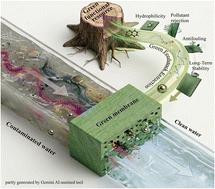
The need to strike a balance between separation performance and environmental responsibility has led to the development of polymeric membranes with green functional groups as a viable approach for sustainable wastewater treatment. Beyond descriptive reporting, this review critically synthesizes molecular findings connecting membrane structure–property–performance correlations to bio-based functional additives. The effects of naturally occurring functional groups, such as phenolics, flavonoids, polysaccharides, amino-rich biopolymers, and plant-based reactive moieties, on the shape, surface chemistry, and interfacial interactions of the membrane are methodically examined. In order to assess several classes of green additives and fabrication techniques based on their operational stability, durability, sustainability indicators, permeability-selectivity trade-offs, and fouling resistance, a comparative approach is presented. The review clarifies the main mechanisms for antifouling and separation, including hydrogen-bonding networks, surface charge modulation, hydration layer formation, radical scavenging, and antimicrobial activity. It also critically analyzes how these mechanisms result in better dye, heavy metal, and oil contamination removal. Significantly, the analysis reveals the discrepancies and knowledge gaps in published mechanistic interpretations, such as the long-term stability of bio-functionalized membranes under practical operating conditions, the relative contributions of surface chemistry versus bulk structural changes, and additive dispersion and leaching effects. Lastly, future research directions are discussed, with a focus on scalable manufacturing routes, hybrid green nanocomposite functionalization, and intelligent and stimulus-responsive bio-additives. All things considered, this review offers a comparative and mechanistic viewpoint that clarifies the actual and potential constraints of green advanced functional groups for developing next-generation high-performance wastewater treatment membranes.
期刊介绍:
An international, peer-reviewed journal covering all of the chemical sciences, including multidisciplinary and emerging areas. RSC Advances is a gold open access journal allowing researchers free access to research articles, and offering an affordable open access publishing option for authors around the world.

 求助内容:
求助内容: 应助结果提醒方式:

 京公网安备 11010802042870号


