Ramesh Duraisamy, Wabi Regasa Bogale and Gada Muleta Fanta
{"title":"Waste-to-worth: nano activated carbon from fruit peels for sulfur-free sugarcane juice clarification","authors":"Ramesh Duraisamy, Wabi Regasa Bogale and Gada Muleta Fanta","doi":"10.1039/D6RA01408A","DOIUrl":null,"url":null,"abstract":"<p >The sugar industry faces significant challenges in achieving high purity and maximizing yield during production, particularly in the crucial clarification stage. Effective clarifying agents are essential for this process. Activated carbon has emerged as a highly suitable adsorbent for removing impurities from sugarcane juice, due to its strong adsorption capacity. This study focuses on preparing nano activated carbon (NAC) derived from mixed fruit peels for clarifying sugarcane juice. Using Design-Expert software, we optimized the experimental parameters for NAC production, determining the optimal conditions: carbonization at 410 °C for 100 min with an acid impregnation ratio of 1. Under these conditions, the resulting NAC achieved a yield of 74.86%, a fixed carbon content of 89.25 ± 0.38%, and a specific surface area of 650.87 ± 0.26 m<small><sup>2</sup></small> g<small><sup>−1</sup></small>. Characterization by X-ray diffraction and scanning electron microscopy revealed that the NAC had an average particle size of 24.46 nm, with a predominant particle size distribution between 20 and 30 nm. The optimization of NAC for cane juice clarification yielded impressive results under optimal conditions: a NAC dose of 0.01%, pH of 4, temperature of 90 °C, duration of 20 min, and agitation speed of 100 rpm, resulting in a turbidity reduction to 1760.6 NTU, a settling rate of 0.09 cm min<small><sup>−1</sup></small>, a mud volume of 6.66 mL per 100 mL, and a color removal efficiency of 97.4%. Additionally, we examined the physicochemical properties of the NAC, the juice posttreatment, and the final sugar product. The findings demonstrate that NAC synthesized from mixed fruit peels exhibits a high carbon yield and a high specific surface area, highlighting its potential as an effective biosorption material. The synthesized NAC demonstrated excellent clarification efficiency, making it an advantageous clarifying agent for sugarcane juice processing and sulfur-free sugar production. This research has significant implications for waste management, particularly in reducing landfill pollution, while also contributing to the development of value-added products that enhance bioresource management.</p>","PeriodicalId":102,"journal":{"name":"RSC Advances","volume":" 27","pages":" 24325-24355"},"PeriodicalIF":4.6000,"publicationDate":"2026-05-08","publicationTypes":"Journal Article","fieldsOfStudy":null,"isOpenAccess":false,"openAccessPdf":"https://pubs.rsc.org/en/content/articlepdf/2026/ra/d6ra01408a?page=search","citationCount":"0","resultStr":null,"platform":"Semanticscholar","paperid":null,"PeriodicalName":"RSC Advances","FirstCategoryId":"92","ListUrlMain":"https://pubs.rsc.org/en/content/articlelanding/2026/ra/d6ra01408a","RegionNum":3,"RegionCategory":"化学","ArticlePicture":[],"TitleCN":null,"AbstractTextCN":null,"PMCID":null,"EPubDate":"","PubModel":"","JCR":"Q2","JCRName":"CHEMISTRY, MULTIDISCIPLINARY","Score":null,"Total":0}
引用次数: 0
Abstract
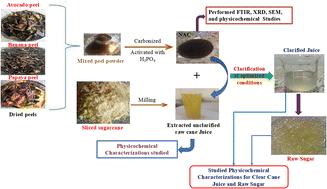
The sugar industry faces significant challenges in achieving high purity and maximizing yield during production, particularly in the crucial clarification stage. Effective clarifying agents are essential for this process. Activated carbon has emerged as a highly suitable adsorbent for removing impurities from sugarcane juice, due to its strong adsorption capacity. This study focuses on preparing nano activated carbon (NAC) derived from mixed fruit peels for clarifying sugarcane juice. Using Design-Expert software, we optimized the experimental parameters for NAC production, determining the optimal conditions: carbonization at 410 °C for 100 min with an acid impregnation ratio of 1. Under these conditions, the resulting NAC achieved a yield of 74.86%, a fixed carbon content of 89.25 ± 0.38%, and a specific surface area of 650.87 ± 0.26 m2 g−1. Characterization by X-ray diffraction and scanning electron microscopy revealed that the NAC had an average particle size of 24.46 nm, with a predominant particle size distribution between 20 and 30 nm. The optimization of NAC for cane juice clarification yielded impressive results under optimal conditions: a NAC dose of 0.01%, pH of 4, temperature of 90 °C, duration of 20 min, and agitation speed of 100 rpm, resulting in a turbidity reduction to 1760.6 NTU, a settling rate of 0.09 cm min−1, a mud volume of 6.66 mL per 100 mL, and a color removal efficiency of 97.4%. Additionally, we examined the physicochemical properties of the NAC, the juice posttreatment, and the final sugar product. The findings demonstrate that NAC synthesized from mixed fruit peels exhibits a high carbon yield and a high specific surface area, highlighting its potential as an effective biosorption material. The synthesized NAC demonstrated excellent clarification efficiency, making it an advantageous clarifying agent for sugarcane juice processing and sulfur-free sugar production. This research has significant implications for waste management, particularly in reducing landfill pollution, while also contributing to the development of value-added products that enhance bioresource management.
期刊介绍:
An international, peer-reviewed journal covering all of the chemical sciences, including multidisciplinary and emerging areas. RSC Advances is a gold open access journal allowing researchers free access to research articles, and offering an affordable open access publishing option for authors around the world.

 求助内容:
求助内容: 应助结果提醒方式:

 京公网安备 11010802042870号


