Xin Huang, Ziang Wang, Yakun Zong, Xichao Liang, Yuanzhang Jiang, Junwen Ren, Lin Tan
{"title":"Aromatic polyamide-reinforced regenerated cellulose fiber with low fibrillation and enhanced mechanical properties","authors":"Xin Huang, Ziang Wang, Yakun Zong, Xichao Liang, Yuanzhang Jiang, Junwen Ren, Lin Tan","doi":"10.1007/s10570-026-07040-0","DOIUrl":null,"url":null,"abstract":"<div><p>The green fabrication of low-fibrillation and multifunctional regenerated cellulose fibers represents a significant yet challenging research frontier. In this study, a novel cellulose/aromatic polyamide (ArPA) composite fiber system was developed to solve the trade-off between the mechanical properties of lyocell-type fibers and the tendency to fibrillate. The composite fibers were prepared by dry-jet wet spinning after co-dissolving cellulose and ArPA spinning solution with a green solvent 1-butyl-3-methylimidazole chloride/1,3-dimethyl-2-imidazolidinone ([Bmim]Cl/DMI) solvent system. The rheological and molecular dynamics (MD) simulation results confirmed the excellent compatibility between cellulose and ArPA. The composite fiber with a 2% addition ratio of ArPA (C/A2) showed significant performance improvement, with a tensile strength of 1.44 cN/dtex (18.6% higher than that of pure cellulose fiber), a crystallinity index of 64.2%, and a significantly low degree of fibrillation (a fibrillation index below 0.1 even after 90 min of sonication). Moreover, C/A2 fiber maintained good dyeability and could be modified with polyhexamethylene guanidine hydrochloride (PHMG) to achieve high antibacterial efficiency. This study provides a green and versatile strategy for overcoming the fibrillation problem in conventional lyocell-type fibers while achieving multifunctionality.</p><h3>Graphical abstract</h3>\n<div><figure><div><div><picture><source><img></source></picture><span>The alternative text for this image may have been generated using AI.</span></div></div></figure></div></div>","PeriodicalId":511,"journal":{"name":"Cellulose","volume":"33 6","pages":"3749 - 3765"},"PeriodicalIF":4.8000,"publicationDate":"2026-04-19","publicationTypes":"Journal Article","fieldsOfStudy":null,"isOpenAccess":false,"openAccessPdf":"","citationCount":"0","resultStr":null,"platform":"Semanticscholar","paperid":null,"PeriodicalName":"Cellulose","FirstCategoryId":"88","ListUrlMain":"https://link.springer.com/article/10.1007/s10570-026-07040-0","RegionNum":2,"RegionCategory":"工程技术","ArticlePicture":[],"TitleCN":null,"AbstractTextCN":null,"PMCID":null,"EPubDate":"","PubModel":"","JCR":"Q1","JCRName":"MATERIALS SCIENCE, PAPER & WOOD","Score":null,"Total":0}
引用次数: 0
Abstract
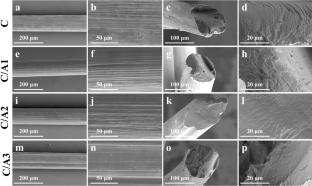
The green fabrication of low-fibrillation and multifunctional regenerated cellulose fibers represents a significant yet challenging research frontier. In this study, a novel cellulose/aromatic polyamide (ArPA) composite fiber system was developed to solve the trade-off between the mechanical properties of lyocell-type fibers and the tendency to fibrillate. The composite fibers were prepared by dry-jet wet spinning after co-dissolving cellulose and ArPA spinning solution with a green solvent 1-butyl-3-methylimidazole chloride/1,3-dimethyl-2-imidazolidinone ([Bmim]Cl/DMI) solvent system. The rheological and molecular dynamics (MD) simulation results confirmed the excellent compatibility between cellulose and ArPA. The composite fiber with a 2% addition ratio of ArPA (C/A2) showed significant performance improvement, with a tensile strength of 1.44 cN/dtex (18.6% higher than that of pure cellulose fiber), a crystallinity index of 64.2%, and a significantly low degree of fibrillation (a fibrillation index below 0.1 even after 90 min of sonication). Moreover, C/A2 fiber maintained good dyeability and could be modified with polyhexamethylene guanidine hydrochloride (PHMG) to achieve high antibacterial efficiency. This study provides a green and versatile strategy for overcoming the fibrillation problem in conventional lyocell-type fibers while achieving multifunctionality.
Graphical abstract
The alternative text for this image may have been generated using AI.
期刊介绍:
Cellulose is an international journal devoted to the dissemination of research and scientific and technological progress in the field of cellulose and related naturally occurring polymers. The journal is concerned with the pure and applied science of cellulose and related materials, and also with the development of relevant new technologies. This includes the chemistry, biochemistry, physics and materials science of cellulose and its sources, including wood and other biomass resources, and their derivatives. Coverage extends to the conversion of these polymers and resources into manufactured goods, such as pulp, paper, textiles, and manufactured as well natural fibers, and to the chemistry of materials used in their processing. Cellulose publishes review articles, research papers, and technical notes.

 求助内容:
求助内容: 应助结果提醒方式:

 京公网安备 11010802042870号


