
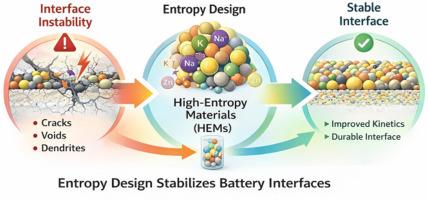
Engineering Disorder: Entropy as a Design Lever for Stable Interfaces in Solid-state Sodium-metal Batteries
IF 20.2
1区 材料科学
Q1 CHEMISTRY, PHYSICAL
引用次数: 0
Abstract
Solid-state sodium-metal batteries (SSSMBs) promise a rare combination of high energy density, enhanced safety, and elemental abundance. Yet, their progress is repeatedly stalled not by bulk properties, but by a far more elusive barrier: the interface. Across oxide, sulfide, and halide electrolytes, electrochemical degradation, space-charge polarization, and contact failure continue to limit performance; often irreversibly. This review reframes the interface not as a passive boundary to be tolerated, but as an active, designable medium that dictates long-term stability. We critically dissect how ion transport, chemical reactivity, and interphase mechanics evolve under realistic cycling conditions, and show that conventional fixes, such as thin film coatings, wetting agents, and buffer layers, offer only fragmented relief. In contrast, we spotlight configurational entropy as a powerful, underexploited tool to systematically modulate interfacial behaviour. Through compositional complexity, entropy rich architectures can flatten potential gradients, localize electron exclusion, and foster self-limiting passivation, while preserving Na+ mobility. We unify these insights across electrolyte chemistries, benchmark interfacial performance under practical constraints, and offer a roadmap for building reproducible, scalable, and high rate SSSMBs. This review does not merely summarize a field; it sharpens its focus and proposes a new scientific language for tackling one of energy storage’s most persistent bottlenecks.
工程无序:熵作为固态钠金属电池稳定界面的设计杠杆
固态钠金属电池(SSSMBs)有望实现高能量密度、增强安全性和元素丰富的罕见组合。然而,他们的进展一再停滞不前,不是因为体积特性,而是因为一个更难以捉摸的障碍:界面。在氧化物、硫化物和卤化物电解质中,电化学降解、空间电荷极化和接触失效继续限制性能;往往不可逆转。这篇综述将界面重新定义为一种主动的、可设计的、指示长期稳定性的媒介,而不是一个被动的边界。我们批判性地剖析了离子传输、化学反应性和间相力学在现实循环条件下是如何演变的,并表明传统的固定剂,如薄膜涂层、润湿剂和缓冲层,只能提供碎片化的缓解。相反,我们强调构型熵是一种强大的、未被充分利用的工具,可以系统地调节界面行为。通过组成复杂性,富熵结构可以平坦电位梯度,局部电子排斥,促进自限制钝化,同时保持Na+迁移率。我们将这些见解统一到电解质化学中,在实际限制下对接口性能进行基准测试,并为构建可复制,可扩展和高速率的sssmb提供路线图。这篇综述不只是总结一个领域;它聚焦于此,并提出了一种新的科学语言来解决能源存储最持久的瓶颈之一。
本文章由计算机程序翻译,如有差异,请以英文原文为准。
求助全文
约1分钟内获得全文
求助全文
来源期刊
Energy Storage Materials
Materials Science-General Materials Science
CiteScore
33.00
自引率
5.90%
发文量
652
审稿时长
27 days
期刊介绍:
Energy Storage Materials is a global interdisciplinary journal dedicated to sharing scientific and technological advancements in materials and devices for advanced energy storage and related energy conversion, such as in metal-O2 batteries. The journal features comprehensive research articles, including full papers and short communications, as well as authoritative feature articles and reviews by leading experts in the field.
Energy Storage Materials covers a wide range of topics, including the synthesis, fabrication, structure, properties, performance, and technological applications of energy storage materials. Additionally, the journal explores strategies, policies, and developments in the field of energy storage materials and devices for sustainable energy.
Published papers are selected based on their scientific and technological significance, their ability to provide valuable new knowledge, and their relevance to the international research community.
 求助内容:
求助内容: 应助结果提醒方式:

 京公网安备 11010802042870号


