
MAP3K1 integrates RhoA/ROCK signaling to regulate epithelial morphogenesis
IF 4.1
2区 综合性期刊
Q1 MULTIDISCIPLINARY SCIENCES
引用次数: 0
Abstract
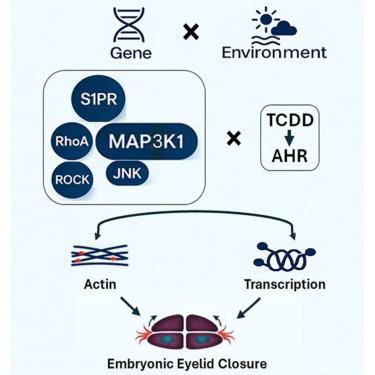
Biological processes rely on the interplay between genetic and environmental cues, yet the mechanisms underlying gene-gene (G×G) and gene-environment (G×E) interactions remain poorly understood. Using mouse embryonic eyelid closure as an experimentally tractable model, we extend the established S1PR-MAP3K1-JNK signaling axis by identifying a RhoA-ROCK branch as a functionally integrated component of the MAP3K1 network. These pathways converge on paxillin phosphorylation and c-Jun activation, coupling cytoskeletal remodeling with AP-1-dependent transcriptional responses. TurboID-based proximity proteomics identifies Gβ2 and RhoGEF1/5 as candidate intermediates linking MAP3K1 to S1PR and RhoA. Genetic analyses reveal that Rhoa or Rock1 loss alone is harmless, whereas their combined deficiency or single-gene loss in the context of Map3k1 heterozygosity, S1pr deletion or dioxin exposure, disrupts eyelid closure. These findings define RhoA-ROCK as an integral module within a broader MAP3K1 regulatory network that integrates genetic and environmental inputs to ensure robust morphogenesis.
MAP3K1整合RhoA/ROCK信号调控上皮形态发生
生物过程依赖于遗传和环境线索之间的相互作用,然而基因-基因(G×G)和基因-环境(G×E)相互作用的机制仍然知之甚少。利用小鼠胚胎眼睑闭合作为实验可处理的模型,我们通过确定RhoA-ROCK分支作为MAP3K1网络的功能集成组件来扩展已建立的S1PR-MAP3K1-JNK信号轴。这些途径集中于paxillin磷酸化和c-Jun激活,将细胞骨架重塑与ap -1依赖的转录反应结合起来。基于turboid的接近蛋白质组学鉴定出Gβ2和RhoGEF1/5是连接MAP3K1与S1PR和RhoA的候选中间体。遗传分析表明,Rhoa或Rock1的缺失是无害的,而在Map3k1杂合性、S1pr缺失或二恶英暴露的情况下,它们的联合缺失或单基因缺失会破坏眼睑闭合。这些发现将RhoA-ROCK定义为更广泛的MAP3K1调控网络中的一个完整模块,该网络整合了遗传和环境输入,以确保稳健的形态发生。
本文章由计算机程序翻译,如有差异,请以英文原文为准。
求助全文
约1分钟内获得全文
求助全文
来源期刊
iScience
Multidisciplinary-Multidisciplinary
CiteScore
7.20
自引率
1.70%
发文量
1972
审稿时长
6 weeks
期刊介绍:
Science has many big remaining questions. To address them, we will need to work collaboratively and across disciplines. The goal of iScience is to help fuel that type of interdisciplinary thinking. iScience is a new open-access journal from Cell Press that provides a platform for original research in the life, physical, and earth sciences. The primary criterion for publication in iScience is a significant contribution to a relevant field combined with robust results and underlying methodology. The advances appearing in iScience include both fundamental and applied investigations across this interdisciplinary range of topic areas. To support transparency in scientific investigation, we are happy to consider replication studies and papers that describe negative results.
We know you want your work to be published quickly and to be widely visible within your community and beyond. With the strong international reputation of Cell Press behind it, publication in iScience will help your work garner the attention and recognition it merits. Like all Cell Press journals, iScience prioritizes rapid publication. Our editorial team pays special attention to high-quality author service and to efficient, clear-cut decisions based on the information available within the manuscript. iScience taps into the expertise across Cell Press journals and selected partners to inform our editorial decisions and help publish your science in a timely and seamless way.
 求助内容:
求助内容: 应助结果提醒方式:

 京公网安备 11010802042870号


