Haytham E. M. Hussein, Panagiotis N. Kechagiopoulos and Angel Cuesta
{"title":"Electrochemical conversion of CO2 plasmas","authors":"Haytham E. M. Hussein, Panagiotis N. Kechagiopoulos and Angel Cuesta","doi":"10.1039/D5SE01488C","DOIUrl":null,"url":null,"abstract":"<p >The integration of non-thermal CO<small><sub>2</sub></small> plasma (NTP) with a custom-designed electrolyte-gap electrolyser and CuO catalysts represents an innovative strategy to enhance the electrochemical conversion of CO<small><sub>2</sub></small> into C1–C3 products. Systematic galvanostatic experiments conducted at current densities ranging from 100 to 225 mA cm<small><sup>−2</sup></small> demonstrated that plasma-on operation significantly reduces cell voltages (by up to ∼1.3 V) and that product selectivity transitions from C1 species (CO and methane) to C2+ products, including ethylene, ethanol, acetate, propylene, and propanol. While CO and H<small><sub>2</sub></small> predominate under plasma-off conditions, with limited formation of C2 products, the hybrid plasma–electrochemical system increases the faradaic efficiency (FE) for ethylene up to 39.5% and ethanol up to 18.1%. These enhancements are attributed to plasma-generated reactive species (radicals and excited-state molecules) that lower kinetic barriers for C–C coupling and modify the interfacial pH, thereby reducing parasitic carbonate/bicarbonate losses. The plasma-on state resulted in a statistically significant increase in liquid product carbon efficiency, from an average of ∼0.41% during plasma-off experiments to ∼0.91% during plasma-on experiments. Although the system currently exhibits lower overall energy efficiency owing to the power demands of the plasma discharge, this work establishes a robust framework for flexible product tuning and sustainable carbon utilisation <em>via</em> plasma-activated feeds.</p>","PeriodicalId":104,"journal":{"name":"Sustainable Energy & Fuels","volume":" 9","pages":" 2327-2343"},"PeriodicalIF":4.1000,"publicationDate":"2026-04-10","publicationTypes":"Journal Article","fieldsOfStudy":null,"isOpenAccess":false,"openAccessPdf":"https://pubs.rsc.org/en/content/articlepdf/2026/se/d5se01488c?page=search","citationCount":"0","resultStr":null,"platform":"Semanticscholar","paperid":null,"PeriodicalName":"Sustainable Energy & Fuels","FirstCategoryId":"88","ListUrlMain":"https://pubs.rsc.org/en/content/articlelanding/2026/se/d5se01488c","RegionNum":3,"RegionCategory":"材料科学","ArticlePicture":[],"TitleCN":null,"AbstractTextCN":null,"PMCID":null,"EPubDate":"","PubModel":"","JCR":"Q2","JCRName":"CHEMISTRY, PHYSICAL","Score":null,"Total":0}
引用次数: 0
Abstract
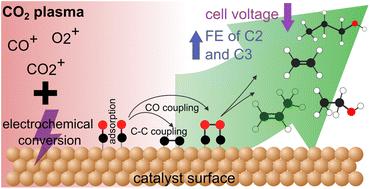
The integration of non-thermal CO2 plasma (NTP) with a custom-designed electrolyte-gap electrolyser and CuO catalysts represents an innovative strategy to enhance the electrochemical conversion of CO2 into C1–C3 products. Systematic galvanostatic experiments conducted at current densities ranging from 100 to 225 mA cm−2 demonstrated that plasma-on operation significantly reduces cell voltages (by up to ∼1.3 V) and that product selectivity transitions from C1 species (CO and methane) to C2+ products, including ethylene, ethanol, acetate, propylene, and propanol. While CO and H2 predominate under plasma-off conditions, with limited formation of C2 products, the hybrid plasma–electrochemical system increases the faradaic efficiency (FE) for ethylene up to 39.5% and ethanol up to 18.1%. These enhancements are attributed to plasma-generated reactive species (radicals and excited-state molecules) that lower kinetic barriers for C–C coupling and modify the interfacial pH, thereby reducing parasitic carbonate/bicarbonate losses. The plasma-on state resulted in a statistically significant increase in liquid product carbon efficiency, from an average of ∼0.41% during plasma-off experiments to ∼0.91% during plasma-on experiments. Although the system currently exhibits lower overall energy efficiency owing to the power demands of the plasma discharge, this work establishes a robust framework for flexible product tuning and sustainable carbon utilisation via plasma-activated feeds.
期刊介绍:
Sustainable Energy & Fuels will publish research that contributes to the development of sustainable energy technologies with a particular emphasis on new and next-generation technologies.

 求助内容:
求助内容: 应助结果提醒方式:

 京公网安备 11010802042870号


