Fabrication and evaluation of phosphorus-doped laser-induced graphene with tunable defects and enriched active sites for high-performance supercapacitors
Shruti Lavania, Adil Alshoaibi, Nagih M. Shaalan, Gargi Dhiman, Manas Nasit, Saurabh Dalela, P. A. Alvi, Aditya Sharma, Ranjeet Kumar Brajpuriya and Shalendra Kumar
{"title":"Fabrication and evaluation of phosphorus-doped laser-induced graphene with tunable defects and enriched active sites for high-performance supercapacitors","authors":"Shruti Lavania, Adil Alshoaibi, Nagih M. Shaalan, Gargi Dhiman, Manas Nasit, Saurabh Dalela, P. A. Alvi, Aditya Sharma, Ranjeet Kumar Brajpuriya and Shalendra Kumar","doi":"10.1039/D5SE01674F","DOIUrl":null,"url":null,"abstract":"<p >Laser-induced graphene (LIG) has garnered substantial consideration in applications based on energy storage owing to its economical nature and exceptional performance as a flexible electrode material. This work presents a straightforward method for synthesising phosphorus-doped laser-induced graphene (PLIG). The synthesis comprised the formation of pure LIG, subsequent dispersion of phosphoric acid <em>via</em> the drop-casting technique, and re-irradiation. The multilayer structure of PLIG was confirmed <em>via</em> the ratio of intensities of 2D and G bands in the Raman spectrum (<em>I</em><small><sub>2D</sub></small>/<em>I</em><small><sub>G</sub></small> = 0.8). The presence of a peak at 2<em>θ</em> ∼26.07° in X-ray diffraction spectra confirms the formation of graphene. The morphological analysis was done through field emission scanning electron microscopy and high-resolution transmission electron microscopy. The occurrence of P–O and P–C in the P 2p peak's core level spectra in X-ray photoelectron spectroscopy confirms the existence of phosphorus in LIG. Furthermore, the fabricated electrode of PLIG-2 unveiled a remarkable specific capacitance (<em>C</em><small><sub>s</sub></small>) of 105 mF cm<small><sup>−2</sup></small> at a 2 mV s<small><sup>−1</sup></small> scan rate, employing a three-electrode system. Moreover, the symmetric supercapacitor device (Swagelok cell) obtained a <em>C</em><small><sub>s</sub></small> of 18.6 mF cm<small><sup>−2</sup></small> at 0.011 mA cm<small><sup>−2</sup></small> current density, and the pouch cell offers 21 mF cm<small><sup>−2</sup></small><em>C</em><small><sub>s</sub></small> at 0.05 mA cm<small><sup>−2</sup></small> current density, demonstrating its application as an energy storage device.</p>","PeriodicalId":104,"journal":{"name":"Sustainable Energy & Fuels","volume":" 9","pages":" 2271-2289"},"PeriodicalIF":4.1000,"publicationDate":"2026-04-13","publicationTypes":"Journal Article","fieldsOfStudy":null,"isOpenAccess":false,"openAccessPdf":"","citationCount":"0","resultStr":null,"platform":"Semanticscholar","paperid":null,"PeriodicalName":"Sustainable Energy & Fuels","FirstCategoryId":"88","ListUrlMain":"https://pubs.rsc.org/en/content/articlelanding/2026/se/d5se01674f","RegionNum":3,"RegionCategory":"材料科学","ArticlePicture":[],"TitleCN":null,"AbstractTextCN":null,"PMCID":null,"EPubDate":"","PubModel":"","JCR":"Q2","JCRName":"CHEMISTRY, PHYSICAL","Score":null,"Total":0}
引用次数: 0
Abstract
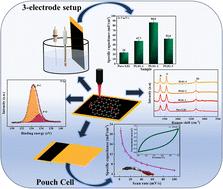
Laser-induced graphene (LIG) has garnered substantial consideration in applications based on energy storage owing to its economical nature and exceptional performance as a flexible electrode material. This work presents a straightforward method for synthesising phosphorus-doped laser-induced graphene (PLIG). The synthesis comprised the formation of pure LIG, subsequent dispersion of phosphoric acid via the drop-casting technique, and re-irradiation. The multilayer structure of PLIG was confirmed via the ratio of intensities of 2D and G bands in the Raman spectrum (I2D/IG = 0.8). The presence of a peak at 2θ ∼26.07° in X-ray diffraction spectra confirms the formation of graphene. The morphological analysis was done through field emission scanning electron microscopy and high-resolution transmission electron microscopy. The occurrence of P–O and P–C in the P 2p peak's core level spectra in X-ray photoelectron spectroscopy confirms the existence of phosphorus in LIG. Furthermore, the fabricated electrode of PLIG-2 unveiled a remarkable specific capacitance (Cs) of 105 mF cm−2 at a 2 mV s−1 scan rate, employing a three-electrode system. Moreover, the symmetric supercapacitor device (Swagelok cell) obtained a Cs of 18.6 mF cm−2 at 0.011 mA cm−2 current density, and the pouch cell offers 21 mF cm−2Cs at 0.05 mA cm−2 current density, demonstrating its application as an energy storage device.
期刊介绍:
Sustainable Energy & Fuels will publish research that contributes to the development of sustainable energy technologies with a particular emphasis on new and next-generation technologies.

 求助内容:
求助内容: 应助结果提醒方式:

 京公网安备 11010802042870号


