Sivasubramaniam Ragul, Kalidoss Kannadasan and Perumal Elumalai
{"title":"High-stability and high-capacity aqueous sodium-ion battery using a high-entropy oxide cathode: intercalation vs. capacitive sodium charge storage","authors":"Sivasubramaniam Ragul, Kalidoss Kannadasan and Perumal Elumalai","doi":"10.1039/D5SE01701G","DOIUrl":null,"url":null,"abstract":"<p >Aqueous sodium-ion batteries are emerging as a potential battery technology due to their ease of fabrication and large-scale grid storage applications. The challenge in aqueous SIBs is achieving high stability and high capacity. In this work, a high-entropy oxide cathode, NaMn<small><sub>0.2</sub></small>Ni<small><sub>0.2</sub></small>Co<small><sub>0.2</sub></small>Fe<small><sub>0.2</sub></small>Al<small><sub>0.1</sub></small>Cu<small><sub>0.1</sub></small>O<small><sub>2</sub></small>, was generated by means of lyophilization and explored as a cathode for aqueous SIBs. Material characterizations such as powder X-ray diffraction, Raman spectroscopy, scanning electron microscopy (SEM), energy-dispersive X-ray analysis (EDAX), transmission electron microscopy (TEM), and X-ray photoelectron spectroscopy (XPS) were used to confirm the phase purity, elemental composition and morphology. The electrochemical activity of the HEO cathode examined in different electrolytes confirmed that the HEO cathode was active only in Na<small><sup>+</sup></small>-conductive electrolytes. The electrolyte engineering confirmed that the 1 M NaPF<small><sub>6</sub></small> electrolyte was the most suitable for efficient sodium charge storage. The detailed cyclic voltammetry (CV) and Dunn's analyses confirmed that the charge storage was due to Na<small><sup>+</sup></small> ion intercalation/deintercalation, along with a minor contribution from the capacitive mode. Consequently, a full-cell aqueous SIB in the form of CR2032 could deliver a discharge capacity of 55 mA h g<small><sup>−1</sup></small>. The laboratory prototype CR2032 coin-type aqueous SIB and pouch-type batteries were demonstrated to power commercial LED bulbs and a temperature sensor.</p>","PeriodicalId":104,"journal":{"name":"Sustainable Energy & Fuels","volume":" 9","pages":" 2256-2270"},"PeriodicalIF":4.1000,"publicationDate":"2026-04-13","publicationTypes":"Journal Article","fieldsOfStudy":null,"isOpenAccess":false,"openAccessPdf":"","citationCount":"0","resultStr":null,"platform":"Semanticscholar","paperid":null,"PeriodicalName":"Sustainable Energy & Fuels","FirstCategoryId":"88","ListUrlMain":"https://pubs.rsc.org/en/content/articlelanding/2026/se/d5se01701g","RegionNum":3,"RegionCategory":"材料科学","ArticlePicture":[],"TitleCN":null,"AbstractTextCN":null,"PMCID":null,"EPubDate":"","PubModel":"","JCR":"Q2","JCRName":"CHEMISTRY, PHYSICAL","Score":null,"Total":0}
引用次数: 0
Abstract
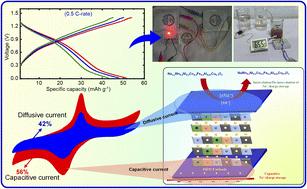
Aqueous sodium-ion batteries are emerging as a potential battery technology due to their ease of fabrication and large-scale grid storage applications. The challenge in aqueous SIBs is achieving high stability and high capacity. In this work, a high-entropy oxide cathode, NaMn0.2Ni0.2Co0.2Fe0.2Al0.1Cu0.1O2, was generated by means of lyophilization and explored as a cathode for aqueous SIBs. Material characterizations such as powder X-ray diffraction, Raman spectroscopy, scanning electron microscopy (SEM), energy-dispersive X-ray analysis (EDAX), transmission electron microscopy (TEM), and X-ray photoelectron spectroscopy (XPS) were used to confirm the phase purity, elemental composition and morphology. The electrochemical activity of the HEO cathode examined in different electrolytes confirmed that the HEO cathode was active only in Na+-conductive electrolytes. The electrolyte engineering confirmed that the 1 M NaPF6 electrolyte was the most suitable for efficient sodium charge storage. The detailed cyclic voltammetry (CV) and Dunn's analyses confirmed that the charge storage was due to Na+ ion intercalation/deintercalation, along with a minor contribution from the capacitive mode. Consequently, a full-cell aqueous SIB in the form of CR2032 could deliver a discharge capacity of 55 mA h g−1. The laboratory prototype CR2032 coin-type aqueous SIB and pouch-type batteries were demonstrated to power commercial LED bulbs and a temperature sensor.
由于易于制造和大规模电网存储应用,水钠离子电池正成为一种潜在的电池技术。水性sib的挑战在于实现高稳定性和高容量。本文采用冻干法制备了一种高熵氧化物阴极,NaMn0.2Ni0.2Co0.2Fe0.2Al0.1Cu0.1O2,并对其作为sib的阴极进行了研究。采用粉末x射线衍射、拉曼光谱、扫描电子显微镜(SEM)、能量色散x射线分析(EDAX)、透射电子显微镜(TEM)和x射线光电子能谱(XPS)等材料表征来确定相纯度、元素组成和形貌。在不同电解质中检测了HEO阴极的电化学活性,证实了HEO阴极仅在Na+导电电解质中具有活性。电解液工程证实,1 M的NaPF6电解液最适合高效的钠电荷存储。详细的循环伏安法(CV)和Dunn的分析证实,电荷存储是由于Na+离子的插入/脱嵌,以及电容模式的一小部分贡献。因此,以CR2032形式的全电池水相SIB可以提供55 mA h g−1的放电容量。实验室原型CR2032硬币型水SIB和袋式电池被演示为商用LED灯泡和温度传感器供电。
期刊介绍:
Sustainable Energy & Fuels will publish research that contributes to the development of sustainable energy technologies with a particular emphasis on new and next-generation technologies.

 求助内容:
求助内容: 应助结果提醒方式:

 京公网安备 11010802042870号


