Siyuan Zhao, Yafang Wu, Yinglin Wang, Dezhi Li, Xudong Guo, Wenjun Zhao, Qing Liu
{"title":"Development of a Lateral Flow Immunoassay Strip Using Self-Paired Monoclonal Antibody for the Rapid Detection of Xanthomonas axonopodis pv. Citri","authors":"Siyuan Zhao, Yafang Wu, Yinglin Wang, Dezhi Li, Xudong Guo, Wenjun Zhao, Qing Liu","doi":"10.1134/S106193482560297X","DOIUrl":null,"url":null,"abstract":"<p>Citrus canker (<b>CC</b>), caused by <i>Xanthomonas axonopodis pv. citri</i> (<b><i>Xac</i></b>), is a devastating bacterial disease that poses a severe threat to citrus production globally. Outbreaks of <i>Xac</i> infections often result in substantial economic losses to the citrus industry, underscoring the urgent need for rapid, reliable, and on-site detection tools to facilitate timely disease management. In this study, a specific monoclonal antibody (<b>mAb</b>), designated 4C3, was generated, and a self-paired gold nanoparticle (<b>AuNP</b>)-based lateral flow immunochromatographic strip (<b>LFIS</b>) was subsequently developed. The AuNPs used were spherical with an average diameter of 40.2 ± 2.3 nm and were synthesized <i>via</i> trisodium citrate reduction of chloroauric acid. Using mAb 4C3 as both the capture antibody and the gold-labeled detector antibody, the performance of the developed AuNPs-LFIS was systematically evaluated. Under optimal conditions, the strip exhibited: (1) a working concentration range of 1 × 10<sup>5</sup>–1 × 10<sup>8</sup> CFU/mL for <i>Xac</i>; (2) a detection limit of 1 × 10<sup>5</sup> CFU/mL; and (3) results visually interpretable within 10 min without specialized equipment. For plant sample testing, pretreatment involved homogenizing citrus leaves/pericarps in Luria–Bertani medium, centrifuging at 5722 <i>g</i> for 10 min, and filtering the supernatant through a 0.22 μm membrane. Furthermore, the AuNPs-LFIS showed excellent specificity: it successfully detected six geographically distinct wild <i>Xac</i> isolates, while no cross-reactivity was observed with 12 other common plant pathogenic bacteria. Importantly, the strip also demonstrated reliable performance in the detection of <i>Xac</i> in artificially inoculated or naturally infected citrus leaf samples, confirming its applicability for real-world field testing. To the best of current knowledge, this is one of the first reports of a self-paired colloidal gold LFIS that enables specific <i>Xac</i> detection using a single mAb. This simplified design not only reduces the complexity and cost of strip production but also maintains high sensitivity and specificity, making it a promising tool for the rapid surveillance, early diagnosis, and effective control of CC.</p>","PeriodicalId":606,"journal":{"name":"Journal of Analytical Chemistry","volume":"81 :","pages":"681 - 692"},"PeriodicalIF":1.1000,"publicationDate":"2026-05-04","publicationTypes":"Journal Article","fieldsOfStudy":null,"isOpenAccess":false,"openAccessPdf":"","citationCount":"0","resultStr":null,"platform":"Semanticscholar","paperid":null,"PeriodicalName":"Journal of Analytical Chemistry","FirstCategoryId":"92","ListUrlMain":"https://link.springer.com/article/10.1134/S106193482560297X","RegionNum":4,"RegionCategory":"化学","ArticlePicture":[],"TitleCN":null,"AbstractTextCN":null,"PMCID":null,"EPubDate":"","PubModel":"","JCR":"Q4","JCRName":"CHEMISTRY, ANALYTICAL","Score":null,"Total":0}
引用次数: 0
Abstract
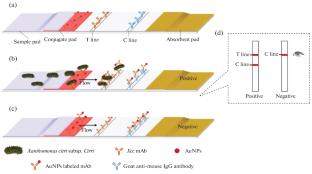
Citrus canker (CC), caused by Xanthomonas axonopodis pv. citri (Xac), is a devastating bacterial disease that poses a severe threat to citrus production globally. Outbreaks of Xac infections often result in substantial economic losses to the citrus industry, underscoring the urgent need for rapid, reliable, and on-site detection tools to facilitate timely disease management. In this study, a specific monoclonal antibody (mAb), designated 4C3, was generated, and a self-paired gold nanoparticle (AuNP)-based lateral flow immunochromatographic strip (LFIS) was subsequently developed. The AuNPs used were spherical with an average diameter of 40.2 ± 2.3 nm and were synthesized via trisodium citrate reduction of chloroauric acid. Using mAb 4C3 as both the capture antibody and the gold-labeled detector antibody, the performance of the developed AuNPs-LFIS was systematically evaluated. Under optimal conditions, the strip exhibited: (1) a working concentration range of 1 × 10⁵–1 × 10⁸ CFU/mL for Xac; (2) a detection limit of 1 × 10⁵ CFU/mL; and (3) results visually interpretable within 10 min without specialized equipment. For plant sample testing, pretreatment involved homogenizing citrus leaves/pericarps in Luria–Bertani medium, centrifuging at 5722 g for 10 min, and filtering the supernatant through a 0.22 μm membrane. Furthermore, the AuNPs-LFIS showed excellent specificity: it successfully detected six geographically distinct wild Xac isolates, while no cross-reactivity was observed with 12 other common plant pathogenic bacteria. Importantly, the strip also demonstrated reliable performance in the detection of Xac in artificially inoculated or naturally infected citrus leaf samples, confirming its applicability for real-world field testing. To the best of current knowledge, this is one of the first reports of a self-paired colloidal gold LFIS that enables specific Xac detection using a single mAb. This simplified design not only reduces the complexity and cost of strip production but also maintains high sensitivity and specificity, making it a promising tool for the rapid surveillance, early diagnosis, and effective control of CC.
期刊介绍:
The Journal of Analytical Chemistry is an international peer reviewed journal that covers theoretical and applied aspects of analytical chemistry; it informs the reader about new achievements in analytical methods, instruments and reagents. Ample space is devoted to problems arising in the analysis of vital media such as water and air. Consideration is given to the detection and determination of metal ions, anions, and various organic substances. The journal welcomes manuscripts from all countries in the English or Russian language.

 求助内容:
求助内容: 应助结果提醒方式:

 京公网安备 11010802042870号


