{"title":"Dendritic Nanosilica Supported Sm2CoMnO6: A Sustainable Catalyst for Green Polymer and Biopolymer Synthesis from CO2","authors":"Ning Xu, Hongtai Chen, Seyed Mohsen Sadeghzadeh","doi":"10.1007/s10562-026-05390-9","DOIUrl":null,"url":null,"abstract":"<div><p>The design of catalysts with hierarchical architectures and phase interfaces is crucial for enhancing active site accessibility and catalytic efficiency. In this work, a recyclable nanocatalyst based on Sm<sub>2</sub>CoMnO<sub>6</sub> nanoparticles embedded in dendritic fibrous nanosilica (DFNS) was developed using a green and straightforward synthetic strategy. A deep eutectic solvent assisted method was employed to fabricate DFNS with high surface area and a threadlike, dandelion like morphology composed of ultrathin 3D nanosheets and mesoscopic cavities. The large specific surface area originates from the material’s three dimensional hierarchical architecture, which consists of interconnected two dimensional ultrathin layers featuring mesoporous voids. Sm<sub>2</sub>CoMnO<sub>6</sub> nanoparticles were successfully incorporated onto DFNS through a simple and efficient synthesis procedure. This environmentally friendly synthesis route avoided the use of toxic solvents or hazardous reagents and utilized natural epoxides as renewable feedstocks. The resulting Sm<sub>2</sub>CoMnO<sub>6</sub> DFNS nanocatalyst demonstrated high efficiency in the synthesizing biopolymers and polymers through the reaction of CO<sub>2</sub> with oxetane, epoxide, or limonene epoxide under mild conditions with excellent conversion and selectivity. These findings highlight the dual potential of this nanocatalyst platform for CO<sub>2</sub> fixation and green polymer synthesis, paving the way for integrated carbon capture and material production strategies.</p><h3>Graphical Abstract</h3><div><figure><div><div><picture><source><img></source></picture><span>The alternative text for this image may have been generated using AI.</span></div></div></figure></div></div>","PeriodicalId":508,"journal":{"name":"Catalysis Letters","volume":"156 6","pages":""},"PeriodicalIF":2.3000,"publicationDate":"2026-05-04","publicationTypes":"Journal Article","fieldsOfStudy":null,"isOpenAccess":false,"openAccessPdf":"","citationCount":"0","resultStr":null,"platform":"Semanticscholar","paperid":null,"PeriodicalName":"Catalysis Letters","FirstCategoryId":"92","ListUrlMain":"https://link.springer.com/article/10.1007/s10562-026-05390-9","RegionNum":4,"RegionCategory":"化学","ArticlePicture":[],"TitleCN":null,"AbstractTextCN":null,"PMCID":null,"EPubDate":"","PubModel":"","JCR":"Q3","JCRName":"CHEMISTRY, PHYSICAL","Score":null,"Total":0}
引用次数: 0
Abstract
The design of catalysts with hierarchical architectures and phase interfaces is crucial for enhancing active site accessibility and catalytic efficiency. In this work, a recyclable nanocatalyst based on Sm2CoMnO6 nanoparticles embedded in dendritic fibrous nanosilica (DFNS) was developed using a green and straightforward synthetic strategy. A deep eutectic solvent assisted method was employed to fabricate DFNS with high surface area and a threadlike, dandelion like morphology composed of ultrathin 3D nanosheets and mesoscopic cavities. The large specific surface area originates from the material’s three dimensional hierarchical architecture, which consists of interconnected two dimensional ultrathin layers featuring mesoporous voids. Sm2CoMnO6 nanoparticles were successfully incorporated onto DFNS through a simple and efficient synthesis procedure. This environmentally friendly synthesis route avoided the use of toxic solvents or hazardous reagents and utilized natural epoxides as renewable feedstocks. The resulting Sm2CoMnO6 DFNS nanocatalyst demonstrated high efficiency in the synthesizing biopolymers and polymers through the reaction of CO2 with oxetane, epoxide, or limonene epoxide under mild conditions with excellent conversion and selectivity. These findings highlight the dual potential of this nanocatalyst platform for CO2 fixation and green polymer synthesis, paving the way for integrated carbon capture and material production strategies.
Graphical Abstract
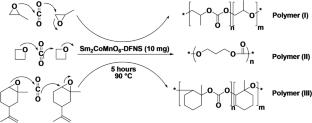
The alternative text for this image may have been generated using AI.
期刊介绍:
Catalysis Letters aim is the rapid publication of outstanding and high-impact original research articles in catalysis. The scope of the journal covers a broad range of topics in all fields of both applied and theoretical catalysis, including heterogeneous, homogeneous and biocatalysis.
The high-quality original research articles published in Catalysis Letters are subject to rigorous peer review. Accepted papers are published online first and subsequently in print issues. All contributions must include a graphical abstract. Manuscripts should be written in English and the responsibility lies with the authors to ensure that they are grammatically and linguistically correct. Authors for whom English is not the working language are encouraged to consider using a professional language-editing service before submitting their manuscripts.