
Effects of red ginseng on gut microbiome in patients after gastrointestinal cancer surgery: A pilot, randomized controlled trial
IF 5.6
2区 医学
Q1 CHEMISTRY, MEDICINAL
Journal of Ginseng Research
Pub Date : 2026-05-01
Epub Date: 2025-12-20
DOI:10.1016/j.jgr.2025.100932
引用次数: 0
Abstract
Background
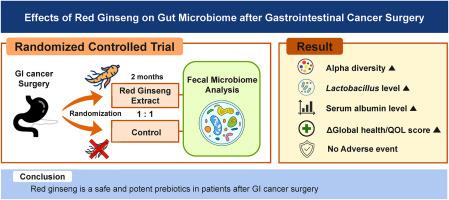
The gut microbiome plays diverse roles in human health. Although Korean red ginseng (KRG) has shown therapeutic potential in animal models, its effects on the human gut microbiome after gastrointestinal (GI) cancer surgery remain underexplored. This prospective randomized controlled study aimed to evaluate postoperative safety of KRG and its impact on the gut microbiome and postoperative outcomes after GI cancer surgery.
Methods
Patients were randomly assigned 1:1 to the red ginseng or control groups. Microbiome analysis of preoperative and postoperative fecal samples was performed using 16S rRNA sequencing. The alpha and beta diversities, taxonomic composition changes of microbiome, nutritional index, clinical symptoms, GI symptoms, and quality of life (QOL) were assessed.
Results
A total of 60 patients were enrolled and 16 patients in the red ginseng group and 25 in the control group were included in the final analysis. Postoperative alpha diversity decreased significantly in the control group, but remained relatively stable in the red ginseng group. Postoperative Lactobacillus levels increased significantly in the red ginseng group compared to the control group (18.34 % vs. 0.23 %; p < 0.001), whereas Bifidobacterium levels decreased (p = 0.002). Serum albumin levels were significantly higher in the red ginseng group at 3 months postoperatively (p = 0.003), and global health status/QOL scores were improved in the red ginseng group (p = 0.047).
Conclusion
Red ginseng supplementation may play a protective role in gut microbiome, improving clinical outcomes in patients undergoing GI cancer surgery, as a safe and supportive therapy for enhancing postoperative recovery.
红参对胃肠道肿瘤手术后患者肠道微生物组的影响:一项先导、随机对照试验
肠道微生物群在人体健康中发挥着多种作用。虽然韩国红参(KRG)在动物模型中显示出治疗潜力,但其对胃肠道(GI)癌症手术后人体肠道微生物群的影响仍未得到充分研究。本前瞻性随机对照研究旨在评估KRG的术后安全性及其对胃肠道肿瘤手术后肠道微生物组和术后预后的影响。方法将患者按1:1的比例随机分为红参组和对照组。采用16S rRNA测序对术前和术后粪便样本进行微生物组分析。评估α和β多样性、微生物组分类学组成变化、营养指数、临床症状、胃肠道症状和生活质量(QOL)。结果共纳入60例患者,其中红参组16例,对照组25例。术后α多样性在对照组明显下降,但在红参组保持相对稳定。与对照组相比,红参组术后乳酸杆菌水平显著升高(18.34% vs. 0.23%; p < 0.001),而双歧杆菌水平下降(p = 0.002)。红参组术后3个月血清白蛋白水平明显升高(p = 0.003),整体健康状况/生活质量评分明显改善(p = 0.047)。结论补充红参可能对胃肠道肿瘤手术患者的肠道微生物群具有保护作用,可改善患者的临床预后,是一种安全、促进术后恢复的支持性治疗方法。
本文章由计算机程序翻译,如有差异,请以英文原文为准。
求助全文
约1分钟内获得全文
求助全文
来源期刊
Journal of Ginseng Research
CHEMISTRY, MEDICINAL-INTEGRATIVE & COMPLEMENTARY MEDICINE
CiteScore
11.40
自引率
9.50%
发文量
111
审稿时长
6-12 weeks
期刊介绍:
Journal of Ginseng Research (JGR) is an official, open access journal of the Korean Society of Ginseng and is the only international journal publishing scholarly reports on ginseng research in the world. The journal is a bimonthly peer-reviewed publication featuring high-quality studies related to basic, pre-clinical, and clinical researches on ginseng to reflect recent progresses in ginseng research.
JGR publishes papers, either experimental or theoretical, that advance our understanding of ginseng science, including plant sciences, biology, chemistry, pharmacology, toxicology, pharmacokinetics, veterinary medicine, biochemistry, manufacture, and clinical study of ginseng since 1976. It also includes the new paradigm of integrative research, covering alternative medicinal approaches. Article types considered for publication include review articles, original research articles, and brief reports.
JGR helps researchers to understand mechanisms for traditional efficacy of ginseng and to put their clinical evidence together. It provides balanced information on basic science and clinical applications to researchers, manufacturers, practitioners, teachers, scholars, and medical doctors.
 求助内容:
求助内容: 应助结果提醒方式:

 京公网安备 11010802042870号


