
Red ginseng-derived components attenuate UVB-induced keratinocyte senescence via senomorphic mechanisms
IF 5.6
2区 医学
Q1 CHEMISTRY, MEDICINAL
Journal of Ginseng Research
Pub Date : 2026-05-01
Epub Date: 2026-02-28
DOI:10.1016/j.jgr.2026.101018
引用次数: 0
Abstract
Background
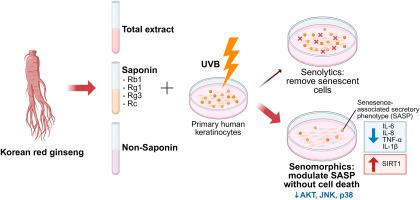
Senescent cells progressively accumulate within tissues and induce further senescence in neighboring cells through the senescence-associated secretory phenotype (SASP), thereby contributing to tissue dysfunction and aging. While senolytics selectively eliminate senescent cells, senomorphics modulate SASP without inducing cell death. Although red ginseng has been studied for anti-photoaging properties, its role in directly modulating SASP-driven keratinocyte senescence and paracrine aging signaling remains insufficiently defined. This study aimed to investigate whether Korean red ginseng-derived components (RGCs) exert senolytic or senomorphic activity in ultraviolet B (UVB)-induced senescent primary human keratinocytes.
Methods
Cellular senescence was induced by repeated UVB irradiation in primary human keratinocytes. A transwell co-culture system was employed to evaluate SASP-mediated paracrine effects on neighboring keratinocytes. Three RGC fractions were examined. Senescence markers (p16 and p21), SASP factors (IL-6, IL-8, IL-1β, and TNF-α), and differentiation/proliferation markers were analyzed. Representative major ginsenosides (Rb1, Rg1, Rg3, Rc) and stress signaling pathways (MAPK/JNK and AKT) were also evaluated.
Results
RGCs did not exhibit significant senolytic activity or apoptosis induction. Instead, they demonstrated pronounced senomorphic effects by attenuating UVB-induced upregulation of p16, p21, IL-6, IL-8, and IL-1β. RGCs enhanced keratinocyte proliferation and partially restored early-to-intermediate differentiation markers. In the co-culture model, RGCs mitigated SASP-mediated paracrine effects, reducing senescence and inflammatory signaling in adjacent keratinocytes. These effects were associated with modulation of stress-responsive MAPK/JNK pathways and were partially recapitulated by ginsenosides.
Conclusion
Our findings demonstrate that RGCs function predominantly as senomorphic modulators in UVB-induced keratinocyte senescence, attenuating SASP propagation and stress signaling without inducing cell death.
红参衍生成分通过感形机制减弱uvb诱导的角质细胞衰老
衰老细胞在组织内逐渐积累,并通过衰老相关分泌表型(SASP)诱导邻近细胞进一步衰老,从而导致组织功能障碍和衰老。虽然抗衰老药物选择性地消除衰老细胞,但异胚性药物在不诱导细胞死亡的情况下调节SASP。虽然红参具有抗光老化的特性,但其在直接调节sasp驱动的角质细胞衰老和旁分泌衰老信号中的作用仍然不够明确。本研究旨在探讨红参衍生成分(RGCs)是否在紫外线B (UVB)诱导的衰老人原代角质形成细胞中发挥衰老或促衰老活性。方法多次UVB照射诱导人原代角质形成细胞衰老。transwell共培养系统用于评估sasp介导的旁分泌对邻近角质形成细胞的影响。研究了三个RGC组分。分析衰老标志物(p16和p21)、SASP因子(IL-6、IL-8、IL-1β和TNF-α)和分化/增殖标志物。我们还评估了具有代表性的人参皂苷(Rb1、Rg1、Rg3、Rc)和应激信号通路(MAPK/JNK和AKT)。结果rgcs未表现出明显的衰老活性或诱导细胞凋亡。相反,它们通过减弱uvb诱导的p16、p21、IL-6、IL-8和IL-1β的上调表现出明显的同型效应。RGCs增强角质细胞增殖,部分恢复早期到中期分化标记。在共培养模型中,RGCs减轻了sasp介导的旁分泌效应,减少了邻近角质形成细胞的衰老和炎症信号。这些作用与应激响应的MAPK/JNK通路的调节有关,人参皂苷部分地概括了这些作用。结论在uvb诱导的角质形成细胞衰老过程中,RGCs主要作为senomorphic调节剂,在不诱导细胞死亡的情况下抑制SASP繁殖和应激信号。
本文章由计算机程序翻译,如有差异,请以英文原文为准。
求助全文
约1分钟内获得全文
求助全文
来源期刊
Journal of Ginseng Research
CHEMISTRY, MEDICINAL-INTEGRATIVE & COMPLEMENTARY MEDICINE
CiteScore
11.40
自引率
9.50%
发文量
111
审稿时长
6-12 weeks
期刊介绍:
Journal of Ginseng Research (JGR) is an official, open access journal of the Korean Society of Ginseng and is the only international journal publishing scholarly reports on ginseng research in the world. The journal is a bimonthly peer-reviewed publication featuring high-quality studies related to basic, pre-clinical, and clinical researches on ginseng to reflect recent progresses in ginseng research.
JGR publishes papers, either experimental or theoretical, that advance our understanding of ginseng science, including plant sciences, biology, chemistry, pharmacology, toxicology, pharmacokinetics, veterinary medicine, biochemistry, manufacture, and clinical study of ginseng since 1976. It also includes the new paradigm of integrative research, covering alternative medicinal approaches. Article types considered for publication include review articles, original research articles, and brief reports.
JGR helps researchers to understand mechanisms for traditional efficacy of ginseng and to put their clinical evidence together. It provides balanced information on basic science and clinical applications to researchers, manufacturers, practitioners, teachers, scholars, and medical doctors.
 求助内容:
求助内容: 应助结果提醒方式:

 京公网安备 11010802042870号


