
The cardioprotective mechanism of total saponins from mountain cultivated ginseng against doxorubicin-induced heart failure: Insights from gut-heart axis modulation based on gut microbiota and fecal metabolomics
IF 5.6
2区 医学
Q1 CHEMISTRY, MEDICINAL
Journal of Ginseng Research
Pub Date : 2026-05-01
Epub Date: 2026-01-24
DOI:10.1016/j.jgr.2026.100983
引用次数: 0
Abstract
Background
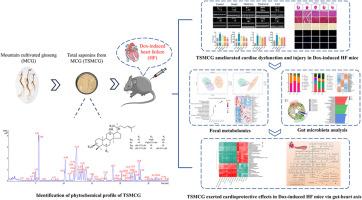
Mountain cultivated ginseng (MCG) has been reported to exert superior therapeutic efficacy in heart failure (HF) models, but the mechanism of total saponins from MCG (TSMCG) remains unclear.
Methods
This study aimed to elucidate the mechanism of TSMCG protects against doxorubicin-induced HF through the gut-heart axis. The phytochemical profile of TSMCG was identified using UPLC/Q-TOF-MS. TSMCG (50 or 200 mg/kg) was administered to mice daily for one week before and after doxorubicin exposure. Cardiac function was evaluated via echocardiography, followed by blood biochemical and cardiac histological analyses. Metabolic profiles and gut microbiota composition were analyzed. Fecal microbiota transplantation experiments were employed for mechanistic validation.
Results
TSMCG treatment significantly improved cardiac function in HF mice, as evidenced by increased ejection fraction. TSMCG markedly attenuated doxorubicin-induced myocardial injury (CK-MB, NT-proBNP, AST, LDH), oxidative stress (SOD, MDA, CAT, GSH), and cardiac fibrosis. TSMCG effectively regulated key metabolic pathways, particularly tryptophan and bile acid metabolism, and alleviated gut microbiota dysbiosis, particularly Parasutterella and Akkermansia, in HF mice. Close associations between differential microbiota and metabolites were observed. The cardioprotective effects of TSMCG were associated with fecal microbiota transplantation.
Conclusion
These findings elucidated the gut-heart axis-based mechanism by which TSMCG alleviated doxorubicin-induced HF and highlighted its potential as a candidate for HF intervention.
山参总皂苷对阿霉素诱导心力衰竭的心脏保护机制:基于肠道微生物群和粪便代谢组学的肠-心轴调节的见解
山栽培人参(MCG)在心力衰竭(HF)模型中表现出优越的治疗效果,但山栽培人参总皂苷(TSMCG)的作用机制尚不清楚。方法本研究旨在阐明TSMCG通过肠-心轴对阿霉素诱导的HF的保护机制。采用UPLC/Q-TOF-MS鉴定了TSMCG的植物化学特征。在阿霉素暴露前后一周,每天给小鼠注射TSMCG(50或200 mg/kg)。通过超声心动图评估心功能,随后进行血液生化和心脏组织学分析。分析代谢谱和肠道菌群组成。采用粪便菌群移植实验进行机理验证。结果stsmcg治疗显著改善HF小鼠心功能,射血分数升高。TSMCG可显著减轻阿霉素诱导的心肌损伤(CK-MB、NT-proBNP、AST、LDH)、氧化应激(SOD、MDA、CAT、GSH)和心肌纤维化。TSMCG有效调节HF小鼠的关键代谢途径,特别是色氨酸和胆酸代谢,缓解肠道菌群失调,特别是副菌和阿克曼氏菌。观察到不同微生物群和代谢物之间的密切联系。TSMCG的心脏保护作用与粪便菌群移植有关。结论这些发现阐明了TSMCG减轻阿霉素诱导的HF的肠-心轴机制,并突出了其作为HF干预的候选药物的潜力。
本文章由计算机程序翻译,如有差异,请以英文原文为准。
求助全文
约1分钟内获得全文
求助全文
来源期刊
Journal of Ginseng Research
CHEMISTRY, MEDICINAL-INTEGRATIVE & COMPLEMENTARY MEDICINE
CiteScore
11.40
自引率
9.50%
发文量
111
审稿时长
6-12 weeks
期刊介绍:
Journal of Ginseng Research (JGR) is an official, open access journal of the Korean Society of Ginseng and is the only international journal publishing scholarly reports on ginseng research in the world. The journal is a bimonthly peer-reviewed publication featuring high-quality studies related to basic, pre-clinical, and clinical researches on ginseng to reflect recent progresses in ginseng research.
JGR publishes papers, either experimental or theoretical, that advance our understanding of ginseng science, including plant sciences, biology, chemistry, pharmacology, toxicology, pharmacokinetics, veterinary medicine, biochemistry, manufacture, and clinical study of ginseng since 1976. It also includes the new paradigm of integrative research, covering alternative medicinal approaches. Article types considered for publication include review articles, original research articles, and brief reports.
JGR helps researchers to understand mechanisms for traditional efficacy of ginseng and to put their clinical evidence together. It provides balanced information on basic science and clinical applications to researchers, manufacturers, practitioners, teachers, scholars, and medical doctors.
 求助内容:
求助内容: 应助结果提醒方式:

 京公网安备 11010802042870号


