
Research progress and applications of high-performance fiber ropes in infrastructure: A systematic review
IF 7.1
2区 材料科学
Q1 MATERIALS SCIENCE, COMPOSITES
Composite Structures
Pub Date : 2026-05-01
Epub Date: 2026-04-25
DOI:10.1016/j.compstruct.2026.120370
引用次数: 0
Abstract
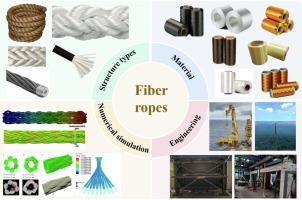
With the growing demand for lightweight and high-strength designs in marine engineering and civil infrastructure, high-performance synthetic fiber ropes have emerged as promising alternatives to conventional load-bearing components. Owing to their low density, high specific strength, and excellent flexibility, these ropes offer significant potential in next-generation structural systems. However, most existing studies focus on either single-fiber behavior or specific rope configurations, lacking a systematic, cross-material, and cross-structure synthesis. This review aims to provide a comprehensive overview of recent advances in high-performance fiber ropes, encompassing their material characteristics, structural design, mechanical behavior, and civil engineering applications. It highlights the typical configurations, mechanical responses, and functional scenarios of commonly used ropes, while comparing the intrinsic properties of various high-performance fibers and their performance under tensile, creep, and fatigue tests. Furthermore, the paper summarizes the characteristics and applicability of “yarn-level” and “fiber-level” modeling approaches in numerical simulations and discusses the practical uses of fiber ropes in infrastructure systems. Finally, the main challenges and potential research directions are discussed to provide insights for future studies in this evolving field.
高性能纤维绳索在基础设施中的研究进展及应用综述
随着海洋工程和民用基础设施对轻量化和高强度设计的需求不断增长,高性能合成纤维绳索已成为传统承重部件的有希望的替代品。由于其低密度、高比强度和优异的柔韧性,这些绳索在下一代结构系统中具有巨大的潜力。然而,大多数现有的研究都集中在单纤维的性能或特定的绳索结构上,缺乏系统的、跨材料和跨结构的综合。本文综述了高性能纤维绳的最新进展,包括其材料特性、结构设计、力学性能和土木工程应用。重点介绍了常用绳索的典型结构、机械响应和功能场景,同时比较了各种高性能纤维的内在特性及其在拉伸、蠕变和疲劳测试中的性能。此外,本文总结了“纱线级”和“纤维级”建模方法在数值模拟中的特点和适用性,并讨论了纤维绳在基础设施系统中的实际应用。最后,讨论了该领域面临的主要挑战和潜在的研究方向,为该领域的未来研究提供见解。
本文章由计算机程序翻译,如有差异,请以英文原文为准。
求助全文
约1分钟内获得全文
求助全文
来源期刊

Composite Structures
工程技术-材料科学:复合
CiteScore
12.00
自引率
12.70%
发文量
1246
审稿时长
78 days
期刊介绍:
The past few decades have seen outstanding advances in the use of composite materials in structural applications. There can be little doubt that, within engineering circles, composites have revolutionised traditional design concepts and made possible an unparalleled range of new and exciting possibilities as viable materials for construction. Composite Structures, an International Journal, disseminates knowledge between users, manufacturers, designers and researchers involved in structures or structural components manufactured using composite materials.
The journal publishes papers which contribute to knowledge in the use of composite materials in engineering structures. Papers deal with design, research and development studies, experimental investigations, theoretical analysis and fabrication techniques relevant to the application of composites in load-bearing components for assemblies, ranging from individual components such as plates and shells to complete composite structures.
 求助内容:
求助内容: 应助结果提醒方式:

 京公网安备 11010802042870号


