
Advancing aquifer recharge forecasting through hybrid explainable AI and hydrological modeling

IF 12.7 1区 地球科学 Q1 GEOSCIENCES, MULTIDISCIPLINARY
Geoscience frontiers Pub Date : 2026-07-01 Epub Date: 2026-04-15 DOI:10.1016/j.gsf.2026.102336
Chetan Sharma , Hakan Başağaoğlu , Logan Schmidt , Icen Yoosefdoost , Adrienne M. Wootten , F. Paul Bertetti , M. Arif Şahinli , Arfan Arshad , Maryam Samimi , John M. Sharp , Changbing Yang , Ali Mirchi , Debaditya Chakraborty
{"title":"Advancing aquifer recharge forecasting through hybrid explainable AI and hydrological modeling","authors":"Chetan Sharma ,&nbsp;Hakan Başağaoğlu ,&nbsp;Logan Schmidt ,&nbsp;Icen Yoosefdoost ,&nbsp;Adrienne M. Wootten ,&nbsp;F. Paul Bertetti ,&nbsp;M. Arif Şahinli ,&nbsp;Arfan Arshad ,&nbsp;Maryam Samimi ,&nbsp;John M. Sharp ,&nbsp;Changbing Yang ,&nbsp;Ali Mirchi ,&nbsp;Debaditya Chakraborty","doi":"10.1016/j.gsf.2026.102336","DOIUrl":null,"url":null,"abstract":"<div><div>Reliable aquifer recharge prediction is essential for climate-resilient and sustainable groundwater management, yet uncertainty persists due to subsurface heterogeneity and the lack of direct basin-scale recharge measurements. We present a serial hybrid eXplainable Artificial Intelligence (XAI) framework that leverages hydrological model-derived recharge estimates to train AI models, improving prediction accuracy, transparency, and interpretability. The framework was applied to two basins within the karstic Edwards aquifer system in Texas, USA. The XAI models identified recharge events in the test dataset that were missed by the hydrological model, with findings corroborated by in-situ hydroclimatic records, HSPF recharge estimates, GRACE-derived groundwater storage anomalies, and bootstrap analyses. The results demonstrated the XAI model’s superior learning capability beyond emulators to identify limitations in the training model and test data while robustly predicting high and low aquifer recharge events. Using long-term (1946–2023) hydroclimatic records and SHapley Additive exPlanations (SHAP), the best-performing AI model (Extremely Randomized Trees) identified basin-specific recharge drivers: current-month precipitation dominated in the larger, warmer, and drier basin with perennial streams, while lagged recharge, a proxy for antecedent soil moisture, was the primary driver in the smaller urbanizing basin characterized by small ephemeral streams and highly fractured zones. Each driver explained ∼32% of the variability in recharge estimates, underscoring the model’s generalizability. SHAP-based analysis further enabled probabilistic identification of hydroclimatic conditions conducive to enhanced recharge. Projections based on downscaled CMIP6 climate data under intermediate- and high-emission scenarios indicate a decline in large recharge events in both basins through 2100, highlighting potential risks to groundwater sustainability.</div></div>","PeriodicalId":12711,"journal":{"name":"Geoscience frontiers","volume":"17 4","pages":"Article 102336"},"PeriodicalIF":12.7000,"publicationDate":"2026-07-01","publicationTypes":"Journal Article","fieldsOfStudy":null,"isOpenAccess":false,"openAccessPdf":"","citationCount":"0","resultStr":null,"platform":"Semanticscholar","paperid":null,"PeriodicalName":"Geoscience frontiers","FirstCategoryId":"89","ListUrlMain":"https://www.sciencedirect.com/science/article/pii/S1674987126000903","RegionNum":1,"RegionCategory":"地球科学","ArticlePicture":[],"TitleCN":null,"AbstractTextCN":null,"PMCID":null,"EPubDate":"2026/4/15 0:00:00","PubModel":"Epub","JCR":"Q1","JCRName":"GEOSCIENCES, MULTIDISCIPLINARY","Score":null,"Total":0}
引用次数: 0

Abstract

Reliable aquifer recharge prediction is essential for climate-resilient and sustainable groundwater management, yet uncertainty persists due to subsurface heterogeneity and the lack of direct basin-scale recharge measurements. We present a serial hybrid eXplainable Artificial Intelligence (XAI) framework that leverages hydrological model-derived recharge estimates to train AI models, improving prediction accuracy, transparency, and interpretability. The framework was applied to two basins within the karstic Edwards aquifer system in Texas, USA. The XAI models identified recharge events in the test dataset that were missed by the hydrological model, with findings corroborated by in-situ hydroclimatic records, HSPF recharge estimates, GRACE-derived groundwater storage anomalies, and bootstrap analyses. The results demonstrated the XAI model’s superior learning capability beyond emulators to identify limitations in the training model and test data while robustly predicting high and low aquifer recharge events. Using long-term (1946–2023) hydroclimatic records and SHapley Additive exPlanations (SHAP), the best-performing AI model (Extremely Randomized Trees) identified basin-specific recharge drivers: current-month precipitation dominated in the larger, warmer, and drier basin with perennial streams, while lagged recharge, a proxy for antecedent soil moisture, was the primary driver in the smaller urbanizing basin characterized by small ephemeral streams and highly fractured zones. Each driver explained ∼32% of the variability in recharge estimates, underscoring the model’s generalizability. SHAP-based analysis further enabled probabilistic identification of hydroclimatic conditions conducive to enhanced recharge. Projections based on downscaled CMIP6 climate data under intermediate- and high-emission scenarios indicate a decline in large recharge events in both basins through 2100, highlighting potential risks to groundwater sustainability.
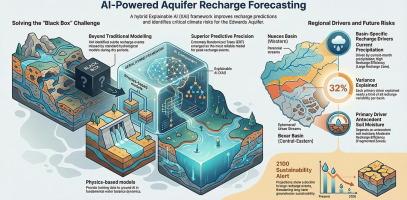
Abstract Image

通过混合可解释人工智能和水文模型推进含水层补给预测
可靠的含水层补给预测对于气候适应性和可持续地下水管理至关重要,但由于地下异质性和缺乏直接的盆地尺度补给测量,不确定性仍然存在。我们提出了一个串联混合可解释人工智能(XAI)框架,该框架利用水文模型衍生的补给估计来训练人工智能模型,提高预测精度、透明度和可解释性。该框架应用于美国德克萨斯州岩溶爱德华兹含水层系统中的两个盆地。XAI模型识别了水文模型遗漏的测试数据集中的补给事件,并得到了原位水文气候记录、HSPF补给估算、grace导出的地下水储存异常和自举分析的证实。结果表明,XAI模型具有比仿真器更好的学习能力,能够识别训练模型和测试数据的局限性,同时可靠地预测高含水层和低含水层补给事件。利用长期(1946-2023)水文气候记录和SHapley加性解释(SHAP),表现最佳的人工智能模型(极端随机树)确定了流域特定的补给驱动因素:在具有多年生河流的较大、温暖和干燥的流域,当月降水占主导地位,而在具有小短暂河流和高度断裂带的较小城市化流域,滞后补给(预先土壤湿度的代表)是主要驱动因素。每个驱动因素解释了充电估计中约32%的变化,强调了该模型的通用性。基于shap的分析进一步实现了有利于增强补给的水文气候条件的概率识别。基于中排放和高排放情景下缩小规模的CMIP6气候数据的预估表明,到2100年,两个流域的大型补给事件将减少,这凸显了地下水可持续性面临的潜在风险。
本文章由计算机程序翻译,如有差异,请以英文原文为准。
求助全文
约1分钟内获得全文 求助全文
来源期刊
Geoscience frontiers
Geoscience frontiers Earth and Planetary Sciences-General Earth and Planetary Sciences
CiteScore
17.80
自引率
3.40%
发文量
147
审稿时长
35 days
期刊介绍: Geoscience Frontiers (GSF) is the Journal of China University of Geosciences (Beijing) and Peking University. It publishes peer-reviewed research articles and reviews in interdisciplinary fields of Earth and Planetary Sciences. GSF covers various research areas including petrology and geochemistry, lithospheric architecture and mantle dynamics, global tectonics, economic geology and fuel exploration, geophysics, stratigraphy and paleontology, environmental and engineering geology, astrogeology, and the nexus of resources-energy-emissions-climate under Sustainable Development Goals. The journal aims to bridge innovative, provocative, and challenging concepts and models in these fields, providing insights on correlations and evolution.

×
引用
GB/T 7714-2015
复制
MLA
复制
APA
复制
导出至
BibTeX EndNote RefMan NoteFirst NoteExpress
×
提示
您的信息不完整,为了账户安全,请先补充。
现在去补充
×
提示
您因"违规操作"
具体请查看互助需知
我知道了
×
提示
确定
请完成安全验证×
copy
已复制链接
快去分享给好友吧!
我知道了
右上角分享
点击右上角分享
0
联系我们:info@booksci.cn Book学术提供免费学术资源搜索服务,方便国内外学者检索中英文文献。致力于提供最便捷和优质的服务体验。 Copyright © 2023 布克学术 All rights reserved.
京ICP备2023020795号-1
ghs 京公网安备 11010802042870号
Book学术文献互助
Book学术文献互助群
群 号:604180095
Book学术官方微信
小红书


