
Entomofauna, mycotoxin accumulation and storage loss dynamics in cereals in the Tshopo province, Democratic Republic of Congo

IF 3.4 2区 农林科学 Q1 ENTOMOLOGY
Journal of Stored Products Research Pub Date : 2026-05-01 Epub Date: 2026-04-28 DOI:10.1016/j.jspr.2026.103049
Jeremy Berdy , Hervé Ambakina , Papy N'Sevolo , Manon Genva , Rudy Caparros Megido , Frédéric Francis , Marie-Laure Fauconnier
{"title":"Entomofauna, mycotoxin accumulation and storage loss dynamics in cereals in the Tshopo province, Democratic Republic of Congo","authors":"Jeremy Berdy ,&nbsp;Hervé Ambakina ,&nbsp;Papy N'Sevolo ,&nbsp;Manon Genva ,&nbsp;Rudy Caparros Megido ,&nbsp;Frédéric Francis ,&nbsp;Marie-Laure Fauconnier","doi":"10.1016/j.jspr.2026.103049","DOIUrl":null,"url":null,"abstract":"<div><div>Post-harvest losses of cereals remain a major challenge for food security in tropical regions, yet data from Central Africa are scarce. This study investigated the entomofauna, mycotoxin contamination, and storage loss dynamics of rice (<em>Oryza sativa</em> L.) and maize (<em>Zea mays</em> L.) stored under traditional conditions in the Tshopo province, Democratic Republic of Congo. Cereals were sampled at nine storage sites across three zones at 0, 30, and 60 days of storage. Insect pests were identified using morphological and molecular approaches, mycotoxins were quantified using immunochromatographic assays validated by UHPLC–MS/MS, and grain quality losses were assessed through weight, moisture, integrity, and germination measurements.</div><div>Stored cereals were dominated by three insect pests: <em>Sitophilus zeamais</em>, <em>Sitotroga cerealella</em>, and <em>Tribolium castaneum</em>, accounting for more than 98% of all collected insects. <em>S. zeamais</em> was ubiquitous and reached high densities in both crops, while <em>S. cerealella</em> showed site-specific infestations, particularly in rice. Aflatoxin contamination was detected in both crops and increased significantly during maize storage, frequently exceeding the European regulatory limit after 60 days in some zones. Fumonisins were detected exclusively in maize at low but consistent concentrations. Grain moisture readings point to a high risk of pre-storage mycotoxin accumulation, with additional in-storage aflatoxin production occurring specifically in stores with the highest moisture levels. Grain quality deteriorated during storage, with significant losses in dry weight, integrity, and germination capacity, particularly in sites with high insect pressure and mycotoxin levels. Correlation analyses revealed strong associations between insect abundance, mycotoxin accumulation, grain moisture content, and grain deterioration. Findings demonstrate that post-harvest losses in stored rice and maize in Tshopo province are driven by synergistic interactions between storage pests and fungal contamination. The study provides the first comprehensive baseline data for the region and highlights the urgent need for improved storage management to reduce food safety risks and cereal losses.</div></div>","PeriodicalId":17019,"journal":{"name":"Journal of Stored Products Research","volume":"117 ","pages":"Article 103049"},"PeriodicalIF":3.4000,"publicationDate":"2026-05-01","publicationTypes":"Journal Article","fieldsOfStudy":null,"isOpenAccess":false,"openAccessPdf":"","citationCount":"0","resultStr":null,"platform":"Semanticscholar","paperid":null,"PeriodicalName":"Journal of Stored Products Research","FirstCategoryId":"97","ListUrlMain":"https://www.sciencedirect.com/science/article/pii/S0022474X26001025","RegionNum":2,"RegionCategory":"农林科学","ArticlePicture":[],"TitleCN":null,"AbstractTextCN":null,"PMCID":null,"EPubDate":"2026/4/28 0:00:00","PubModel":"Epub","JCR":"Q1","JCRName":"ENTOMOLOGY","Score":null,"Total":0}
引用次数: 0

Abstract

Post-harvest losses of cereals remain a major challenge for food security in tropical regions, yet data from Central Africa are scarce. This study investigated the entomofauna, mycotoxin contamination, and storage loss dynamics of rice (Oryza sativa L.) and maize (Zea mays L.) stored under traditional conditions in the Tshopo province, Democratic Republic of Congo. Cereals were sampled at nine storage sites across three zones at 0, 30, and 60 days of storage. Insect pests were identified using morphological and molecular approaches, mycotoxins were quantified using immunochromatographic assays validated by UHPLC–MS/MS, and grain quality losses were assessed through weight, moisture, integrity, and germination measurements.
Stored cereals were dominated by three insect pests: Sitophilus zeamais, Sitotroga cerealella, and Tribolium castaneum, accounting for more than 98% of all collected insects. S. zeamais was ubiquitous and reached high densities in both crops, while S. cerealella showed site-specific infestations, particularly in rice. Aflatoxin contamination was detected in both crops and increased significantly during maize storage, frequently exceeding the European regulatory limit after 60 days in some zones. Fumonisins were detected exclusively in maize at low but consistent concentrations. Grain moisture readings point to a high risk of pre-storage mycotoxin accumulation, with additional in-storage aflatoxin production occurring specifically in stores with the highest moisture levels. Grain quality deteriorated during storage, with significant losses in dry weight, integrity, and germination capacity, particularly in sites with high insect pressure and mycotoxin levels. Correlation analyses revealed strong associations between insect abundance, mycotoxin accumulation, grain moisture content, and grain deterioration. Findings demonstrate that post-harvest losses in stored rice and maize in Tshopo province are driven by synergistic interactions between storage pests and fungal contamination. The study provides the first comprehensive baseline data for the region and highlights the urgent need for improved storage management to reduce food safety risks and cereal losses.

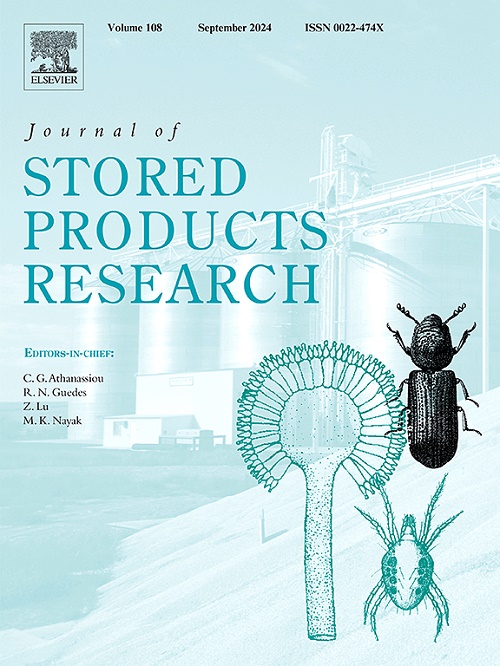
Abstract Image

刚果民主共和国Tshopo省谷物中昆虫、霉菌毒素积累和储存损失动态
谷物收获后损失仍然是热带地区粮食安全面临的主要挑战,但来自中非的数据很少。本研究调查了刚果民主共和国Tshopo省传统储藏条件下水稻(Oryza sativa L.)和玉米(Zea mays L.)的昆虫区系、霉菌毒素污染和储藏损失动态。在0、30和60天的储存中,在三个区域的9个储存地点对谷物进行取样。害虫鉴定采用形态学和分子方法,真菌毒素定量采用免疫层析法(UHPLC-MS /MS验证),粮食质量损失通过重量、水分、完整性和发芽测量进行评估。储粮害虫主要为玉米象、谷象霉和castaneum 3种害虫,占捕获昆虫总数的98%以上。玉米玉米球菌在两种作物中普遍存在,且密度较高,而玉米玉米球菌则表现出特定地点的侵染,特别是在水稻中。在这两种作物中都检测到黄曲霉毒素污染,并在玉米储存期间显著增加,在某些地区,60天后的黄曲霉毒素污染经常超过欧洲规定的限制。伏马菌素仅在玉米中检测到,浓度低但一致。谷物水分读数表明储存前霉菌毒素积累的风险很高,储存中黄曲霉毒素的额外生产尤其发生在水分水平最高的仓库中。粮食品质在储存期间恶化,干重、完整性和发芽能力显著下降,特别是在高虫害压力和霉菌毒素水平的地方。相关分析显示,昆虫丰度、霉菌毒素积累、粮食水分含量和粮食变质之间存在很强的相关性。研究结果表明,Tshopo省储藏水稻和玉米的收获后损失是由储藏害虫和真菌污染之间的协同相互作用驱动的。该研究为该地区提供了第一个全面的基线数据,并强调迫切需要改善储存管理,以减少食品安全风险和谷物损失。
本文章由计算机程序翻译,如有差异,请以英文原文为准。
求助全文
约1分钟内获得全文 求助全文
来源期刊
CiteScore
5.70
自引率
18.50%
发文量
112
审稿时长
45 days
期刊介绍: The Journal of Stored Products Research provides an international medium for the publication of both reviews and original results from laboratory and field studies on the preservation and safety of stored products, notably food stocks, covering storage-related problems from the producer through the supply chain to the consumer. Stored products are characterised by having relatively low moisture content and include raw and semi-processed foods, animal feedstuffs, and a range of other durable items, including materials such as clothing or museum artefacts.

×
引用
GB/T 7714-2015
复制
MLA
复制
APA
复制
导出至
BibTeX EndNote RefMan NoteFirst NoteExpress
×
提示
您的信息不完整,为了账户安全,请先补充。
现在去补充
×
提示
您因"违规操作"
具体请查看互助需知
我知道了
×
提示
确定
请完成安全验证×
copy
已复制链接
快去分享给好友吧!
我知道了
右上角分享
点击右上角分享
0
联系我们:info@booksci.cn Book学术提供免费学术资源搜索服务,方便国内外学者检索中英文文献。致力于提供最便捷和优质的服务体验。 Copyright © 2023 布克学术 All rights reserved.
京ICP备2023020795号-1
ghs 京公网安备 11010802042870号
Book学术文献互助
Book学术文献互助群
群 号:604180095
Book学术官方微信
小红书


