
Nano-fertilizers for climate-smart agriculture: resource efficiency across soil-plant-environment systems
Climate Smart Agriculture
Pub Date : 2026-05-01
Epub Date: 2026-04-24
DOI:10.1016/j.csag.2026.100115
引用次数: 0
Abstract
Climate change is intensifying constraints on agricultural productivity by amplifying nutrient losses, yield instability, and environmental degradation. Climate-smart agriculture (CSA) seeks to address these challenges by integrating productivity, resilience, and sustainability; however, conventional fertilizer practices remain inefficient and environmentally burdensome. Recent advances in nano-fertilizer technologies offer new opportunities to improve nutrient management within CSA frameworks. Nano-fertilizers enhance nutrient delivery through controlled release, improved uptake, and targeted translocation, leading to higher nutrient use efficiency, improved crop performance, and greater tolerance to abiotic stresses such as drought, salinity, and temperature extremes. At the soil scale, nano-enabled formulations influence nutrient retention, microbial activity, and biogeochemical cycling, while at the environmental scale, they reduce nutrient leaching and mitigate emissions of nitrous oxide and ammonia. At the same time, concerns related to environmental fate, ecotoxicological effects, and long-term nanoparticle accumulation highlight the need for cautious deployment. The emerging integration of nano-fertilizers with precision agriculture, digital sensing, and artificial intelligence further strengthens their potential for adaptive nutrient management under climate variability. Overall, nano-fertilizers represent a promising component of climate-smart nutrient strategies, provided that their adoption is supported by field-scale validation, environmentally sound design, and appropriate regulatory oversight.
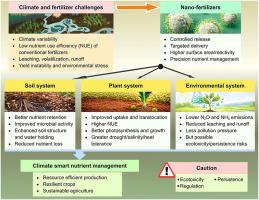
用于气候智能型农业的纳米肥料:土壤-植物-环境系统的资源效率
气候变化加剧了营养流失、产量不稳定和环境退化,从而加剧了对农业生产力的制约。气候智慧型农业(CSA)寻求通过整合生产力、复原力和可持续性来应对这些挑战;然而,传统的施肥方法仍然效率低下,而且对环境造成负担。纳米肥料技术的最新进展为改进CSA框架内的养分管理提供了新的机会。纳米肥料通过控制释放、改善吸收和定向转运来增强养分输送,从而提高养分利用效率,改善作物性能,并增强对干旱、盐和极端温度等非生物胁迫的耐受性。在土壤尺度上,纳米配方影响养分保留、微生物活动和生物地球化学循环,而在环境尺度上,它们减少养分淋失,减少氧化亚氮和氨的排放。与此同时,对环境命运、生态毒理学效应和纳米颗粒长期积累的担忧凸显了谨慎部署的必要性。纳米肥料与精准农业、数字传感和人工智能的新兴融合进一步增强了它们在气候变化下适应性养分管理的潜力。总的来说,纳米肥料代表了气候智能型营养战略的一个有希望的组成部分,前提是它们的采用得到实地规模验证、无害环境的设计和适当的监管监督的支持。
本文章由计算机程序翻译,如有差异,请以英文原文为准。
求助全文
约1分钟内获得全文
求助全文

 求助内容:
求助内容: 应助结果提醒方式:

 京公网安备 11010802042870号


