
Synergistic reinforcement of 38MnVS6 steel via soft–hard gradient laser cladding: Microstructural optimization and tribological behavior
IF 2.9
Q2 MATERIALS SCIENCE, MULTIDISCIPLINARY
引用次数: 0
Abstract
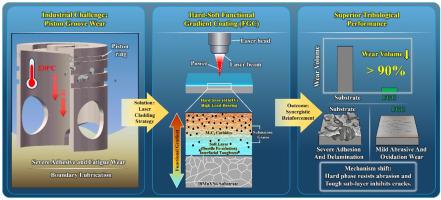
Severe adhesive and fatigue wear of steel piston top ring grooves under high-temperature, high-pressure, and boundary-lubricated conditions significantly compromise engine efficiency and durability. To address this, a novel Fe-based functionally graded coating (FGC) featuring a soft–hard architecture was fabricated on 38MnVS6 steel via laser cladding. This design aims to synergize high surface load-bearing capacity with superior interfacial toughness. Detailed microstructural characterization reveals a gradient transition from a Cr/C-rich hard layer, reinforced by M7C3 carbides and submicron grains (0.87-0.98 μm), to a ductile Fe-based solid-solution soft layer. The hard layer attains an average hardness of 616HV—approximately 2.3 times that of the substrate—effectively resisting plastic deformation. Under rigorous boundary lubrication tests at 230°C, the FGC demonstrates superior tribological stability, reducing the wear volume by more than one order of magnitude compared to the substrate. The dominant wear mechanism notably shifts from severe adhesion and delamination to mild abrasive and limited oxidative wear. These findings elucidate the crucial role of the gradient microstructure in suppressing high-temperature wear, providing an effective route for the surface strengthening and remanufacturing of critical engine components.
软硬梯度激光熔覆38MnVS6钢的协同强化:组织优化和摩擦学行为
在高温、高压和边界润滑条件下,钢制活塞顶环凹槽会发生严重的粘接和疲劳磨损,严重影响发动机的效率和耐用性。为了解决这一问题,采用激光熔覆的方法在38MnVS6钢上制备了一种具有软硬结构的新型铁基功能梯度涂层(FGC)。该设计旨在将高表面承载能力与优异的界面韧性相结合。详细的显微组织表征表明,从富含Cr/ c的硬层(由M7C3碳化物和亚微米晶粒(0.87-0.98 μm)增强)向具有韧性的铁基固溶体软层渐变。硬层的平均硬度达到616hv,约为基体硬度的2.3倍,有效地抵抗了塑性变形。在230°C的严格边界润滑测试中,FGC表现出优异的摩擦学稳定性,与基板相比,磨损量减少了一个数量级以上。主要磨损机制明显从严重的粘附和脱层转变为轻度磨粒和有限的氧化磨损。这些发现阐明了梯度组织在抑制高温磨损方面的重要作用,为发动机关键部件的表面强化和再制造提供了有效途径。
本文章由计算机程序翻译,如有差异,请以英文原文为准。
求助全文
约1分钟内获得全文
求助全文
来源期刊
Materialia
MATERIALS SCIENCE, MULTIDISCIPLINARY-
CiteScore
6.40
自引率
2.90%
发文量
345
审稿时长
36 days
期刊介绍:
Materialia is a multidisciplinary journal of materials science and engineering that publishes original peer-reviewed research articles. Articles in Materialia advance the understanding of the relationship between processing, structure, property, and function of materials.
Materialia publishes full-length research articles, review articles, and letters (short communications). In addition to receiving direct submissions, Materialia also accepts transfers from Acta Materialia, Inc. partner journals. Materialia offers authors the choice to publish on an open access model (with author fee), or on a subscription model (with no author fee).
 求助内容:
求助内容: 应助结果提醒方式:

 京公网安备 11010802042870号


