
Long-term agroforestry effects on soil CO2 and NO emissions in the Brazilian semiarid region
IF 2.5
3区 环境科学与生态学
Q2 ECOLOGY
Journal of Arid Environments
Pub Date : 2026-05-01
Epub Date: 2026-04-26
DOI:10.1016/j.jaridenv.2026.105622
引用次数: 0
Abstract
The Brazilian semi-arid region is highly vulnerable to climate change. This study evaluated greenhouse gas fluxes and soil properties under different land uses in this region. Agroforestry systems, agro-silvopastoral (AGSP) and silvopastoral (SILV), a traditional agricultural system (TR) characterized by slash-and-burn followed by fallow, and natural vegetation (NV) on Luvissolos were compared. C-CO2 and NO-N fluxes were measured during the rainy and dry seasons using static chambers coupled to a portable gas analyzer. The total organic carbon (C) and nitrogen contents of the soil were determined, as well as gravimetric moisture, soil density, and particle density, enabling the estimation of total porosity and water-filled pore space (WFPS). During the rainy season, all managed systems showed higher WFPS than NV. In the dry season, water retention decreased in TR. C-CO2 fluxes were higher in TR during the rainy season (51.33 mg m−2 h−1), while agroforestry systems and NV had the lowest emissions in both seasons. NO-N emissions were detected only during the rainy season, with higher values in NV (92.06 μg m−2 h−1). Agroforestry systems exhibited greater stratification and surface accumulation of C. The resilience index indicated that SILV had the greatest potential to restore C stocks at all depths, while AGSP showed lower resilience in deeper layers. In general, agroforestry systems, especially SILV, demonstrated greater potential to stabilize greenhouse gas fluxes and increase C storage in the soil. These systems can contribute to climate change mitigation and sustainable soil management in semi-arid environments.
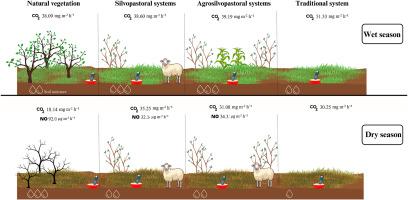
农林业对巴西半干旱区土壤CO2和NO排放的长期影响
巴西半干旱地区极易受到气候变化的影响。本研究评估了该地区不同土地利用方式下的温室气体通量和土壤性质。以农林业(AGSP)和以刀耕火种后休耕为特征的传统农业系统(SILV)为研究对象,比较了农林业系统(AGSP)和传统农林业系统(SILV)与自然植被(NV)的差异。在雨季和旱季,使用与便携式气体分析仪耦合的静态室测量了C-CO2和NO-N通量。测定土壤的总有机碳(C)和总氮含量,以及重量水分、土壤密度和颗粒密度,从而估算总孔隙度和充水孔隙空间(WFPS)。在雨季,所有管理系统的WFPS均高于NV。在旱季,TR的保水能力下降,而在雨季,TR的C-CO2通量较高(51.33 mg m−2 h−1),而农林业系统和NV在两个季节的排放最低。NO-N排放仅在雨季检测到,NV值较高(92.06 μg m−2 h−1)。复合农林业系统表现出更大的C层化和表层积累。恢复指数表明,SILV在所有深度恢复C储量的潜力最大,而AGSP在深层恢复能力较弱。总的来说,农林复合系统,特别是农林复合系统,在稳定温室气体通量和增加土壤中碳储存方面显示出更大的潜力。这些系统可以促进半干旱环境中的气候变化缓解和可持续土壤管理。
本文章由计算机程序翻译,如有差异,请以英文原文为准。
求助全文
约1分钟内获得全文
求助全文
来源期刊
Journal of Arid Environments
环境科学-环境科学
CiteScore
5.70
自引率
3.70%
发文量
144
审稿时长
55 days
期刊介绍:
The Journal of Arid Environments is an international journal publishing original scientific and technical research articles on physical, biological and cultural aspects of arid, semi-arid, and desert environments. As a forum of multi-disciplinary and interdisciplinary dialogue it addresses research on all aspects of arid environments and their past, present and future use.
 求助内容:
求助内容: 应助结果提醒方式:

 京公网安备 11010802042870号


