
Characteristics and factors influencing livelihood diversity in rural and nomadic communities in semi-arid environments

IF 2.5 3区 环境科学与生态学 Q2 ECOLOGY
Journal of Arid Environments Pub Date : 2026-05-01 Epub Date: 2026-04-29 DOI:10.1016/j.jaridenv.2026.105628
Abas Abdeshahi, Abbas Mirzaei, Hassan Azarm
{"title":"Characteristics and factors influencing livelihood diversity in rural and nomadic communities in semi-arid environments","authors":"Abas Abdeshahi,&nbsp;Abbas Mirzaei,&nbsp;Hassan Azarm","doi":"10.1016/j.jaridenv.2026.105628","DOIUrl":null,"url":null,"abstract":"<div><div>Livelihood diversity is beneficial for reducing economic and environmental risks while enhancing livelihood sustainability and promoting sustainable development in semi-arid regions. This study employs a framework to conduct a comparative analysis of the characteristics and factors determining diversity among three types of households: farmers, nomadic herders, and sedentary herders. A random sample of 359 households in rural and nomadic areas of Mamasani County in Iran was selected using a multi-stage random sampling method. Data were analyzed using descriptive statistics and advanced statistical techniques. The results indicated that agricultural crop production and livestock keeping constitute the greatest share of income for all three household groups. Additionally, farming households exhibit a higher level of livelihood diversity compared to the other two household types. The ordered logit analysis results showed that variables related to labor capacity and income are positively correlated with the number of livelihood activities across all three household types. However, the number of livestock has a significant negative effect on household livelihood diversity. Furthermore, the size of agricultural land reduces the number of livelihood activities for nomadic herder households. The study recommends prioritizing the enhancement of labor capacity and creating non-agricultural job opportunities that are less dependent on natural resources.</div></div>","PeriodicalId":51080,"journal":{"name":"Journal of Arid Environments","volume":"235 ","pages":"Article 105628"},"PeriodicalIF":2.5000,"publicationDate":"2026-05-01","publicationTypes":"Journal Article","fieldsOfStudy":null,"isOpenAccess":false,"openAccessPdf":"","citationCount":"0","resultStr":null,"platform":"Semanticscholar","paperid":null,"PeriodicalName":"Journal of Arid Environments","FirstCategoryId":"93","ListUrlMain":"https://www.sciencedirect.com/science/article/pii/S0140196326000807","RegionNum":3,"RegionCategory":"环境科学与生态学","ArticlePicture":[],"TitleCN":null,"AbstractTextCN":null,"PMCID":null,"EPubDate":"2026/4/29 0:00:00","PubModel":"Epub","JCR":"Q2","JCRName":"ECOLOGY","Score":null,"Total":0}
引用次数: 0

Abstract

Livelihood diversity is beneficial for reducing economic and environmental risks while enhancing livelihood sustainability and promoting sustainable development in semi-arid regions. This study employs a framework to conduct a comparative analysis of the characteristics and factors determining diversity among three types of households: farmers, nomadic herders, and sedentary herders. A random sample of 359 households in rural and nomadic areas of Mamasani County in Iran was selected using a multi-stage random sampling method. Data were analyzed using descriptive statistics and advanced statistical techniques. The results indicated that agricultural crop production and livestock keeping constitute the greatest share of income for all three household groups. Additionally, farming households exhibit a higher level of livelihood diversity compared to the other two household types. The ordered logit analysis results showed that variables related to labor capacity and income are positively correlated with the number of livelihood activities across all three household types. However, the number of livestock has a significant negative effect on household livelihood diversity. Furthermore, the size of agricultural land reduces the number of livelihood activities for nomadic herder households. The study recommends prioritizing the enhancement of labor capacity and creating non-agricultural job opportunities that are less dependent on natural resources.
半干旱环境下农村和游牧社区生计多样性特征及影响因素
在半干旱区,生计多样性有利于减少经济和环境风险,提高生计可持续性,促进可持续发展。本研究采用一个框架对农户、游牧民和定居牧民三种家庭类型的特征和决定多样性的因素进行了比较分析。采用多阶段随机抽样方法,对伊朗马马萨尼县农村和游牧地区的359户家庭进行随机抽样。数据分析使用描述性统计和先进的统计技术。结果表明,农业作物生产和牲畜饲养在所有三个家庭群体的收入中所占比例最大。此外,与其他两种家庭类型相比,农户表现出更高水平的生计多样性。有序logit分析结果显示,劳动能力和收入相关变量与三种家庭类型的生计活动数量呈正相关。然而,牲畜数量对家庭生计多样性有显著的负面影响。此外,农业用地的规模减少了游牧民家庭的生计活动数量。该研究建议优先提高劳动力能力,创造对自然资源依赖程度较低的非农业就业机会。
本文章由计算机程序翻译,如有差异,请以英文原文为准。
求助全文
约1分钟内获得全文 求助全文
来源期刊
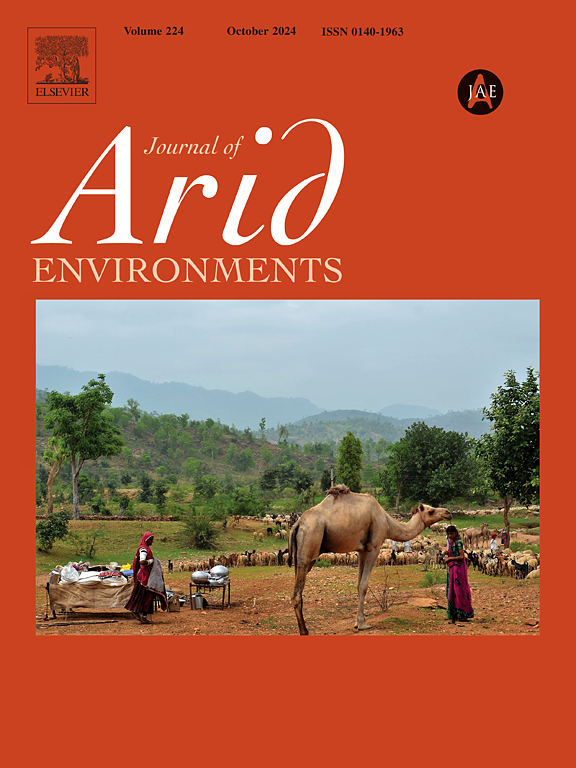
Journal of Arid Environments
Journal of Arid Environments 环境科学-环境科学
CiteScore
5.70
自引率
3.70%
发文量
144
审稿时长
55 days
期刊介绍: The Journal of Arid Environments is an international journal publishing original scientific and technical research articles on physical, biological and cultural aspects of arid, semi-arid, and desert environments. As a forum of multi-disciplinary and interdisciplinary dialogue it addresses research on all aspects of arid environments and their past, present and future use.

×
引用
GB/T 7714-2015
复制
MLA
复制
APA
复制
导出至
BibTeX EndNote RefMan NoteFirst NoteExpress
×
提示
您的信息不完整,为了账户安全,请先补充。
现在去补充
×
提示
您因"违规操作"
具体请查看互助需知
我知道了
×
提示
确定
请完成安全验证×
copy
已复制链接
快去分享给好友吧!
我知道了
右上角分享
点击右上角分享
0
联系我们:info@booksci.cn Book学术提供免费学术资源搜索服务,方便国内外学者检索中英文文献。致力于提供最便捷和优质的服务体验。 Copyright © 2023 布克学术 All rights reserved.
京ICP备2023020795号-1
ghs 京公网安备 11010802042870号
Book学术文献互助
Book学术文献互助群
群 号:604180095
Book学术官方微信
小红书


