{"title":"Marine alga-mediated facile green synthesis of highly stable antibacterial ZnS quantum dots: a selective fluorescent sensor for heavy metal ions","authors":"Debasish Borah, Puja Saikia, Jayashree Rout, Debika Gogoi, Ankita Das, Narendra Nath Ghosh, Piyush Pandey, Chira R. Bhattacharjee","doi":"10.1007/s10853-026-12699-8","DOIUrl":null,"url":null,"abstract":"<div><p>Contamination of water by heavy metals poses a serious and persistent threat to both the environment and human health, thereby intensifying the demand for the development of a more precise and efficient system for detecting heavy metals. Herein, we report a facile, simple, cost-effective, and environmentally friendly method for the fabrication of ZnS quantum dots (QDs) and their application as a rapid fluorometric detection of Hg(II) in aqueous samples. The as-synthesized material is systematically characterized using different spectroscopic and microscopic techniques. XRD analysis revealed the formation of a cubic sphalerite crystal structure, whereas the FTIR spectra confirmed the presence of distinctive functional groups on the as-synthesized nanomaterial. The observed energy band gap of ~ 3.88 eV clearly signified a pronounced blue shift compared to bulk ZnS, consistent with enhanced quantum confinement effects. The as-synthesized material exhibited excellent fluorescence sensing performance for the detection of heavy metal Hg(II) ions in aqueous media with a detection limit of 1.38 nM, with high sensitivity and selectivity. The reported probe can be used for nanomolar-level fluorometric detection of Hg(II). Moreover, the green-synthesized ZnS QDs show promise as a low-dimensional biomaterial, exhibiting significant efficacy against selective pathogenic bacterial strains.</p><h3>Graphical abstract</h3>\n<div><figure><div><div><picture><source><img></source></picture><span>The alternative text for this image may have been generated using AI.</span></div></div></figure></div></div>","PeriodicalId":645,"journal":{"name":"Journal of Materials Science","volume":"61 22","pages":"15557 - 15575"},"PeriodicalIF":3.9000,"publicationDate":"2026-04-13","publicationTypes":"Journal Article","fieldsOfStudy":null,"isOpenAccess":false,"openAccessPdf":"","citationCount":"0","resultStr":null,"platform":"Semanticscholar","paperid":null,"PeriodicalName":"Journal of Materials Science","FirstCategoryId":"88","ListUrlMain":"https://link.springer.com/article/10.1007/s10853-026-12699-8","RegionNum":3,"RegionCategory":"材料科学","ArticlePicture":[],"TitleCN":null,"AbstractTextCN":null,"PMCID":null,"EPubDate":"","PubModel":"","JCR":"Q2","JCRName":"MATERIALS SCIENCE, MULTIDISCIPLINARY","Score":null,"Total":0}
引用次数: 0
Abstract
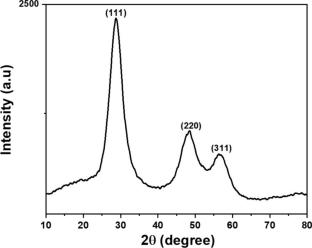
Contamination of water by heavy metals poses a serious and persistent threat to both the environment and human health, thereby intensifying the demand for the development of a more precise and efficient system for detecting heavy metals. Herein, we report a facile, simple, cost-effective, and environmentally friendly method for the fabrication of ZnS quantum dots (QDs) and their application as a rapid fluorometric detection of Hg(II) in aqueous samples. The as-synthesized material is systematically characterized using different spectroscopic and microscopic techniques. XRD analysis revealed the formation of a cubic sphalerite crystal structure, whereas the FTIR spectra confirmed the presence of distinctive functional groups on the as-synthesized nanomaterial. The observed energy band gap of ~ 3.88 eV clearly signified a pronounced blue shift compared to bulk ZnS, consistent with enhanced quantum confinement effects. The as-synthesized material exhibited excellent fluorescence sensing performance for the detection of heavy metal Hg(II) ions in aqueous media with a detection limit of 1.38 nM, with high sensitivity and selectivity. The reported probe can be used for nanomolar-level fluorometric detection of Hg(II). Moreover, the green-synthesized ZnS QDs show promise as a low-dimensional biomaterial, exhibiting significant efficacy against selective pathogenic bacterial strains.
Graphical abstract
The alternative text for this image may have been generated using AI.
期刊介绍:
The Journal of Materials Science publishes reviews, full-length papers, and short Communications recording original research results on, or techniques for studying the relationship between structure, properties, and uses of materials. The subjects are seen from international and interdisciplinary perspectives covering areas including metals, ceramics, glasses, polymers, electrical materials, composite materials, fibers, nanostructured materials, nanocomposites, and biological and biomedical materials. The Journal of Materials Science is now firmly established as the leading source of primary communication for scientists investigating the structure and properties of all engineering materials.

 求助内容:
求助内容: 应助结果提醒方式:

 京公网安备 11010802042870号


