
Biochar–Hydrogel composites as multifunctional materials for environmental remediation and circular resource recovery
IF 7.7
Q2 ENGINEERING, ENVIRONMENTAL
Journal of hazardous materials advances
Pub Date : 2026-05-01
Epub Date: 2026-04-13
DOI:10.1016/j.hazadv.2026.101169
引用次数: 0
Abstract
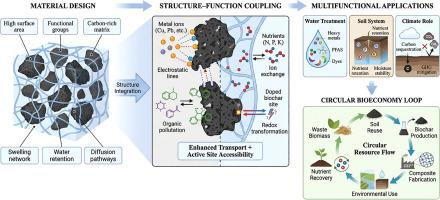
Soil degradation, water contamination, nutrient depletion, and climate change are interlinked global challenges that demand multifunctional, sustainable solutions. Conventional remediation methods such as activated carbon adsorption, coagulation–flocculation, and advanced oxidation are often costly, energy-intensive, and limited in scalability. Biochar–hydrogel (BC–HG) composites have recently emerged as promising materials that integrate the high porosity, surface functionality, and carbon sequestration potential of biochar with the water-retention and controlled-release properties of hydrogels. This review critically synthesizes advances in BC–HG research by linking substrate choice, synthesis techniques, and physicochemical characterization with performance outcomes across environmental and agricultural applications. This review further highlights how synthesis-driven composite architecture governs dominant adsorption pathways, enabling design-oriented optimization beyond model-based interpretation. Mechanistic insights from adsorption kinetics, isotherm modeling, and thermodynamics are integrated to explain the composites’ ability to remove heavy metals, dyes, pharmaceuticals, and emerging contaminants, while simultaneously supporting nutrient recovery, soil fertility, drought resilience, and greenhouse gas reduction. Compared to standalone biochar or hydrogels, BC–HGs exhibit enhanced mechanical stability, swelling behavior, and pollutant affinity, positioning them as multifunctional platforms for remediation and sustainable resource use. However, challenges remain in scaling up synthesis, improving regeneration efficiency, ensuring stability under real-matrix conditions with competing ions and natural organic matter, and addressing risks from waste-derived feedstocks. Framing BC–HGs within the circular bioeconomy this review highlights their potential to valorize waste resources, recycle nutrients, and contribute to carbon management.
生物炭-水凝胶复合材料作为环境修复和循环资源回收的多功能材料
土壤退化、水污染、养分枯竭和气候变化是相互关联的全球挑战,需要多功能、可持续的解决方案。传统的修复方法,如活性炭吸附、混凝-絮凝和高级氧化,往往是昂贵的,能源密集型的,并且在可扩展性有限。生物炭-水凝胶(BC-HG)复合材料最近成为一种很有前途的材料,它将生物炭的高孔隙率、表面功能性、碳固存潜力与水凝胶的保水和控释特性结合在一起。本文通过将底物选择、合成技术、物理化学表征与环境和农业应用的性能结果联系起来,批判性地综合了BC-HG研究的进展。这篇综述进一步强调了合成驱动的复合结构如何控制主要的吸附途径,使设计导向的优化超越了基于模型的解释。从吸附动力学、等温线模型和热力学的机理分析,可以解释复合材料去除重金属、染料、药物和新出现的污染物的能力,同时支持养分恢复、土壤肥力、抗旱能力和温室气体减排。与独立的生物炭或水凝胶相比,bc - hg表现出更强的机械稳定性、溶胀性和污染物亲和力,使其成为修复和可持续资源利用的多功能平台。然而,在扩大合成规模、提高再生效率、确保在真实基质条件下与竞争离子和天然有机物的稳定性以及应对来自废物来源的原料的风险方面,挑战仍然存在。在循环生物经济框架下,本综述强调了BC-HGs在废物资源增值、营养物质回收和碳管理方面的潜力。
本文章由计算机程序翻译,如有差异,请以英文原文为准。
求助全文
约1分钟内获得全文
求助全文
来源期刊

Journal of hazardous materials advances
Environmental Engineering
CiteScore
4.80
自引率
0.00%
发文量
0
审稿时长
50 days
 求助内容:
求助内容: 应助结果提醒方式:

 京公网安备 11010802042870号


