
Technical note: Using static chambers with large footprints to reduce variability in measurements of greenhouse gases from uneven surfaces
IF 3.4
Q2 ENVIRONMENTAL SCIENCES
Atmospheric Environment: X
Pub Date : 2026-04-01
Epub Date: 2026-04-22
DOI:10.1016/j.aeaoa.2026.100455
引用次数: 0
Abstract
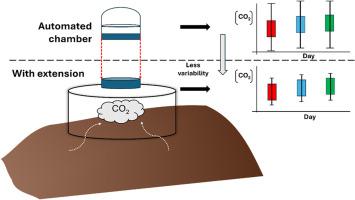
A large-volume static chamber was developed and field-tested as an extension for a semi-automated flux chamber to measure greenhouse gas emissions (GHGs) from uneven compost surfaces. Conventional chambers often have a small footprint (<0.1 m2), limiting accuracy on heterogeneous piles. The chamber extension has a volume of 0.156 m3 and a footprint of 0.385 m2 compared with 0.004 m3 and 0.032 m2 (volume and area of the commercial chamber). It includes four adjustable rods to measure headspace height, four lateral flanges to help press the chamber extension into the compost surface, a mixing fan, and a T-fitting on the sample line for manual gas sampling. Its performance was evaluated against the original semi-automated flux chamber using a paired t-test on CO2 and CH4 fluxes from municipal windrows and stockpiles of uncomposted material. The CH4 and CO2 fluxes measured by the two systems were statistically similar (P > 0.05) on the windrow and stockpile. However, the modified chamber exhibited lower variability, with overall coefficients of variation (CV) for CO2 flux at the peak of the windrow of 41.9% compared to 45.8% for the commercial chamber, while for CH4 flux the CV was 84.1% versus 132.7%, respectively. For stockpiles, the CV for CO2 flux was 64.4% for the modified chamber and 80.6% for the commercial chamber, while for CH4 flux, the CV was 126.4% versus 162.6%, respectively. These results demonstrate that a chamber extension with a larger footprint facilitates accurate and more stable measurements of GHGs from uneven surfaces such as compost windrows.
技术说明:使用大占地面积的静态室来减少来自不均匀表面的温室气体测量的可变性
开发并现场测试了大容量静态室,作为半自动通量室的扩展,用于测量不均匀堆肥表面的温室气体排放(ghg)。传统的室通常占地面积小(0.1 m2),限制了非均质桩的精度。扩建后的商会体积为0.156 m3,占地面积为0.385 m2,而商业商会的体积和面积分别为0.004 m3和0.032 m2。它包括四个可调节杆,测量顶空高度,四个侧法兰,以帮助压室延伸到堆肥表面,一个混合风扇,和一个t型配件在样品线上的手动气体采样。通过对来自市政窗口和未堆肥材料库存的CO2和CH4通量的配对t检验,对其性能与原始的半自动通量室进行了评估。两种系统测量的CH4和CO2通量在窗口和库存上具有统计学上的相似性(P > 0.05)。然而,改进后的试验室表现出较低的变异性,其窗口峰值CO2通量的总变异系数(CV)为41.9%,商用试验室为45.8%;CH4通量的CV为84.1%,商用试验室为132.7%。对库存而言,改进室CO2通量的CV值为64.4%,商用室为80.6%,CH4通量的CV值为126.4%,商用室为162.6%。这些结果表明,具有更大足迹的室扩展有助于准确和更稳定地测量来自不均匀表面(如堆肥窗)的温室气体。
本文章由计算机程序翻译,如有差异,请以英文原文为准。
求助全文
约1分钟内获得全文
求助全文
来源期刊
Atmospheric Environment: X
Environmental Science-Environmental Science (all)
CiteScore
8.00
自引率
0.00%
发文量
47
审稿时长
12 weeks
 求助内容:
求助内容: 应助结果提醒方式:

 京公网安备 11010802042870号


