{"title":"Analytical quality by design (AQbD) approach for the simultaneous quantification of FDC in a cardiovascular drug by RP-HPLC method","authors":"Varsha Thorat, Sudhakar Alave, Vijay Bagul","doi":"10.1186/s43094-026-00985-w","DOIUrl":null,"url":null,"abstract":"<div><h3>Background</h3><p>A sustainable and stability-indicating reversed-phase high-pressure liquid chromatography (RP-HPLC) method has been developed for the simultaneous estimation of chlorthalidone (CHL), Amlodipine (AML), and olmesartan medoxomil (OLM) in a combined cardiovascular dosage form by implementing an Analytical Quality by Design (AQbD) approach.</p><h3>Methods</h3><p>The RP-HPLC system employed a Sunniest C18 column (150 mm × 4.6 mm, 5.0 μm). The mobile phase consisted of 0.1% triethylamine in water (pH 2.4) and ethanol in a ratio of (65:35 v/v). At a flow rate of 1.5 mL/min. Detection was carried out at 245 nm using a photodiode array detector. Method optimization was performed using a Central composite design (CCD) under the AQbD framework. Forced degradation studies were conducted under acid, base, oxidative, thermal, and photolytic conditions to assess the method’s stability-indicating capability.</p><h3>Results</h3><p>The method showed good linearity in the 50–150% of test concentration with correlation coefficients (r<sup>2</sup>) exceeding 0.99 for all analytes. The method precision was found 98.9% for CHL and 101.4% for both AML and OLM. Forced degradation studies confirmed the method’s ability to resolve the active pharmaceutical ingredients from their degradation products. Well-separated, spectrally pure peaks were obtained for all analytes under all stress conditions, as confirmed by peak purity values greater than 0.950, indicating no interference from degradation products. The method demonstrated accuracy, precision, specificity, robustness as per the International Conference on Harmonization guidelines. Environmental sustainability was evaluated with GAPI (77), AMGS123, AGREEprep (0.69), and AGREE (0.81) scores, confirming its eco-friendly nature.</p><h3>Conclusions</h3><p>The integrated approach reduced solvent consumption, waste generation, and energy usage, supporting sustainable analysis. The method, validated as per ICH Q2(R2) guidelines, exhibited excellent linearity, precision, accuracy, specificity, robustness, and ruggedness. Forced degradation studies confirmed its stability-indicating capability. The present study highlights the need for incorporating antioxidants and implementing precautions against acidic and alkaline degradation, along with adopting proper packaging and storage strategies to enhance the stability of CHL, OLM, and AML in formulations prone to degradation..</p><h3>Graphical abstract</h3><div><figure><div><div><picture><source><img></source></picture><span>The alternative text for this image may have been generated using AI.</span></div></div></figure></div></div>","PeriodicalId":577,"journal":{"name":"Future Journal of Pharmaceutical Sciences","volume":"12 1","pages":""},"PeriodicalIF":3.0000,"publicationDate":"2026-04-28","publicationTypes":"Journal Article","fieldsOfStudy":null,"isOpenAccess":false,"openAccessPdf":"https://link.springer.com/content/pdf/10.1186/s43094-026-00985-w.pdf","citationCount":"0","resultStr":null,"platform":"Semanticscholar","paperid":null,"PeriodicalName":"Future Journal of Pharmaceutical Sciences","FirstCategoryId":"1085","ListUrlMain":"https://link.springer.com/article/10.1186/s43094-026-00985-w","RegionNum":0,"RegionCategory":null,"ArticlePicture":[],"TitleCN":null,"AbstractTextCN":null,"PMCID":null,"EPubDate":"","PubModel":"","JCR":"Q2","JCRName":"PHARMACOLOGY & PHARMACY","Score":null,"Total":0}
引用次数: 0
Abstract
Background
A sustainable and stability-indicating reversed-phase high-pressure liquid chromatography (RP-HPLC) method has been developed for the simultaneous estimation of chlorthalidone (CHL), Amlodipine (AML), and olmesartan medoxomil (OLM) in a combined cardiovascular dosage form by implementing an Analytical Quality by Design (AQbD) approach.
Methods
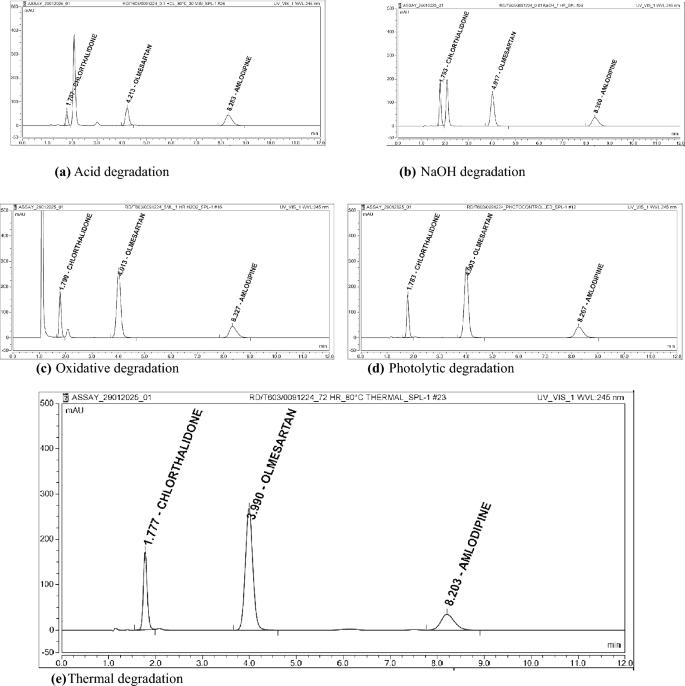
The RP-HPLC system employed a Sunniest C18 column (150 mm × 4.6 mm, 5.0 μm). The mobile phase consisted of 0.1% triethylamine in water (pH 2.4) and ethanol in a ratio of (65:35 v/v). At a flow rate of 1.5 mL/min. Detection was carried out at 245 nm using a photodiode array detector. Method optimization was performed using a Central composite design (CCD) under the AQbD framework. Forced degradation studies were conducted under acid, base, oxidative, thermal, and photolytic conditions to assess the method’s stability-indicating capability.
Results
The method showed good linearity in the 50–150% of test concentration with correlation coefficients (r2) exceeding 0.99 for all analytes. The method precision was found 98.9% for CHL and 101.4% for both AML and OLM. Forced degradation studies confirmed the method’s ability to resolve the active pharmaceutical ingredients from their degradation products. Well-separated, spectrally pure peaks were obtained for all analytes under all stress conditions, as confirmed by peak purity values greater than 0.950, indicating no interference from degradation products. The method demonstrated accuracy, precision, specificity, robustness as per the International Conference on Harmonization guidelines. Environmental sustainability was evaluated with GAPI (77), AMGS123, AGREEprep (0.69), and AGREE (0.81) scores, confirming its eco-friendly nature.
Conclusions
The integrated approach reduced solvent consumption, waste generation, and energy usage, supporting sustainable analysis. The method, validated as per ICH Q2(R2) guidelines, exhibited excellent linearity, precision, accuracy, specificity, robustness, and ruggedness. Forced degradation studies confirmed its stability-indicating capability. The present study highlights the need for incorporating antioxidants and implementing precautions against acidic and alkaline degradation, along with adopting proper packaging and storage strategies to enhance the stability of CHL, OLM, and AML in formulations prone to degradation..
Graphical abstract
The alternative text for this image may have been generated using AI.
期刊介绍:
Future Journal of Pharmaceutical Sciences (FJPS) is the official journal of the Future University in Egypt. It is a peer-reviewed, open access journal which publishes original research articles, review articles and case studies on all aspects of pharmaceutical sciences and technologies, pharmacy practice and related clinical aspects, and pharmacy education. The journal publishes articles covering developments in drug absorption and metabolism, pharmacokinetics and dynamics, drug delivery systems, drug targeting and nano-technology. It also covers development of new systems, methods and techniques in pharmacy education and practice. The scope of the journal also extends to cover advancements in toxicology, cell and molecular biology, biomedical research, clinical and pharmaceutical microbiology, pharmaceutical biotechnology, medicinal chemistry, phytochemistry and nutraceuticals.

 求助内容:
求助内容: 应助结果提醒方式:

 京公网安备 11010802042870号


