Erica E Zeno, Prabda Praphasiri, Wichan Bhunyakitikorn, Sutthichai Nakphook, Darunee Ditsungnoen, Wuttiphong Phakdeekul, Passakorn Ongarj, Ratchadaporn Ungcharoen, Warinmad Kedthongma, Seesai Yeesoonsang, Kanlaya Sornwong, Chaninan Sonthichai, Anna N Chard, William W Davis, Martha P Montgomery, Kriengkrai Prasert
{"title":"Validity of influenza vaccine effectiveness calculations using a test-negative design in Thailand.","authors":"Erica E Zeno, Prabda Praphasiri, Wichan Bhunyakitikorn, Sutthichai Nakphook, Darunee Ditsungnoen, Wuttiphong Phakdeekul, Passakorn Ongarj, Ratchadaporn Ungcharoen, Warinmad Kedthongma, Seesai Yeesoonsang, Kanlaya Sornwong, Chaninan Sonthichai, Anna N Chard, William W Davis, Martha P Montgomery, Kriengkrai Prasert","doi":"10.1093/aje/kwag094","DOIUrl":null,"url":null,"abstract":"<p><p>Thailand uses a test-negative design to calculate influenza vaccine effectiveness (VE) annually for the Southern Hemisphere formulation and shares estimates with the World Health Organization to inform global vaccine strain selection. This study analyzed potential misclassification and confounding factors to evaluate validity of the test-negative design in Thailand. We retrospectively reviewed influenza sentinel surveillance data from June 2023 to May 2024 and gathered information on vaccination history and health-seeking behavior. Cases were medically attended illnesses with positive influenza test results; noncases had negative results for influenza and SARS-CoV-2. We compared VE using the routine approach with six scenarios, representing four potential threats to the validity of test-negative design studies. We assessed exposure (vaccination) misclassification, outcome (influenza) misclassification, and confounding by health-seeking behavior. Unmeasured confounding was evaluated by calculating VE against rhinovirus, an outcome unrelated to influenza vaccination. A total of 4709 patients were included, of which 328 (7.0%) were vaccinated against influenza. Under the routine approach, VE against medically attended influenza was 36.9% (95% CI, 13.5%-53.9%). In alternative scenarios, VE ranged from 32.4% to 42.8%, with overlapping 95% CIs. These findings support the validity of Thailand's VE estimates and can inform improvements in surveillance procedures.</p>","PeriodicalId":7472,"journal":{"name":"American journal of epidemiology","volume":" ","pages":"2423-2429"},"PeriodicalIF":4.1000,"publicationDate":"2026-09-03","publicationTypes":"Journal Article","fieldsOfStudy":null,"isOpenAccess":false,"openAccessPdf":"https://www.ncbi.nlm.nih.gov/pmc/articles/PMC13537842/pdf/","citationCount":"0","resultStr":null,"platform":"Semanticscholar","paperid":null,"PeriodicalName":"American journal of epidemiology","FirstCategoryId":"3","ListUrlMain":"https://doi.org/10.1093/aje/kwag094","RegionNum":2,"RegionCategory":"医学","ArticlePicture":[],"TitleCN":null,"AbstractTextCN":null,"PMCID":null,"EPubDate":"","PubModel":"","JCR":"Q1","JCRName":"PUBLIC, ENVIRONMENTAL & OCCUPATIONAL HEALTH","Score":null,"Total":0}
引用次数: 0
Abstract
Thailand uses a test-negative design to calculate influenza vaccine effectiveness (VE) annually for the Southern Hemisphere formulation and shares estimates with the World Health Organization to inform global vaccine strain selection. This study analyzed potential misclassification and confounding factors to evaluate validity of the test-negative design in Thailand. We retrospectively reviewed influenza sentinel surveillance data from June 2023 to May 2024 and gathered information on vaccination history and health-seeking behavior. Cases were medically attended illnesses with positive influenza test results; noncases had negative results for influenza and SARS-CoV-2. We compared VE using the routine approach with six scenarios, representing four potential threats to the validity of test-negative design studies. We assessed exposure (vaccination) misclassification, outcome (influenza) misclassification, and confounding by health-seeking behavior. Unmeasured confounding was evaluated by calculating VE against rhinovirus, an outcome unrelated to influenza vaccination. A total of 4709 patients were included, of which 328 (7.0%) were vaccinated against influenza. Under the routine approach, VE against medically attended influenza was 36.9% (95% CI, 13.5%-53.9%). In alternative scenarios, VE ranged from 32.4% to 42.8%, with overlapping 95% CIs. These findings support the validity of Thailand's VE estimates and can inform improvements in surveillance procedures.
期刊介绍:
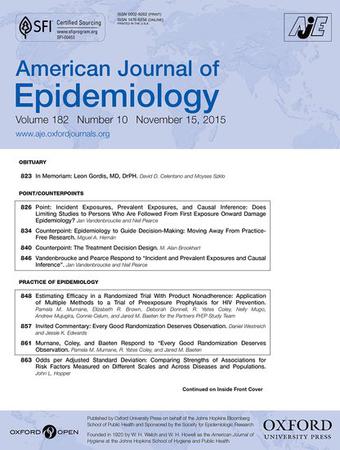
The American Journal of Epidemiology is the oldest and one of the premier epidemiologic journals devoted to the publication of empirical research findings, opinion pieces, and methodological developments in the field of epidemiologic research.
It is a peer-reviewed journal aimed at both fellow epidemiologists and those who use epidemiologic data, including public health workers and clinicians.

 求助内容:
 应助结果提醒方式:


 京公网安备 11010802042870号


