Sofia L Panasiuk, Laura C Rosella, Elizabeth Page-Gould, Felix Cheung
{"title":"The link between life satisfaction and outcome-wide health: evidence from the Canadian Longitudinal Study on Aging.","authors":"Sofia L Panasiuk, Laura C Rosella, Elizabeth Page-Gould, Felix Cheung","doi":"10.1093/aje/kwag088","DOIUrl":null,"url":null,"abstract":"<p><p>A promising avenue for improving physical health and reducing health risks in older adulthood is intervening on transdiagnostic protective factors-those that form the mechanisms of several diseases. A potential candidate for a transdiagnostic protective factor is subjective well-being (SWB). Despite accumulating evidence favoring SWB as a protective factor, individual studies tend to neglect the cumulative effect of publication bias, explicitly specifying a causal model, and the possibility of alternative causal models that guide the selection of confounders. Using 3 waves of longitudinal data from the Canadian Longitudinal Study on Aging with a sample of 51 338 older adults, we tested whether the relationships between life satisfaction and 23 health outcomes (e.g., cancer, arthritis, asthma) were robust to alternative causal model specifications. An increase in life satisfaction, according to the preferred causal model, predicted a 3%-31% reduction in the risk of diagnosis for several health outcomes 3 years later-including osteoarthritis, movement disorders, and respiratory tract diseases-and predicted greater self-rated general health. Importantly, these effects persisted under different causal model specifications. These results suggest that life satisfaction is prospectively linked to multiple positive health outcomes and demonstrate the value of an analytical framework that acknowledges the uncertainty inherent in confounder selection.</p>","PeriodicalId":7472,"journal":{"name":"American journal of epidemiology","volume":" ","pages":"2528-2536"},"PeriodicalIF":4.1000,"publicationDate":"2026-10-07","publicationTypes":"Journal Article","fieldsOfStudy":null,"isOpenAccess":false,"openAccessPdf":"https://www.ncbi.nlm.nih.gov/pmc/articles/PMC13642370/pdf/","citationCount":"0","resultStr":null,"platform":"Semanticscholar","paperid":null,"PeriodicalName":"American journal of epidemiology","FirstCategoryId":"3","ListUrlMain":"https://doi.org/10.1093/aje/kwag088","RegionNum":2,"RegionCategory":"医学","ArticlePicture":[],"TitleCN":null,"AbstractTextCN":null,"PMCID":null,"EPubDate":"","PubModel":"","JCR":"Q1","JCRName":"PUBLIC, ENVIRONMENTAL & OCCUPATIONAL HEALTH","Score":null,"Total":0}
引用次数: 0
Abstract
A promising avenue for improving physical health and reducing health risks in older adulthood is intervening on transdiagnostic protective factors-those that form the mechanisms of several diseases. A potential candidate for a transdiagnostic protective factor is subjective well-being (SWB). Despite accumulating evidence favoring SWB as a protective factor, individual studies tend to neglect the cumulative effect of publication bias, explicitly specifying a causal model, and the possibility of alternative causal models that guide the selection of confounders. Using 3 waves of longitudinal data from the Canadian Longitudinal Study on Aging with a sample of 51 338 older adults, we tested whether the relationships between life satisfaction and 23 health outcomes (e.g., cancer, arthritis, asthma) were robust to alternative causal model specifications. An increase in life satisfaction, according to the preferred causal model, predicted a 3%-31% reduction in the risk of diagnosis for several health outcomes 3 years later-including osteoarthritis, movement disorders, and respiratory tract diseases-and predicted greater self-rated general health. Importantly, these effects persisted under different causal model specifications. These results suggest that life satisfaction is prospectively linked to multiple positive health outcomes and demonstrate the value of an analytical framework that acknowledges the uncertainty inherent in confounder selection.
改善老年人身体健康和降低健康风险的一个有希望的途径是干预跨诊断保护因素——那些形成几种疾病机制的因素。一个潜在的跨诊断保护因素是主观幸福感(SWB)。尽管越来越多的证据表明主观幸福感是一种保护因素,但个别研究往往忽视了发表偏倚的累积效应,明确指定因果模型,以及指导混杂因素选择的替代因果模型的可能性。利用加拿大老龄化纵向研究(Canadian longitudinal Study of Aging)的三波纵向数据,我们测试了生活满意度与23种健康结果(如癌症、关节炎、哮喘)之间的关系是否对其他因果模型规范具有稳健性。在首选因果模型下,生活满意度增加一个标准差,预示着三年后几种健康结果的诊断风险降低3-31%,包括骨关节炎、运动障碍和呼吸道疾病,并预示着更高的自我评价一般健康状况。重要的是,在不同的因果模型规范下,效果仍然存在。这些结果表明,生活满意度与多种积极的健康结果具有前瞻性联系,并证明了承认混杂因素选择中固有不确定性的分析框架的价值。
期刊介绍:
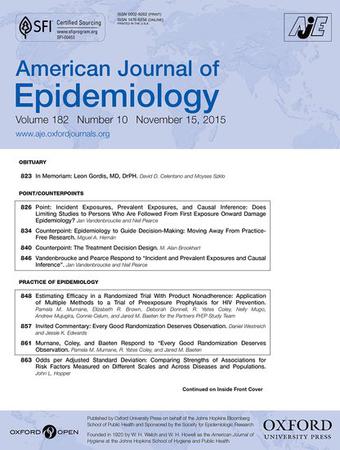
The American Journal of Epidemiology is the oldest and one of the premier epidemiologic journals devoted to the publication of empirical research findings, opinion pieces, and methodological developments in the field of epidemiologic research.
It is a peer-reviewed journal aimed at both fellow epidemiologists and those who use epidemiologic data, including public health workers and clinicians.

 求助内容:
 应助结果提醒方式:


 京公网安备 11010802042870号


