Sua Kim, Suhyeok Kim, Danbi Shin, Nalin Medagoda, Kyeong-Jun Lee
{"title":"Physiological and Metabolic Responses to Graded Dietary Biotin Supplementation in Juvenile Penaeus vannamei","authors":"Sua Kim, Suhyeok Kim, Danbi Shin, Nalin Medagoda, Kyeong-Jun Lee","doi":"10.1007/s10126-026-10615-4","DOIUrl":null,"url":null,"abstract":"<div>\n \n <p>Biotin serves as a coenzyme in carboxylation reactions and plays a fundamental role in supporting growth, nutrient metabolism and overall physiological function in aquatic animals. This study investigated the biochemical and metabolic responses of graded dietary biotin in <i>Penaeus vannamei</i>. Five experimental diets were prepared with graded biotin supplementation levels of 0, 2, 4, 6 and 8 mg/kg (designated as Con, B02, B04, B06 and B08, respectively). The corresponding analyzed biotin concentrations were 1.65, 3.76, 5.84, 8.14 and 10.41 mg/kg, respectively. Twenty shrimp (0.55 ± 0.01 g) were randomly stocked into each tank, with four replicate tanks assigned to each experimental diet. The shrimp were fed the diets six times daily for 6 weeks. Dietary biotin supplementation significantly increased growth and improved feed utilization and protein efficiency ratio. Survival was not affected by the dietary treatment during the feeding trial. Whole-body lipid decreased linearly with increasing dietary biotin concentration. Hepatopancreatic biotin concentration exhibited a significant linear increase with graded dietary biotin concentrations. Chymotrypsin, lipase and amylase activities and intestinal villi height showed significant quadratic responses to dietary biotin concentration. Lysozyme activity increased linearly with dietary biotin concentrations, while antiprotease activity was significantly elevated in B02, B04 and B06 groups compared to Con group. Superoxide dismutase activity was significantly elevated in all biotin-supplemented groups. Based on piece-wise regression analysis, the optimal dietary biotin concentration for growth and feed conversion ratio was estimated at 3.09 to 3.66 mg/kg, respectively.</p>\n </div>","PeriodicalId":690,"journal":{"name":"Marine Biotechnology","volume":"28 3","pages":""},"PeriodicalIF":2.8000,"publicationDate":"2026-04-25","publicationTypes":"Journal Article","fieldsOfStudy":null,"isOpenAccess":false,"openAccessPdf":"","citationCount":"0","resultStr":null,"platform":"Semanticscholar","paperid":null,"PeriodicalName":"Marine Biotechnology","FirstCategoryId":"99","ListUrlMain":"https://link.springer.com/article/10.1007/s10126-026-10615-4","RegionNum":3,"RegionCategory":"生物学","ArticlePicture":[],"TitleCN":null,"AbstractTextCN":null,"PMCID":null,"EPubDate":"","PubModel":"","JCR":"Q3","JCRName":"BIOTECHNOLOGY & APPLIED MICROBIOLOGY","Score":null,"Total":0}
引用次数: 0
Abstract
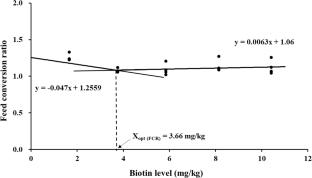
Biotin serves as a coenzyme in carboxylation reactions and plays a fundamental role in supporting growth, nutrient metabolism and overall physiological function in aquatic animals. This study investigated the biochemical and metabolic responses of graded dietary biotin in Penaeus vannamei. Five experimental diets were prepared with graded biotin supplementation levels of 0, 2, 4, 6 and 8 mg/kg (designated as Con, B02, B04, B06 and B08, respectively). The corresponding analyzed biotin concentrations were 1.65, 3.76, 5.84, 8.14 and 10.41 mg/kg, respectively. Twenty shrimp (0.55 ± 0.01 g) were randomly stocked into each tank, with four replicate tanks assigned to each experimental diet. The shrimp were fed the diets six times daily for 6 weeks. Dietary biotin supplementation significantly increased growth and improved feed utilization and protein efficiency ratio. Survival was not affected by the dietary treatment during the feeding trial. Whole-body lipid decreased linearly with increasing dietary biotin concentration. Hepatopancreatic biotin concentration exhibited a significant linear increase with graded dietary biotin concentrations. Chymotrypsin, lipase and amylase activities and intestinal villi height showed significant quadratic responses to dietary biotin concentration. Lysozyme activity increased linearly with dietary biotin concentrations, while antiprotease activity was significantly elevated in B02, B04 and B06 groups compared to Con group. Superoxide dismutase activity was significantly elevated in all biotin-supplemented groups. Based on piece-wise regression analysis, the optimal dietary biotin concentration for growth and feed conversion ratio was estimated at 3.09 to 3.66 mg/kg, respectively.
期刊介绍:
Marine Biotechnology welcomes high-quality research papers presenting novel data on the biotechnology of aquatic organisms. The journal publishes high quality papers in the areas of molecular biology, genomics, proteomics, cell biology, and biochemistry, and particularly encourages submissions of papers related to genome biology such as linkage mapping, large-scale gene discoveries, QTL analysis, physical mapping, and comparative and functional genome analysis. Papers on technological development and marine natural products should demonstrate innovation and novel applications.

 求助内容:
求助内容: 应助结果提醒方式:

 京公网安备 11010802042870号


