
Rapid Gluten Quantification by Aggregation-Driven Magnetophoretic Transduction Using Core–Satellite Magnetic Particles
IF 3.7
1区 化学
Q1 CHEMISTRY, ANALYTICAL
引用次数: 0
Abstract
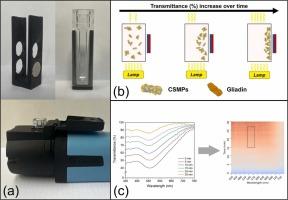
Reliable detection of trace amounts of gluten in food products is essential to safeguard individuals affected by coeliac disease and other gluten-related disorders. However, standard immunoassays such as ELISA, while highly sensitive, are time-consuming, laboratory-bound, and not easily adaptable to rapid on-site screening. In this work, we present a magnetophoretic biosensor based on core–satellite magnetic particles (CSMPs), functionalised with anti-gliadin antibodies through a photochemical immobilisation strategy integrated into a 3D-printed microfluidic mixer. Upon antigen binding, CSMPs undergo aggregation, which enhances their magnetophoretic migration under an external magnetic field, producing a quantifiable change in optical transmittance. A custom 3D-printed cuvette holder incorporating a permanent magnet enables time-resolved measurements with a portable spectrophotometer. The analytical response, obtained from transmittance monitoring in under 30 min, follows a sigmoidal dose–response curve with a limit of detection of 3 mg kg-1, below the 20 mg kg-1 regulatory threshold defined for gluten-free labelling. Validation with both commercial and spiked food samples demonstrated strong agreement with the reference R5 ELISA method across diverse matrices, confirming analytical robustness and applicability to real samples. Owing to its rapidity, low cost, and minimal instrumentation requirements, the proposed system represents a promising tool for preliminary gluten screening and on-site quality control in food safety monitoring.
利用核-卫星磁颗粒聚合驱动磁电泳转导快速测定谷蛋白
可靠地检测食品中的微量麸质对于保护受乳糜泻和其他麸质相关疾病影响的个体至关重要。然而,标准免疫测定法,如ELISA,虽然高度敏感,但耗时,实验室限制,不容易适应快速现场筛选。在这项工作中,我们提出了一种基于核心-卫星磁颗粒(CSMPs)的磁电泳生物传感器,通过光化学固定策略集成到3d打印的微流体混合器中,用抗麦胶蛋白抗体功能化。抗原结合后,CSMPs发生聚集,这增强了它们在外磁场下的磁泳迁移,产生了可量化的光学透过率变化。定制的3d打印比色管支架包含一个永久磁铁,可以使用便携式分光光度计进行时间分辨测量。在30分钟内通过透射率监测获得的分析响应遵循s型剂量-响应曲线,检测限为3 mg kg-1,低于无谷蛋白标签规定的20 mg kg-1监管阈值。对商业和加标食品样品的验证表明,该方法与参考R5 ELISA方法在不同基质上的一致性很强,证实了分析稳健性和对实际样品的适用性。由于其快速、低成本和最小的仪器要求,该系统是食品安全监测中麸质初步筛选和现场质量控制的有前途的工具。
本文章由计算机程序翻译,如有差异,请以英文原文为准。
求助全文
约1分钟内获得全文
求助全文
来源期刊
Sensors and Actuators B: Chemical
工程技术-电化学
CiteScore
14.60
自引率
11.90%
发文量
1776
审稿时长
3.2 months
期刊介绍:
Sensors & Actuators, B: Chemical is an international journal focused on the research and development of chemical transducers. It covers chemical sensors and biosensors, chemical actuators, and analytical microsystems. The journal is interdisciplinary, aiming to publish original works showcasing substantial advancements beyond the current state of the art in these fields, with practical applicability to solving meaningful analytical problems. Review articles are accepted by invitation from an Editor of the journal.
 求助内容:
求助内容: 应助结果提醒方式:

 京公网安备 11010802042870号


