
Dendritic hierarchical porous photothermal composite hydrogels based on directional freezing for highly efficient uranium extraction
IF 13.2
1区 工程技术
Q1 ENGINEERING, CHEMICAL
引用次数: 0
Abstract
As the demand for clean energy increases, extracting uranium from seawater has emerged as a vital solution to address fuel shortages. Nevertheless, practical applications encounter various challenges, including the low presence of uranyl ions and the interference caused by competing ions. To address these issues, a photothermal composite hydrogel (PAO/PEI@M) featuring a dendritic hierarchical porous structure was synthesized through directional freezing, enabling efficient recovery and selective extraction of uranium from seawater. This hydrogel exhibits excellent hydrophilicity, swelling capacity, and thermal stability, meanwhile, the photothermal conversion properties of MXene significantly enhance the selective adsorption of uranium by PAO. Adsorption experiments show that after the uniform coating and light-induced heating of the hydrogel surface, its uranium adsorption capacity reaches 395.26 mg·g−1 while maintaining high selectivity. After six cycles of adsorption and desorption, the PAO/PEI@M hydrogel maintains a high uranium adsorption capacity of 250.87 mg·g−1. In simulated seawater, the PAO/PEI@M hydrogel demonstrates excellent uranium removal efficiency and selectivity. Overall, the PAO/PEI@M hydrogel show promising application prospects for the selective enrichment of uranium from seawater.
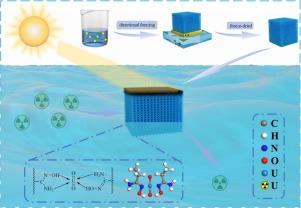
基于定向冷冻的枝状分层多孔光热复合水凝胶高效提铀
随着对清洁能源需求的增加,从海水中提取铀已成为解决燃料短缺的重要解决方案。然而,实际应用遇到各种挑战,包括铀酰离子的低存在和竞争离子引起的干扰。为了解决这些问题,通过定向冷冻合成了一种具有树枝状分层多孔结构的光热复合水凝胶(PAO/PEI@M),能够有效地从海水中回收和选择性提取铀。该水凝胶具有优异的亲水性、溶胀性和热稳定性,同时MXene的光热转化特性显著增强了PAO对铀的选择性吸附。吸附实验表明,水凝胶表面经过均匀包覆和光致加热后,其对铀的吸附量达到395.26 mg·g−1,同时保持了较高的选择性。经过6次循环的吸附和解吸,PAO/PEI@M水凝胶对铀的吸附量保持在250.87 mg·g−1。在模拟海水中,PAO/PEI@M水凝胶表现出优异的除铀效率和选择性。总之,PAO/PEI@M水凝胶在海水中选择性富集铀方面具有良好的应用前景。
本文章由计算机程序翻译,如有差异,请以英文原文为准。
求助全文
约1分钟内获得全文
求助全文
来源期刊
Chemical Engineering Journal
工程技术-工程:化工
CiteScore
21.70
自引率
9.30%
发文量
6781
审稿时长
2.4 months
期刊介绍:
The Chemical Engineering Journal is an international research journal that invites contributions of original and novel fundamental research. It aims to provide an international platform for presenting original fundamental research, interpretative reviews, and discussions on new developments in chemical engineering. The journal welcomes papers that describe novel theory and its practical application, as well as those that demonstrate the transfer of techniques from other disciplines. It also welcomes reports on carefully conducted experimental work that is soundly interpreted. The main focus of the journal is on original and rigorous research results that have broad significance. The Catalysis section within the Chemical Engineering Journal focuses specifically on Experimental and Theoretical studies in the fields of heterogeneous catalysis, molecular catalysis, and biocatalysis. These studies have industrial impact on various sectors such as chemicals, energy, materials, foods, healthcare, and environmental protection.
 求助内容:
求助内容: 应助结果提醒方式:

 京公网安备 11010802042870号


