
Extractable organofluorine (EOF) and target PFAS, including trifluoroacetic acid (TFA), in human serum from a Norwegian cohort, with a case study on the impact of fluorinated pharmaceuticals
IF 9.7
1区 环境科学与生态学
Q1 ENVIRONMENTAL SCIENCES
引用次数: 0
Abstract
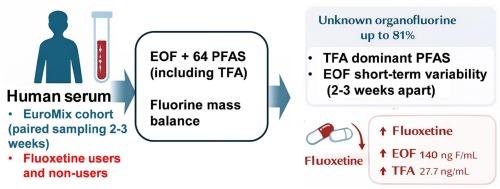
This study investigated the amount and proportion of unidentified organofluorine (UOF) in human serum and assessed short-term variability in exposure using extractable organofluorine (EOF) analysis and a fluorine mass balance approach. Serum samples were obtained from the well-characterized EuroMix cohort, comprising residents living in and around Oslo, Norway, collected between September 2016 and November 2017. Short-term intra-individual variability was evaluated using 72 paired serum samples collected 2–3 weeks apart. An extended target list of 64 PFAS, including trifluoroacetic acid (TFA), was applied to quantify identified and unidentified EOF. UOF accounted for up to 81% of EOF (median: 38%) in EuroMix samples. In 36% of paired samples, EOF concentrations varied by more than 25% over the 2–3-week interval, indicating the presence of compounds with relatively short biological half-lives. TFA was the most abundant individual PFAS detected, with median concentrations approximately twice those of PFOS. In a separate case study, serum samples from individuals using the fluorinated pharmaceutical Fluoxetine showed substantially elevated EOF and TFA concentrations (EOF: median 140 ng F/mL; TFA: median 27.7 ng/mL) compared with samples from individuals not using Fluoxetine (EOF: median < 8 ng F/mL; TFA: median 6.22 ng/mL). These findings indicate that fluorinated pharmaceuticals may contribute significantly to circulating EOF and TFA in humans. The large fraction of UOF and the widespread occurrence of TFA highlight the need to identify their sources relevant to human exposure. Together, these findings indicate that current PFAS including TFA biomonitoring approaches capture only a fraction (estimated to be 50%) of total human exposure to fluorinated substances and highlight the need to complement target analysis with fluorine mass balance approaches in future exposure assessment.
挪威队列人类血清中的可提取有机氟(EOF)和目标全氟磺酸,包括三氟乙酸(TFA),并对氟化药物的影响进行了案例研究
本研究调查了人类血清中不明有机氟(UOF)的数量和比例,并利用可提取有机氟(EOF)分析和氟质量平衡方法评估了暴露的短期变异性。血清样本来自特征良好的EuroMix队列,包括居住在挪威奥斯陆及其周边地区的居民,收集时间为2016年9月至2017年11月。使用相隔2-3 周收集的72个配对血清样本评估短期个体内变异性。应用包括三氟乙酸(TFA)在内的64种PFAS的扩展目标清单来量化已识别和未识别的EOF。在EuroMix样品中,UOF占EOF的81%(中位数:38%)。在36%的配对样品中,EOF浓度在2 - 3周的间隔内变化超过25%,表明存在生物半衰期相对较短的化合物。TFA是检测到的最丰富的单个PFAS,其中位数浓度约为PFOS的两倍。在另一项单独的案例研究中,与未使用氟西汀的个体(EOF:中位数 <; 8 ng F/mL; TFA:中位数6.22 ng/mL)相比,使用氟西汀的个体的血清样本显示EOF和TFA浓度显著升高(EOF:中位数140 ng F/mL; TFA:中位数27.7 ng/mL)。这些发现表明,含氟药物可能对人体循环EOF和TFA有重大影响。不明飞行物的大比例和TFA的广泛发生突出表明需要确定其与人类接触有关的来源。综上所述,这些发现表明,目前包括TFA生物监测方法在内的PFAS仅捕获了人类氟化物质暴露总量的一小部分(估计为50%),并强调在未来的暴露评估中需要用氟质量平衡方法补充目标分析。
本文章由计算机程序翻译,如有差异,请以英文原文为准。
求助全文
约1分钟内获得全文
求助全文
来源期刊
Environment International
环境科学-环境科学
CiteScore
21.90
自引率
3.40%
发文量
734
审稿时长
2.8 months
期刊介绍:
Environmental Health publishes manuscripts focusing on critical aspects of environmental and occupational medicine, including studies in toxicology and epidemiology, to illuminate the human health implications of exposure to environmental hazards. The journal adopts an open-access model and practices open peer review.
It caters to scientists and practitioners across all environmental science domains, directly or indirectly impacting human health and well-being. With a commitment to enhancing the prevention of environmentally-related health risks, Environmental Health serves as a public health journal for the community and scientists engaged in matters of public health significance concerning the environment.
 求助内容:
求助内容: 应助结果提醒方式:

 京公网安备 11010802042870号


