
Epithelial-to-mesenchymal transition as a central driver of tumor cell plasticity
IF 28.5
1区 医学
Q1 ONCOLOGY
引用次数: 0
Abstract
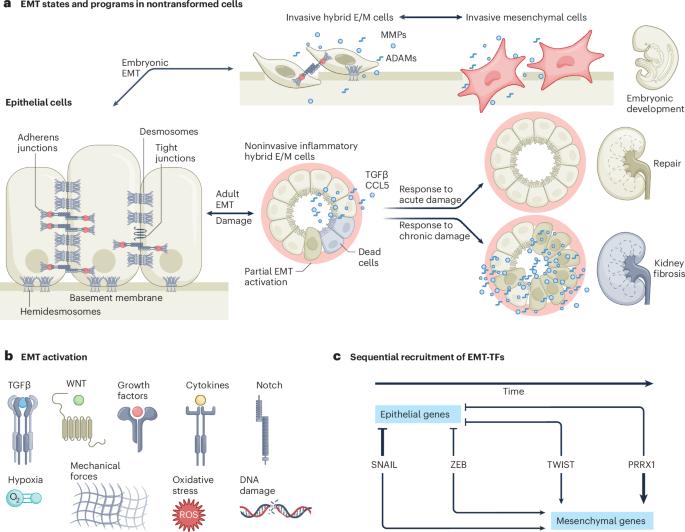
Epithelial-to-mesenchymal transition (EMT) is a central driver of cancer cell plasticity, enabling invasion, immune evasion, therapeutic resistance and metastasis. Rather than a binary switch, EMT comprises a continuum of transient, reversible states that endow tumor cells with distinct functional properties. Recent technological advances have revealed an unexpected diversity of EMT states across tumor contexts, with implications for disease progression and therapy response. In this Review, we synthesize emerging evidence on EMT heterogeneity and dynamics during cancer progression, examine how new methodologies have increased our understanding of the process and outline therapeutic challenges and opportunities. Jimenez-Castaño and Nieto review the latest research on cellular plasticity associated with epithelial–mesenchymal transition (EMT) states in cancer cells, highlighting the contributions of EMT to tumor progression, metastatic dissemination and therapy response.
上皮-间质转化是肿瘤细胞可塑性的主要驱动因素
上皮-间充质转化(Epithelial-to-mesenchymal transition, EMT)是癌细胞可塑性的核心驱动因素,可实现侵袭、免疫逃避、治疗抵抗和转移。EMT不是二进制开关,而是由连续的瞬时可逆状态组成,赋予肿瘤细胞独特的功能特性。最近的技术进步揭示了不同肿瘤背景下EMT状态的意想不到的多样性,这对疾病进展和治疗反应具有影响。在这篇综述中,我们综合了癌症进展过程中EMT异质性和动态的新证据,研究了新方法如何增加了我们对这一过程的理解,并概述了治疗的挑战和机遇。Jimenez-Castaño和Nieto回顾了癌细胞上皮-间质转化(epithelial-mesenchymal transition, EMT)状态与细胞可塑性相关的最新研究,重点介绍了EMT在肿瘤进展、转移传播和治疗反应中的作用。
本文章由计算机程序翻译,如有差异,请以英文原文为准。
求助全文
约1分钟内获得全文
求助全文
来源期刊
Nature cancer
Medicine-Oncology
CiteScore
31.10
自引率
1.80%
发文量
129
期刊介绍:
Cancer is a devastating disease responsible for millions of deaths worldwide. However, many of these deaths could be prevented with improved prevention and treatment strategies. To achieve this, it is crucial to focus on accurate diagnosis, effective treatment methods, and understanding the socioeconomic factors that influence cancer rates.
Nature Cancer aims to serve as a unique platform for sharing the latest advancements in cancer research across various scientific fields, encompassing life sciences, physical sciences, applied sciences, and social sciences. The journal is particularly interested in fundamental research that enhances our understanding of tumor development and progression, as well as research that translates this knowledge into clinical applications through innovative diagnostic and therapeutic approaches. Additionally, Nature Cancer welcomes clinical studies that inform cancer diagnosis, treatment, and prevention, along with contributions exploring the societal impact of cancer on a global scale.
In addition to publishing original research, Nature Cancer will feature Comments, Reviews, News & Views, Features, and Correspondence that hold significant value for the diverse field of cancer research.
 求助内容:
求助内容: 应助结果提醒方式:

 京公网安备 11010802042870号


