Hikmet Sis, Tufan Kiyak, Murat Erdemoğlu, Nizamettin Demirkiran, Ramazan Aydoğmuş
{"title":"Recovery of Zinc from Flotation Tailings of Lead–Zinc Ore Through a Hydrometallurgical Route","authors":"Hikmet Sis, Tufan Kiyak, Murat Erdemoğlu, Nizamettin Demirkiran, Ramazan Aydoğmuş","doi":"10.1007/s11837-025-08039-x","DOIUrl":null,"url":null,"abstract":"<div><p>This study focuses on recovering zinc from flotation tailings through a hydrometallurgical route, including sequential H<sub>2</sub>SO<sub>4</sub> leaching, iron precipitation, and solvent extraction (SX) processes. The effect of leachate concentration, leaching temperature, and time on the zinc recovery was investigated at constant solid/liquid ratio and stirring rate. In order to remove impurities from the pregnant leach solution (PLS), dissolved iron was first precipitated with NaOH solution, and then the dissolved zinc ions were extracted selectively by D2EHPA. Finally, the zinc in the organic D2EHPA phase was stripped into an aqueous phase by utilizing H<sub>2</sub>SO<sub>4</sub> solution to obtain a concentrated and purified zinc solution. It was seen that 93.50% of zinc in the tailings could be leached under optimum leaching conditions. In the SX process, the organic phases, prepared at organic/aqueous ratio (O/A) of 1/1 by volume, could extract 95.3% of the zinc in the pregnant leach solution within 10 min of extraction time. The stripping of 96.83% zinc into the aqueous phase was possible by using a 0.5-M H<sub>2</sub>SO<sub>4</sub> solution, prepared at an O/A ratio of 1/1 by volume. Calculations showed that an 82.65% of cumulative zinc recovery could be achieved through the proposed leaching and SX route.</p></div>","PeriodicalId":605,"journal":{"name":"JOM","volume":"78 5","pages":"4271 - 4283"},"PeriodicalIF":2.3000,"publicationDate":"2025-12-29","publicationTypes":"Journal Article","fieldsOfStudy":null,"isOpenAccess":false,"openAccessPdf":"","citationCount":"0","resultStr":null,"platform":"Semanticscholar","paperid":null,"PeriodicalName":"JOM","FirstCategoryId":"88","ListUrlMain":"https://link.springer.com/article/10.1007/s11837-025-08039-x","RegionNum":4,"RegionCategory":"材料科学","ArticlePicture":[],"TitleCN":null,"AbstractTextCN":null,"PMCID":null,"EPubDate":"","PubModel":"","JCR":"Q3","JCRName":"MATERIALS SCIENCE, MULTIDISCIPLINARY","Score":null,"Total":0}
引用次数: 0
Abstract
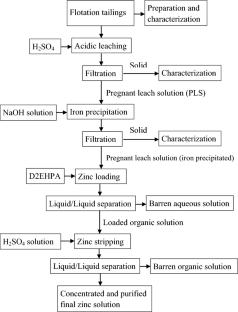
This study focuses on recovering zinc from flotation tailings through a hydrometallurgical route, including sequential H2SO4 leaching, iron precipitation, and solvent extraction (SX) processes. The effect of leachate concentration, leaching temperature, and time on the zinc recovery was investigated at constant solid/liquid ratio and stirring rate. In order to remove impurities from the pregnant leach solution (PLS), dissolved iron was first precipitated with NaOH solution, and then the dissolved zinc ions were extracted selectively by D2EHPA. Finally, the zinc in the organic D2EHPA phase was stripped into an aqueous phase by utilizing H2SO4 solution to obtain a concentrated and purified zinc solution. It was seen that 93.50% of zinc in the tailings could be leached under optimum leaching conditions. In the SX process, the organic phases, prepared at organic/aqueous ratio (O/A) of 1/1 by volume, could extract 95.3% of the zinc in the pregnant leach solution within 10 min of extraction time. The stripping of 96.83% zinc into the aqueous phase was possible by using a 0.5-M H2SO4 solution, prepared at an O/A ratio of 1/1 by volume. Calculations showed that an 82.65% of cumulative zinc recovery could be achieved through the proposed leaching and SX route.
期刊介绍:
JOM is a technical journal devoted to exploring the many aspects of materials science and engineering. JOM reports scholarly work that explores the state-of-the-art processing, fabrication, design, and application of metals, ceramics, plastics, composites, and other materials. In pursuing this goal, JOM strives to balance the interests of the laboratory and the marketplace by reporting academic, industrial, and government-sponsored work from around the world.

 求助内容:
求助内容: 应助结果提醒方式:

 京公网安备 11010802042870号


