
Applications of Infrared Spectroscopy in Monitoring Solvent Distillation during Early-Phase Pharmaceutical Process Development─Lean Chemometrics to Address Temperature and Matrix Effects
IF 3.5
3区 化学
Q2 CHEMISTRY, APPLIED
引用次数: 0
Abstract
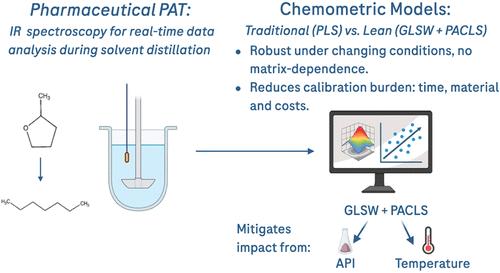
Solvent exchanges are a common step in the synthetic chemical crystallization process during pharmaceutical development. In this study, we explore the application of in-line mid-infrared (IR) spectroscopy-based Process Analytical Technology (PAT) tools to determine the solvent content during distillation in early-phase development in the presence of an active pharmaceutical ingredient (API). During solvent swaps, the composition of solvents and temperature in the reactor can change drastically, generating nonideal solvent mixtures, and interference from the API signal creates additional challenges in modeling these systems. IR spectroscopy can be a useful tool in monitoring these changes, and lean chemometric models built off pure solvent spectra present an opportunity to capture the effects of temperature and API addition without requiring extensive calibration samples. An example solvent system was used for the study, where 2-methyltetrahydrofuran was replaced with heptane through a binary solvent exchange across a temperature range of 10–80 °C. Various solvent combinations were prepared at different ratios for a calibrated partial least-squares (PLS) model. Lean chemometric algorithms, namely classical least-squares and prediction-augmented classical least-squares (PACLS), with generalized least-squares weighting (GLSW) preprocessing, were applied to monitor these systems via minimizing the calibration burden. Lean model performance and traditional calibrated PLS performance were compared and evaluated by the root mean squared error of prediction for solvent exchanges between binary solvent mixture runs and additional runs with the inclusion of a surrogate API (benzophenone). Results demonstrate that spectral variation influenced by the temperature and API signal on the predictive abilities of multivariate models can effectively be mitigated through a two-pronged GLSW and PACLS lean modeling approach. This combination modeling approach appears to be competitive with PLS, without the additional time and resource constraints of preparing extensive training data, while also circumventing matrix dependence.
红外光谱在制药工艺开发早期溶剂蒸馏监测中的应用──用精益化学计量学研究温度和基质效应
溶剂交换是药物开发过程中合成化学结晶过程中常见的步骤。在本研究中,我们探索了基于中红外(IR)光谱的过程分析技术(PAT)工具的应用,以确定在活性药物成分(API)存在的早期开发阶段蒸馏过程中的溶剂含量。在溶剂交换过程中,溶剂的组成和反应器中的温度可能会发生巨大变化,产生非理想的溶剂混合物,并且API信号的干扰给这些系统的建模带来了额外的挑战。红外光谱可以是监测这些变化的有用工具,并且基于纯溶剂光谱建立的精益化学计量模型提供了一个机会,可以捕获温度和API添加的影响,而无需大量校准样品。在10-80℃的温度范围内,通过二元溶剂交换,2-甲基四氢呋喃被庚烷取代。以不同的比例制备了不同的溶剂组合,用于校准偏最小二乘(PLS)模型。精益化学计量学算法,即经典最小二乘和预测增强经典最小二乘(PACLS),结合广义最小二乘加权(GLSW)预处理,通过最小化校准负担来监测这些系统。对精益模型的性能和传统校准PLS的性能进行比较,并通过预测二元溶剂混合物运行和包含替代API(二苯甲酮)的附加运行之间溶剂交换的均方根误差进行评估。结果表明,温度和API信号对多变量模型预测能力的影响可以通过GLSW和PACLS双管齐下的精益建模方法得到有效缓解。这种组合建模方法似乎与PLS竞争,没有准备大量训练数据的额外时间和资源限制,同时也绕过了矩阵依赖。
本文章由计算机程序翻译,如有差异,请以英文原文为准。
求助全文
约1分钟内获得全文
求助全文
来源期刊
CiteScore
6.90
自引率
14.70%
发文量
251
审稿时长
2 months
期刊介绍:
The journal Organic Process Research & Development serves as a communication tool between industrial chemists and chemists working in universities and research institutes. As such, it reports original work from the broad field of industrial process chemistry but also presents academic results that are relevant, or potentially relevant, to industrial applications. Process chemistry is the science that enables the safe, environmentally benign and ultimately economical manufacturing of organic compounds that are required in larger amounts to help address the needs of society. Consequently, the Journal encompasses every aspect of organic chemistry, including all aspects of catalysis, synthetic methodology development and synthetic strategy exploration, but also includes aspects from analytical and solid-state chemistry and chemical engineering, such as work-up tools,process safety, or flow-chemistry. The goal of development and optimization of chemical reactions and processes is their transfer to a larger scale; original work describing such studies and the actual implementation on scale is highly relevant to the journal. However, studies on new developments from either industry, research institutes or academia that have not yet been demonstrated on scale, but where an industrial utility can be expected and where the study has addressed important prerequisites for a scale-up and has given confidence into the reliability and practicality of the chemistry, also serve the mission of OPR&D as a communication tool between the different contributors to the field.
 求助内容:
求助内容: 应助结果提醒方式:

 京公网安备 11010802042870号


