
Bioinspired Molecular Engineering of IRE1-Gated DNAzymes for Self-Adaptive Bidirectional Modulation of ER Stress
IF 16.9
1区 化学
Q1 CHEMISTRY, MULTIDISCIPLINARY
引用次数: 0
Abstract
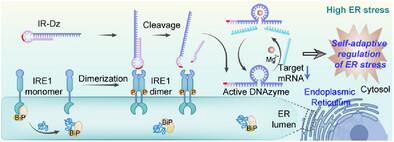
Precise regulation of endoplasmic reticulum (ER) stress signaling in cancer remains a central challenge for nucleic acid–based therapeutics, largely due to their inability to discriminate ER-stressed malignant cells and non-stressed normal cells. Here we report an ER stress–responsive regulatory platform that couples the disease-associated endoribonuclease activity of inositol-requiring enzyme 1 (IRE1) to the conditional activation of DNA-based effectors. By rationally grafting an X-box binding protein 1 (XBP1)-mimetic stem–loop “gate” onto canonical DNAzymes (IR-Dz), we generate constructs that remain catalytically inert under basal IRE1 activity but are activated upon ER stress–induced IRE1 cleavage. The resulting IR-Dz mediates cell-selective c-MYC silencing in ER-stressed cancer cells, thereby attenuating ER stress while sparing normal counterparts. Redirecting IR-Dz to IRE1 mRNA achieves the opposite outcome—self-silencing of IRE1 and amplification of ER stress in tumor cells. This modular architecture can be adapted to other nucleic-acid modalities, such as antisense oligonucleotides. By establishing IRE1 as an endogenous molecular trigger for spatially and contextually precise activation of nucleic acid effectors, our study introduces a general strategy for programmable, condition-dependent gene regulation and dynamic modulation of ER stress signaling in cancer.
内质网胁迫自适应双向调节ire1门控DNAzymes的生物启发分子工程
肿瘤内质网(ER)应激信号的精确调控仍然是基于核酸的治疗方法的核心挑战,主要是因为它们无法区分ER应激的恶性细胞和非应激的正常细胞。在这里,我们报道了一个内质网应激反应性调节平台,该平台将肌醇需要酶1 (IRE1)的疾病相关核糖核酸内切酶活性与基于dna的效应物的条件激活结合起来。通过合理地将X-box结合蛋白1 (XBP1)-模拟茎环“门”嫁接到典型DNAzymes (IR-Dz)上,我们产生了在基础IRE1活性下保持催化惰性,但在内质网应激诱导的IRE1切割时被激活的结构体。由此产生的IR-Dz在内质网应激的癌细胞中介导细胞选择性c-MYC沉默,从而减弱内质网应激,同时保留正常对应物。将IR-Dz重定向到IRE1 mRNA上可以达到相反的结果——IRE1的自我沉默和肿瘤细胞内质网应激的扩增。这种模块化结构可以适应其他核酸模式,如反义寡核苷酸。通过将IRE1作为一个内源性分子触发器,在空间和环境上精确激活核酸效应物,我们的研究介绍了可编程的、条件依赖的基因调控和癌症内质网应激信号的动态调节的一般策略。
本文章由计算机程序翻译,如有差异,请以英文原文为准。
求助全文
约1分钟内获得全文
求助全文
来源期刊
CiteScore
26.60
自引率
6.60%
发文量
3549
审稿时长
1.5 months
期刊介绍:
Angewandte Chemie, a journal of the German Chemical Society (GDCh), maintains a leading position among scholarly journals in general chemistry with an impressive Impact Factor of 16.6 (2022 Journal Citation Reports, Clarivate, 2023). Published weekly in a reader-friendly format, it features new articles almost every day. Established in 1887, Angewandte Chemie is a prominent chemistry journal, offering a dynamic blend of Review-type articles, Highlights, Communications, and Research Articles on a weekly basis, making it unique in the field.
 求助内容:
求助内容: 应助结果提醒方式:

 京公网安备 11010802042870号


