
High-Efficiency Optical Signal Transmission Achieved Using an Integrated Carbon Nanotube-Based 1D Emitter and 2D Detector
IF 19
1区 材料科学
Q1 CHEMISTRY, MULTIDISCIPLINARY
引用次数: 0
Abstract
Miniaturized and wearable optical communication technology is playing a vital role in a wide range of applications, including environmental and physiological monitoring systems, as well as remote sensing systems. However, it is difficult to manufacture efficient and flexible light emitters and detectors due to the intrinsic limitations of conventional semiconductors. We report a flexible and broadband carbon nanotube (CNT)-based optoelectronic device that consists of a CNT fiber emitter and a Bi2Te3/CNT film detector. The 1D CNT fiber significantly increases thermal emission by minimizing energy loss, while the 2D Bi2Te3/CNT-film efficiently detects the emitted light, because of its high light absorption and conversion capabilities. As a result, the constructed optoelectronic device has a record-high quality factor of 2.8 × 10⁵ S A m−1 W−1, which is an order of magnitude higher than that of reported carbon-based devices. A minimized and wearable optical communication system was constructed, which enables data transmission between a spun fiber emitter and a film detector. When integrated with wet-spinning equipment for the manufacture of CNT-fibers, it enabled the in situ testing of the quality of the fibers.
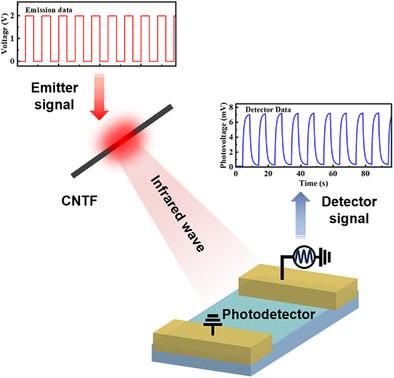
基于碳纳米管的一维发射器和二维探测器集成实现了高效光信号传输
小型化和可穿戴光通信技术在环境和生理监测系统以及遥感系统等广泛应用中发挥着至关重要的作用。然而,由于传统半导体固有的局限性,很难制造出高效、灵活的光发射器和探测器。我们报道了一种基于碳纳米管(CNT)的柔性宽带光电器件,该器件由碳纳米管光纤发射器和Bi2Te3/CNT薄膜探测器组成。一维碳纳米管光纤通过最小化能量损失显著增加热发射,而二维Bi2Te3/碳纳米管薄膜由于其高光吸收和转换能力而有效地检测发射光。因此,所构建的光电器件具有2.8 × 105 S a m−1 W−1的创纪录的高品质因子,这比报道的碳基器件高出一个数量级。构建了一种小型可穿戴光通信系统,实现了光纤发射器与薄膜探测器之间的数据传输。当与用于制造碳纳米管纤维的湿纺设备集成时,它可以对纤维的质量进行现场测试。
本文章由计算机程序翻译,如有差异,请以英文原文为准。
求助全文
约1分钟内获得全文
求助全文
来源期刊
Advanced Functional Materials
工程技术-材料科学:综合
CiteScore
29.50
自引率
4.20%
发文量
2086
审稿时长
2.1 months
期刊介绍:
Firmly established as a top-tier materials science journal, Advanced Functional Materials reports breakthrough research in all aspects of materials science, including nanotechnology, chemistry, physics, and biology every week.
Advanced Functional Materials is known for its rapid and fair peer review, quality content, and high impact, making it the first choice of the international materials science community.
 求助内容:
求助内容: 应助结果提醒方式:

 京公网安备 11010802042870号


