
Atomically Dispersed Cr Doping Induced Oxide Pathway Mechanism of Hollow RuO2 to Boost Oxygen Evolution Stability for PEMWE
IF 19
1区 材料科学
Q1 CHEMISTRY, MULTIDISCIPLINARY
引用次数: 0
Abstract
Developing stable and efficient electrocatalysts for acidic oxygen evolution reactions (OER) is crucial for the commercialization of proton exchange membrane water electrolysis (PEMWE). Herein, we use the oxyphilic Cr to atomically doped RuO2 hollow sphere and synthesize Cr0.092-RuO2 catalyst via a phase transition strategy. Theoretical and experimental results indicate that oxyphilic Cr can improve the adsorption of OH−, shorten the distance of bimetallic sites and promote the direct coupling of oxygen free radicals, causing the formation of the heterogeneous bimetallic oxide pathway mechanism (OPM), where Cr can serve as an electron donor to provide stable Cr-O─Ru bonds and effectively avoid the excessive oxidation of Ru. The electrocatalytic performance of Cr0.092-RuO2 is improved significantly, and it not only exhibits high OER activity (overpotential of 168 mV at 10 mA cm−2), but also outstanding catalytic stability (2800 h at 10 mA cm−2). As a result, the Cr0.092-RuO2-based PEMWE only needs 1.62 V at 1 A cm−2 and runs stably for 400 h at 0.5 A cm−2. In short, the OPM pathway of avoiding excessive oxidation of RuO2 proposed here may be a useful strategy for developing highly efficient Ir-free OER catalysts for PEMWE.
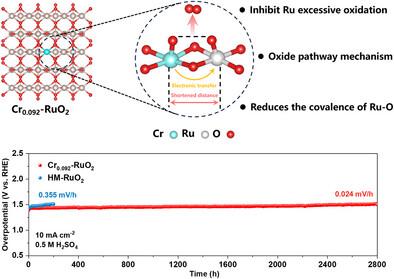
原子分散Cr掺杂诱导空心RuO2氧化途径机制提高PEMWE析氧稳定性
开发稳定、高效的酸性析氧反应电催化剂是实现质子交换膜电解(PEMWE)产业化的关键。本文利用亲氧性Cr原子掺杂RuO2空心球,通过相变策略合成了Cr0.092-RuO2催化剂。理论和实验结果表明,亲氧Cr可以改善OH−的吸附,缩短双金属位点的距离,促进氧自由基的直接偶联,形成非均相双金属氧化途径机制(OPM),其中Cr可以作为电子供体提供稳定的Cr- o─Ru键,有效避免Ru的过度氧化。Cr0.092-RuO2的电催化性能得到显著提高,不仅表现出较高的OER活性(在10 mA cm−2下过电位为168 mV),而且还表现出优异的催化稳定性(在10 mA cm−2下2800 h)。因此,基于cr0.092 - ruo2的PEMWE在1 a cm−2时只需要1.62 V,在0.5 a cm−2时稳定运行400小时。总之,本文提出的避免RuO2过度氧化的OPM途径可能是开发高效无ir的PEMWE OER催化剂的有用策略。
本文章由计算机程序翻译,如有差异,请以英文原文为准。
求助全文
约1分钟内获得全文
求助全文
来源期刊
Advanced Functional Materials
工程技术-材料科学:综合
CiteScore
29.50
自引率
4.20%
发文量
2086
审稿时长
2.1 months
期刊介绍:
Firmly established as a top-tier materials science journal, Advanced Functional Materials reports breakthrough research in all aspects of materials science, including nanotechnology, chemistry, physics, and biology every week.
Advanced Functional Materials is known for its rapid and fair peer review, quality content, and high impact, making it the first choice of the international materials science community.
 求助内容:
求助内容: 应助结果提醒方式:

 京公网安备 11010802042870号


