
Atomic-Scale Intermediate Polarization States Enable Superb Energy Storage in NaNbO3 Ceramics via Machine Learning
IF 19
1区 材料科学
Q1 CHEMISTRY, MULTIDISCIPLINARY
引用次数: 0
Abstract
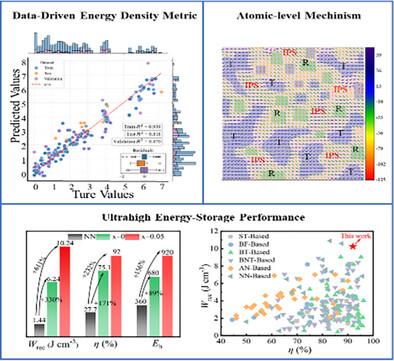
Dielectric energy‑storage ceramics face a fundamental performance limitation stemming from the intrinsic trade‑off between achieving large polarization and minimizing hysteresis loss. This challenge is particularly pronounced in lead‑free NaNbO3‑based materials, where high electric fields induce irreversible antiferroelectric-ferroelectric phase transitions. To overcome this limitation, we develop a machine‑learning‑assisted design strategy that guides the creation of atomic‑scale intermediate polarization states (IPSs) within dual‑phase NaNbO3 heterostructures. Aberration‑corrected scanning transmission electron microscopy directly visualizes IPSs between the tetragonal (T-phase) and rhombohedral (R-phase), which reduce polarization anisotropy and flatten the free‑energy landscape, thereby enabling concurrent large polarization and minimal hysteresis. The optimized ceramic delivers a high recoverable energy density of 10.24 J cm−3 with an exceptional efficiency of 92% under 920 kV cm−1. This work establishes a materials‑design paradigm that decouples polarization from energy loss through the integration of atomic-scale structural control and machine learning, providing a promising pathway toward advanced dielectrics for high-power energy-storage applications.
原子尺度的中间极化态通过机器学习实现NaNbO3陶瓷的卓越能量存储
介电储能陶瓷面临着一个基本的性能限制,源于实现大极化和最小化迟滞损耗之间的内在权衡。这一挑战在无铅NaNbO3基材料中尤为明显,在这种材料中,高电场会诱导不可逆的反铁电-铁电相变。为了克服这一限制,我们开发了一种机器学习辅助设计策略,指导在双相NaNbO3异质结构中创建原子尺度的中间极化态(ips)。像差校正扫描透射电子显微镜直接显示四方(t相)和菱形(r相)之间的ips,这减少了极化各向异性和平坦的自由能景观,从而实现同时大极化和最小的滞后。优化后的陶瓷在920 kV cm - 1下的可回收能量密度高达10.24 J cm - 3,效率高达92%。这项工作建立了一种材料设计范例,通过原子尺度结构控制和机器学习的集成,将极化与能量损失解耦,为大功率储能应用的先进电介质提供了一条有希望的途径。
本文章由计算机程序翻译,如有差异,请以英文原文为准。
求助全文
约1分钟内获得全文
求助全文
来源期刊
Advanced Functional Materials
工程技术-材料科学:综合
CiteScore
29.50
自引率
4.20%
发文量
2086
审稿时长
2.1 months
期刊介绍:
Firmly established as a top-tier materials science journal, Advanced Functional Materials reports breakthrough research in all aspects of materials science, including nanotechnology, chemistry, physics, and biology every week.
Advanced Functional Materials is known for its rapid and fair peer review, quality content, and high impact, making it the first choice of the international materials science community.
 求助内容:
求助内容: 应助结果提醒方式:

 京公网安备 11010802042870号


