
Three-Component C-Glycosylation of Amino Acids and Peptides Enabled by Photoinduced Palladium Catalysis
IF 9.2
1区 化学
Q1 CHEMISTRY, MULTIDISCIPLINARY
引用次数: 0
Abstract
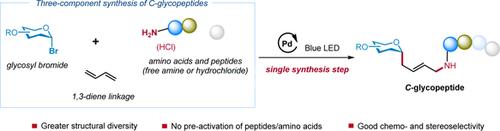
Glycosylation represents a powerful strategy for modulating the properties and functions of peptides and proteins, with significant implications for biochemical and medicinal research. Particularly, C-glycosyl peptides and proteins-structural mimics of native O/N-glycosides-exhibit superior metabolic stability, rendering them attractive candidates for therapeutic development. Despite impressive advances in glycosyl radical-based synthesis of C-Glycopeptides, current approaches largely depend on harnessing nucleophilic reactivity of glycosyl radicals and pre functionalizing amino acid substrates to introduce electrophilic sites. To explore more reactivity patterns of glycosyl radicals and eliminate additional prefunctionalization steps, we herein disclose a photoinduced palladium-catalyzed, three-component glycosylation strategy for the direct assembly of saccharides with non-preactivated amino acids and peptides using 1,3-dienes as versatile coupling linkers. Notably, this approach transforms nucleophilic glycosyl radicals into electrophilic π-allylpalladium species, representing a novel reactivity pattern in glycosyl radical chemistry. Featuring mild conditions and good functional group tolerance, this method provides a versatile and general platform for constructing structurally diverse C-glycoamino acids, peptides, and drug conjugates in good yields with high stereoselectivity.
光诱导钯催化下氨基酸和肽的三组分c -糖基化
糖基化是调节多肽和蛋白质的特性和功能的一种强有力的策略,在生物化学和医学研究中具有重要意义。特别是,c -糖基肽和蛋白质——天然O/ n -糖苷的结构模拟物——表现出优越的代谢稳定性,使它们成为治疗开发的有吸引力的候选者。尽管基于糖基自由基的c -糖肽合成取得了令人印象深刻的进展,但目前的方法主要依赖于利用糖基自由基的亲核反应性和预功能化氨基酸底物来引入亲电位点。为了探索更多的糖基自由基的反应模式并消除额外的预功能化步骤,我们在此披露了一种光诱导钯催化的三组分糖基化策略,该策略使用1,3-二烯作为多功能偶联连接剂,用于糖与非预活化的氨基酸和肽的直接组装。值得注意的是,这种方法将亲核的糖基自由基转化为亲电的π-烯丙基钯,代表了糖基自由基化学中一种新的反应模式。该方法条件温和,具有良好的官能团耐受性,为构建结构多样的c -糖氨基酸、多肽和药物偶联物提供了一个通用的平台,产率高,立体选择性好。
本文章由计算机程序翻译,如有差异,请以英文原文为准。
求助全文
约1分钟内获得全文
求助全文
来源期刊
CCS Chemistry
Chemistry-General Chemistry
CiteScore
13.60
自引率
13.40%
发文量
475
审稿时长
10 weeks
期刊介绍:
CCS Chemistry, the flagship publication of the Chinese Chemical Society, stands as a leading international chemistry journal based in China. With a commitment to global outreach in both contributions and readership, the journal operates on a fully Open Access model, eliminating subscription fees for contributing authors. Issued monthly, all articles are published online promptly upon reaching final publishable form. Additionally, authors have the option to expedite the posting process through Immediate Online Accepted Article posting, making a PDF of their accepted article available online upon journal acceptance.
 求助内容:
求助内容: 应助结果提醒方式:

 京公网安备 11010802042870号


