
Process Optimization and Reaction Kinetic Study of Propylene Glycol Butyl Ether Synthesis from Propylene Oxide in a Microreactor
IF 3.5
3区 化学
Q2 CHEMISTRY, APPLIED
引用次数: 0
Abstract
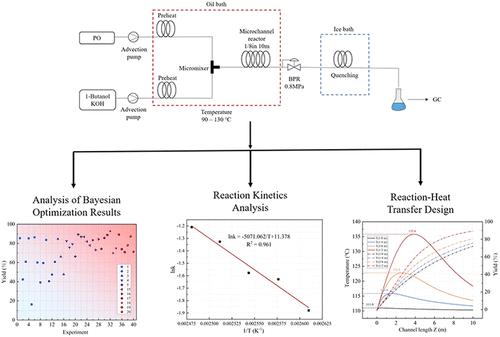
Propylene glycol butyl ether (PNB) is an important environmentally friendly solvent widely used in coatings, inks, and cleaning agents. Its industrial production typically relies on batch processes that suffer from low efficiency and safety concerns. This study proposes a continuous-flow etherification reaction of propylene oxide (PO) with n-butanol in a microreactor to achieve process intensification and improved safety. First, a Bayesian optimization method based on Gaussian processes was employed to systematically optimize key reaction parameters, including temperature, residence time, and reactant molar ratio. An apparent kinetic model of the reaction was further established. By coupling the kinetic model with the heat balance equation, the temperature distribution and yield variation under different channel dimensions and materials were simulated and predicted. The results indicate that under optimal conditions, the yield of PNB can reach 92.75%. Kinetic studies showed that the reaction follows first-order kinetics with respect to propylene oxide, with an activation energy of 42.16 kJ·mol–1. In a 1/8-in. FEP microchannel, the temperature rise was only 1.0 °C, confirming near-isothermal operation. However, increasing the channel diameter to 1/2 in. led to a temperature rise of 25.8 °C, introducing significant thermal risk. Replacing FEP with high-thermal-conductivity materials such as stainless steel effectively suppressed the temperature rise, though with a slight reduction in yield. This work demonstrates that microreactors offer excellent heat transfer control for exothermic etherification reactions. The integrated approach combining Bayesian optimization, kinetic modeling, and thermal simulation provides a useful framework for developing safe and efficient continuous-flow processes. The findings also offer practical guidance for reactor design and scale-up.
微反应器中环氧丙烷合成丙二醇丁醚的工艺优化及反应动力学研究
丙二醇丁基醚(PNB)是一种重要的环保型溶剂,广泛应用于涂料、油墨、清洗剂等领域。其工业生产通常依赖于低效率和安全问题的批量生产。本研究提出在微反应器中进行环氧丙烷(PO)与正丁醇的连续流醚化反应,以达到工艺强化和提高安全性的目的。首先,采用基于高斯过程的贝叶斯优化方法,对反应温度、停留时间、反应物摩尔比等关键参数进行了系统优化。进一步建立了反应的表观动力学模型。将动力学模型与热平衡方程相结合,模拟和预测了不同通道尺寸和不同物料下的温度分布和产率变化。结果表明,在最优条件下,PNB的收率可达92.75%。动力学研究表明,该反应符合环氧丙烷一级动力学,活化能为42.16 kJ·mol-1。1/8英寸。FEP微通道,温升仅为1.0℃,证实了近等温操作。然而,将通道直径增加到1/2英寸。导致温度上升25.8°C,带来重大的热风险。用高导热材料(如不锈钢)代替FEP有效地抑制了升温,但产量略有下降。这项工作表明,微反应器为放热醚化反应提供了良好的传热控制。将贝叶斯优化、动力学建模和热模拟相结合的方法为开发安全高效的连续流工艺提供了一个有用的框架。这些发现也为反应堆的设计和放大提供了实用的指导。
本文章由计算机程序翻译,如有差异,请以英文原文为准。
求助全文
约1分钟内获得全文
求助全文
来源期刊
CiteScore
6.90
自引率
14.70%
发文量
251
审稿时长
2 months
期刊介绍:
The journal Organic Process Research & Development serves as a communication tool between industrial chemists and chemists working in universities and research institutes. As such, it reports original work from the broad field of industrial process chemistry but also presents academic results that are relevant, or potentially relevant, to industrial applications. Process chemistry is the science that enables the safe, environmentally benign and ultimately economical manufacturing of organic compounds that are required in larger amounts to help address the needs of society. Consequently, the Journal encompasses every aspect of organic chemistry, including all aspects of catalysis, synthetic methodology development and synthetic strategy exploration, but also includes aspects from analytical and solid-state chemistry and chemical engineering, such as work-up tools,process safety, or flow-chemistry. The goal of development and optimization of chemical reactions and processes is their transfer to a larger scale; original work describing such studies and the actual implementation on scale is highly relevant to the journal. However, studies on new developments from either industry, research institutes or academia that have not yet been demonstrated on scale, but where an industrial utility can be expected and where the study has addressed important prerequisites for a scale-up and has given confidence into the reliability and practicality of the chemistry, also serve the mission of OPR&D as a communication tool between the different contributors to the field.
 求助内容:
求助内容: 应助结果提醒方式:

 京公网安备 11010802042870号


