{"title":"Process, cost and environmental impact analysis of a solar adsorption cooling system for telecommunications Shelters","authors":"Nassima Bakhaled, Noureddine Cherrad, Khadra Aliouat, Djamel Selloum, Abdelmounam Ayad","doi":"10.1007/s10450-026-00686-z","DOIUrl":null,"url":null,"abstract":"<div><p>Algérie Télécom is a joint-stock company in the telecommunications networks and services sector. To protect its equipment from extreme weather, the company deploys Shelters globally, shielding the equipment from harsh climate conditions. However, these structures face challenges in dissipating internal heat generated by active equipment, especially in desert regions where summer temperatures in the shade exceed 45 °C. Maintaining an internal temperature below 35 °C is crucial for ensuring the proper functioning of the equipment. This study examines a more efficient solution based on solar-powered adsorption cooling using the AC35 activated carbon-methanol pair, backed by a developed thermodynamic model and a numerical simulation algorithm to analyze the system’s behavior. The results show that, over an ambient temperature range of 15 °C to 45 °C and heat dissipation from 1.5 kW to 8.5 kW, the thermal power exchanged by the desorber varies from 5.52 kW to 382.5 kW, while that of the condenser ranges from 3 to 200 kW. Additionally, the mass flow rate of the refrigerant fluid increases proportionally with the heat absorbed by the desorber, rising from 2.58 g/s to 175.62 g/s. Economically, adopting adsorption cooling would reduce total energy investment costs by 48.3%, saving approximately USD 394,600 per station. Furthermore, the environmental impact is significant, with CO₂ emissions reductions estimated between 1.1 and 6.6 tons per station annually.</p></div>","PeriodicalId":458,"journal":{"name":"Adsorption","volume":"32 5","pages":""},"PeriodicalIF":3.1000,"publicationDate":"2026-04-29","publicationTypes":"Journal Article","fieldsOfStudy":null,"isOpenAccess":false,"openAccessPdf":"","citationCount":"0","resultStr":null,"platform":"Semanticscholar","paperid":null,"PeriodicalName":"Adsorption","FirstCategoryId":"5","ListUrlMain":"https://link.springer.com/article/10.1007/s10450-026-00686-z","RegionNum":4,"RegionCategory":"工程技术","ArticlePicture":[],"TitleCN":null,"AbstractTextCN":null,"PMCID":null,"EPubDate":"","PubModel":"","JCR":"Q3","JCRName":"CHEMISTRY, PHYSICAL","Score":null,"Total":0}
引用次数: 0
Abstract
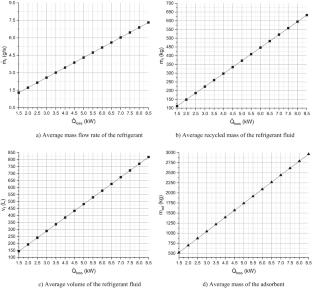
Algérie Télécom is a joint-stock company in the telecommunications networks and services sector. To protect its equipment from extreme weather, the company deploys Shelters globally, shielding the equipment from harsh climate conditions. However, these structures face challenges in dissipating internal heat generated by active equipment, especially in desert regions where summer temperatures in the shade exceed 45 °C. Maintaining an internal temperature below 35 °C is crucial for ensuring the proper functioning of the equipment. This study examines a more efficient solution based on solar-powered adsorption cooling using the AC35 activated carbon-methanol pair, backed by a developed thermodynamic model and a numerical simulation algorithm to analyze the system’s behavior. The results show that, over an ambient temperature range of 15 °C to 45 °C and heat dissipation from 1.5 kW to 8.5 kW, the thermal power exchanged by the desorber varies from 5.52 kW to 382.5 kW, while that of the condenser ranges from 3 to 200 kW. Additionally, the mass flow rate of the refrigerant fluid increases proportionally with the heat absorbed by the desorber, rising from 2.58 g/s to 175.62 g/s. Economically, adopting adsorption cooling would reduce total energy investment costs by 48.3%, saving approximately USD 394,600 per station. Furthermore, the environmental impact is significant, with CO₂ emissions reductions estimated between 1.1 and 6.6 tons per station annually.
期刊介绍:
The journal Adsorption provides authoritative information on adsorption and allied fields to scientists, engineers, and technologists throughout the world. The information takes the form of peer-reviewed articles, R&D notes, topical review papers, tutorial papers, book reviews, meeting announcements, and news.
Coverage includes fundamental and practical aspects of adsorption: mathematics, thermodynamics, chemistry, and physics, as well as processes, applications, models engineering, and equipment design.
Among the topics are Adsorbents: new materials, new synthesis techniques, characterization of structure and properties, and applications; Equilibria: novel theories or semi-empirical models, experimental data, and new measurement methods; Kinetics: new models, experimental data, and measurement methods. Processes: chemical, biochemical, environmental, and other applications, purification or bulk separation, fixed bed or moving bed systems, simulations, experiments, and design procedures.

 求助内容:
求助内容: 应助结果提醒方式:

 京公网安备 11010802042870号


