
Sulfur vacancy-rich 1T–2H MoS2 homojunction supported CoO catalyst for m-cresol hydrodeoxygenation
IF 7.1
2区 材料科学
Q2 MATERIALS SCIENCE, MULTIDISCIPLINARY
Progress in Natural Science: Materials International
Pub Date : 2026-04-01
Epub Date: 2026-03-14
DOI:10.1016/j.pnsc.2026.03.004
引用次数: 0
Abstract
To enhance the selectivity and catalytic activity of m-cresol to toluene in the hydrodeoxygenation (HDO), a unique CoO@MoS2 with high density of sulfur (S)-deficient sites and the 1T-2H homojunction was proposed and synthesized via a facile strategy. As far as the synthesized catalysts are concerned, remarkable directional catalytic performance was manifested in the HDO of m-cresol, specifically 97.5% conversion of m-cresol and 98.8% selectivity to toluene. Furthermore, CoO@MoS2 catalyst also exhibits remarkable versatility in C-O bond cleavage of other lignin-derived phenols (e.g., p-cresol). The excellent HDO activity of CoO@MoS2 can be attributed to the existence of abundant S vacancies and 1T-2H homojunction in the MoS2 support. These features are demonstrated to be feasible for modification of surface charge transfer properties to subsequently influence the adsorption, activation, and desorption between m-cresol and products, thus lowering the activation energy during the reaction, facilitating the progress of reaction and improving the selectivity as a result.
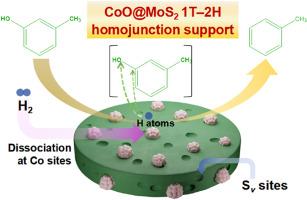
富硫空位的1T-2H MoS2均结负载CoO间甲酚加氢脱氧催化剂
为了提高间甲酚在加氢脱氧(HDO)过程中对甲苯的选择性和催化活性,提出并合成了一种具有高密度硫(S)缺陷位点和1T-2H同源结的独特CoO@MoS2。合成的催化剂对间甲酚的HDO具有显著的定向催化性能,间甲酚对甲苯的转化率为97.5%,选择性为98.8%。此外,CoO@MoS2催化剂在其他木质素衍生的酚类化合物(如对甲酚)的C-O键裂解中也表现出显著的多功能性。CoO@MoS2优异的HDO活性可归因于MoS2载体中存在丰富的S空位和1T-2H同质结。这些特征表明,修饰间甲酚的表面电荷转移性质,进而影响间甲酚与产物之间的吸附、活化和解吸,从而降低反应过程中的活化能,促进反应的进行,提高反应的选择性是可行的。
本文章由计算机程序翻译,如有差异,请以英文原文为准。
求助全文
约1分钟内获得全文
求助全文
来源期刊
CiteScore
8.60
自引率
2.10%
发文量
2812
审稿时长
49 days
期刊介绍:
Progress in Natural Science: Materials International provides scientists and engineers throughout the world with a central vehicle for the exchange and dissemination of basic theoretical studies and applied research of advanced materials. The emphasis is placed on original research, both analytical and experimental, which is of permanent interest to engineers and scientists, covering all aspects of new materials and technologies, such as, energy and environmental materials; advanced structural materials; advanced transportation materials, functional and electronic materials; nano-scale and amorphous materials; health and biological materials; materials modeling and simulation; materials characterization; and so on. The latest research achievements and innovative papers in basic theoretical studies and applied research of material science will be carefully selected and promptly reported. Thus, the aim of this Journal is to serve the global materials science and technology community with the latest research findings.
As a service to readers, an international bibliography of recent publications in advanced materials is published bimonthly.
 求助内容:
求助内容: 应助结果提醒方式:

 京公网安备 11010802042870号


