{"title":"Characterization and kinetic analysis of acid leaching of low carbon fraction in coal gasification slag","authors":"Yu Li, Ruifeng Wang, Yifan Chai, Hui Liu, Zhanfeng Yang, Shengli An","doi":"10.1007/s42823-026-01037-2","DOIUrl":null,"url":null,"abstract":"<div>\n \n <p>Coal gasification slag (CGS), a byproduct of coal chemical processes, can be repurposed as functional materials through acid treatment to remove impurities such as Al, Ca, and Fe.This study investigates the acid-leaching behavior of these impurities by examining the slag’s mineralogical structure and elemental distribution. The process involved initial carbon-ash separation via physical sieving (0.85 mm), yielding a low-carbon slag (L-CS) with < 3% carbon content and a 48.33% yield, characterized by dense, lamellar aluminosilicate glass with uniformly dispersed and encapsulated Ca and Fe. The L-CS was subjected to heat treatment at varying temperatures, followed by hydrochloric acid leaching. Results revealed that heat treatment broke and rearranged the original Si-O-Si(Al) bonds, partially converting [AlO4] structural units into more stable [AlO6] and leading to the sequential formation of magnetite and esseneite phases. This structural reorganization significantly reduced the leaching rates of Al, Ca, and Fe. Kinetic analysis demonstrated that the leaching of Fe and Ca was governed by a combination of internal diffusion and interfacial chemical reactions, whereas Al leaching was controlled solely by interfacial reactions. The Ca and Fe components were leached more readily than Al. Under optimized conditions (70 °C, 180 min, 8% HCl, liquid-to-solid ratio 8:1), the leaching rates reached 74.17% for Al, 90.01% for Ca, and 83.34% for Fe. The acid-leached residue primarily retained amorphous aluminosilicate phases with minor quartz, exhibiting a more ordered structure than the precursor. Morphologically, the original dense structure was disrupted, forming fractured surfaces composed of 40–60 nm nanospheres. The residue possessed a specific surface area of 101.44 m²/g and an average pore diameter of 5.734 nm. These findings indicate that the acid-leached CGS residue has significant potential for direct application as a mesoporous adsorbent material or for uses requiring enhanced reactivity.</p>\n </div>","PeriodicalId":506,"journal":{"name":"Carbon Letters","volume":"36 2","pages":"873 - 883"},"PeriodicalIF":6.2000,"publicationDate":"2026-02-26","publicationTypes":"Journal Article","fieldsOfStudy":null,"isOpenAccess":false,"openAccessPdf":"","citationCount":"0","resultStr":null,"platform":"Semanticscholar","paperid":null,"PeriodicalName":"Carbon Letters","FirstCategoryId":"88","ListUrlMain":"https://link.springer.com/article/10.1007/s42823-026-01037-2","RegionNum":3,"RegionCategory":"材料科学","ArticlePicture":[],"TitleCN":null,"AbstractTextCN":null,"PMCID":null,"EPubDate":"","PubModel":"","JCR":"Q2","JCRName":"CHEMISTRY, MULTIDISCIPLINARY","Score":null,"Total":0}
引用次数: 0
Abstract
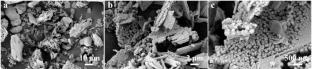
Coal gasification slag (CGS), a byproduct of coal chemical processes, can be repurposed as functional materials through acid treatment to remove impurities such as Al, Ca, and Fe.This study investigates the acid-leaching behavior of these impurities by examining the slag’s mineralogical structure and elemental distribution. The process involved initial carbon-ash separation via physical sieving (0.85 mm), yielding a low-carbon slag (L-CS) with < 3% carbon content and a 48.33% yield, characterized by dense, lamellar aluminosilicate glass with uniformly dispersed and encapsulated Ca and Fe. The L-CS was subjected to heat treatment at varying temperatures, followed by hydrochloric acid leaching. Results revealed that heat treatment broke and rearranged the original Si-O-Si(Al) bonds, partially converting [AlO4] structural units into more stable [AlO6] and leading to the sequential formation of magnetite and esseneite phases. This structural reorganization significantly reduced the leaching rates of Al, Ca, and Fe. Kinetic analysis demonstrated that the leaching of Fe and Ca was governed by a combination of internal diffusion and interfacial chemical reactions, whereas Al leaching was controlled solely by interfacial reactions. The Ca and Fe components were leached more readily than Al. Under optimized conditions (70 °C, 180 min, 8% HCl, liquid-to-solid ratio 8:1), the leaching rates reached 74.17% for Al, 90.01% for Ca, and 83.34% for Fe. The acid-leached residue primarily retained amorphous aluminosilicate phases with minor quartz, exhibiting a more ordered structure than the precursor. Morphologically, the original dense structure was disrupted, forming fractured surfaces composed of 40–60 nm nanospheres. The residue possessed a specific surface area of 101.44 m²/g and an average pore diameter of 5.734 nm. These findings indicate that the acid-leached CGS residue has significant potential for direct application as a mesoporous adsorbent material or for uses requiring enhanced reactivity.
期刊介绍:
Carbon Letters aims to be a comprehensive journal with complete coverage of carbon materials and carbon-rich molecules. These materials range from, but are not limited to, diamond and graphite through chars, semicokes, mesophase substances, carbon fibers, carbon nanotubes, graphenes, carbon blacks, activated carbons, pyrolytic carbons, glass-like carbons, etc. Papers on the secondary production of new carbon and composite materials from the above mentioned various carbons are within the scope of the journal. Papers on organic substances, including coals, will be considered only if the research has close relation to the resulting carbon materials. Carbon Letters also seeks to keep abreast of new developments in their specialist fields and to unite in finding alternative energy solutions to current issues such as the greenhouse effect and the depletion of the ozone layer. The renewable energy basics, energy storage and conversion, solar energy, wind energy, water energy, nuclear energy, biomass energy, hydrogen production technology, and other clean energy technologies are also within the scope of the journal. Carbon Letters invites original reports of fundamental research in all branches of the theory and practice of carbon science and technology.

 求助内容:
求助内容: 应助结果提醒方式:

 京公网安备 11010802042870号


