Design, synthesis, molecular dynamics and in silico pharmacokinetic study of N-(4-(thiazol-2-ylamino)phenyl)benzamide analogues as promising anti-inflammatory agents
{"title":"Design, synthesis, molecular dynamics and in silico pharmacokinetic study of N-(4-(thiazol-2-ylamino)phenyl)benzamide analogues as promising anti-inflammatory agents","authors":"Manoj Kashyap, Muslek Uddin Mazumder, Pooja Patowary, Lalnun Hruaitluangi, Lalzikpuii Sailo, Babita Deka, Debaprotim Dasgupta, Apurba Talukdar, Bhargab Jyoti Sahariah","doi":"10.1007/s11696-025-04535-1","DOIUrl":null,"url":null,"abstract":"<div><p>Six <i>N-(4-(thiazol-2-ylamino)phenyl)benzamide</i> derivatives (MK1–MK6) were designed and synthesized as potential anti-inflammatory agents. Among them, <i>N-(4-(benzo[d]thiazol-2-ylamino)phenyl)benzamide</i> (MK2) exhibited the highest activity in the in vitro protein denaturation inhibition assay (98.99 µg/mL), comparable to diclofenac (91.32 µg/mL). In the in vivo carrageenan-induced rat paw edema model, MK2 produced a significant reduction in paw volume (p < 0.001) at both low and high doses, demonstrating potent anti-inflammatory efficacy. Acute toxicity evaluation confirmed its safety up to 550 mg/kg. In silico molecular docking and 100 ns dynamics simulation against cyclooxygenase-2 (PDB ID: 3PGH) showed strong and stable binding interactions, particularly for MK2. ADME and drug-likeness analysis indicated favorable pharmacokinetic properties, including high gastrointestinal absorption and compliance with Lipinski’s rule of five. Overall, compound MK2 emerged as the most promising lead with excellent biological performance across in vitro, in vivo, and in silico studies, supporting its potential as a safe and effective anti-inflammatory candidate.</p><h3>Graphical abstract</h3><div><figure><div><div><picture><source><img></source></picture><span>The alternative text for this image may have been generated using AI.</span></div></div></figure></div></div>","PeriodicalId":513,"journal":{"name":"Chemical Papers","volume":"80 3","pages":"2627 - 2645"},"PeriodicalIF":2.5000,"publicationDate":"2025-12-08","publicationTypes":"Journal Article","fieldsOfStudy":null,"isOpenAccess":false,"openAccessPdf":"","citationCount":"0","resultStr":null,"platform":"Semanticscholar","paperid":null,"PeriodicalName":"Chemical Papers","FirstCategoryId":"92","ListUrlMain":"https://link.springer.com/article/10.1007/s11696-025-04535-1","RegionNum":4,"RegionCategory":"化学","ArticlePicture":[],"TitleCN":null,"AbstractTextCN":null,"PMCID":null,"EPubDate":"","PubModel":"","JCR":"Q2","JCRName":"Engineering","Score":null,"Total":0}
引用次数: 0
Abstract
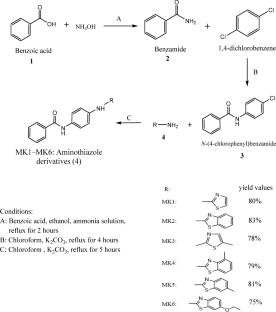
Six N-(4-(thiazol-2-ylamino)phenyl)benzamide derivatives (MK1–MK6) were designed and synthesized as potential anti-inflammatory agents. Among them, N-(4-(benzo[d]thiazol-2-ylamino)phenyl)benzamide (MK2) exhibited the highest activity in the in vitro protein denaturation inhibition assay (98.99 µg/mL), comparable to diclofenac (91.32 µg/mL). In the in vivo carrageenan-induced rat paw edema model, MK2 produced a significant reduction in paw volume (p < 0.001) at both low and high doses, demonstrating potent anti-inflammatory efficacy. Acute toxicity evaluation confirmed its safety up to 550 mg/kg. In silico molecular docking and 100 ns dynamics simulation against cyclooxygenase-2 (PDB ID: 3PGH) showed strong and stable binding interactions, particularly for MK2. ADME and drug-likeness analysis indicated favorable pharmacokinetic properties, including high gastrointestinal absorption and compliance with Lipinski’s rule of five. Overall, compound MK2 emerged as the most promising lead with excellent biological performance across in vitro, in vivo, and in silico studies, supporting its potential as a safe and effective anti-inflammatory candidate.
Graphical abstract
The alternative text for this image may have been generated using AI.
Chemical PapersChemical Engineering-General Chemical Engineering
CiteScore
3.30
自引率
4.50%
发文量
590
期刊介绍:
Chemical Papers is a peer-reviewed, international journal devoted to basic and applied chemical research. It has a broad scope covering the chemical sciences, but favors interdisciplinary research and studies that bring chemistry together with other disciplines.

 求助内容:
求助内容: 应助结果提醒方式:

 京公网安备 11010802042870号


