
Topological control of chirality and spin with structured light
IF 23.4
Q1 OPTICS
引用次数: 0
Abstract
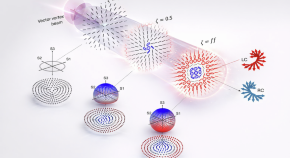
Structured light beams with engineered topological properties offer a powerful means to control spin angular momentum (SAM) and optical chirality, key quantities shaped by spin-orbit interaction (SOI) in light. Such effects are commonly associated with non-paraxial focusing or light-matter interfaces. Here, we demonstrate that higher-order Poincaré modes carrying a tunable Pancharatnam topological charge ℓp enable deterministic control of SOI entirely in free space and within the paraxial regime. We show that modulation of ℓp drives a measurable radial separation of circular polarization components - a free-space optical Hall effect arising from propagation-induced mechanisms alone. The effect originates from differential Gouy-phase evolution and radial divergence between the two circular components of an initially spin-balanced vector beam. This identifies ℓp as a single, tunable parameter linking Pancharatnam topology to paraxial spin-orbit coupling, establishing a simple and material-independent route to generate and control optical chirality and SAM. This approach provides new opportunities for tunable optical manipulation, chiral sensing, and high-dimensional photonic information processing. The alternative text for this image may have been generated using AI.
结构光手性和自旋的拓扑控制
具有工程拓扑特性的结构光束提供了控制自旋角动量(SAM)和光手性的有力手段,这是光中自旋轨道相互作用(SOI)形成的关键量。这种效应通常与非近轴聚焦或光-物质界面有关。在这里,我们证明了携带可调谐Pancharatnam拓扑电荷的高阶poincar模式能够完全在自由空间和近轴区域内对SOI进行确定性控制。我们证明了调制p驱动圆偏振分量的可测量径向分离——一种仅由传播诱导机制产生的自由空间光学霍尔效应。该效应源于初始自旋平衡矢量光束的两个圆分量之间的微分古伊相演化和径向散度。这表明,p是连接Pancharatnam拓扑与旁轴自旋轨道耦合的单一可调参数,建立了一种简单且与材料无关的路径来产生和控制光学手性和SAM。这种方法为可调光学操作、手性传感和高维光子信息处理提供了新的机会。此图像的替代文本可能是使用AI生成的。
本文章由计算机程序翻译,如有差异,请以英文原文为准。
求助全文
约1分钟内获得全文
求助全文
来源期刊

Light-Science & Applications
数理科学, 物理学I, 光学, 凝聚态物性 II :电子结构、电学、磁学和光学性质, 无机非金属材料, 无机非金属类光电信息与功能材料, 工程与材料, 信息科学, 光学和光电子学, 光学和光电子材料, 非线性光学与量子光学
自引率
0.00%
发文量
803
审稿时长
2.1 months
 求助内容:
求助内容: 应助结果提醒方式:

 京公网安备 11010802042870号


